PHALANGES OF THE HAND ANATOMY
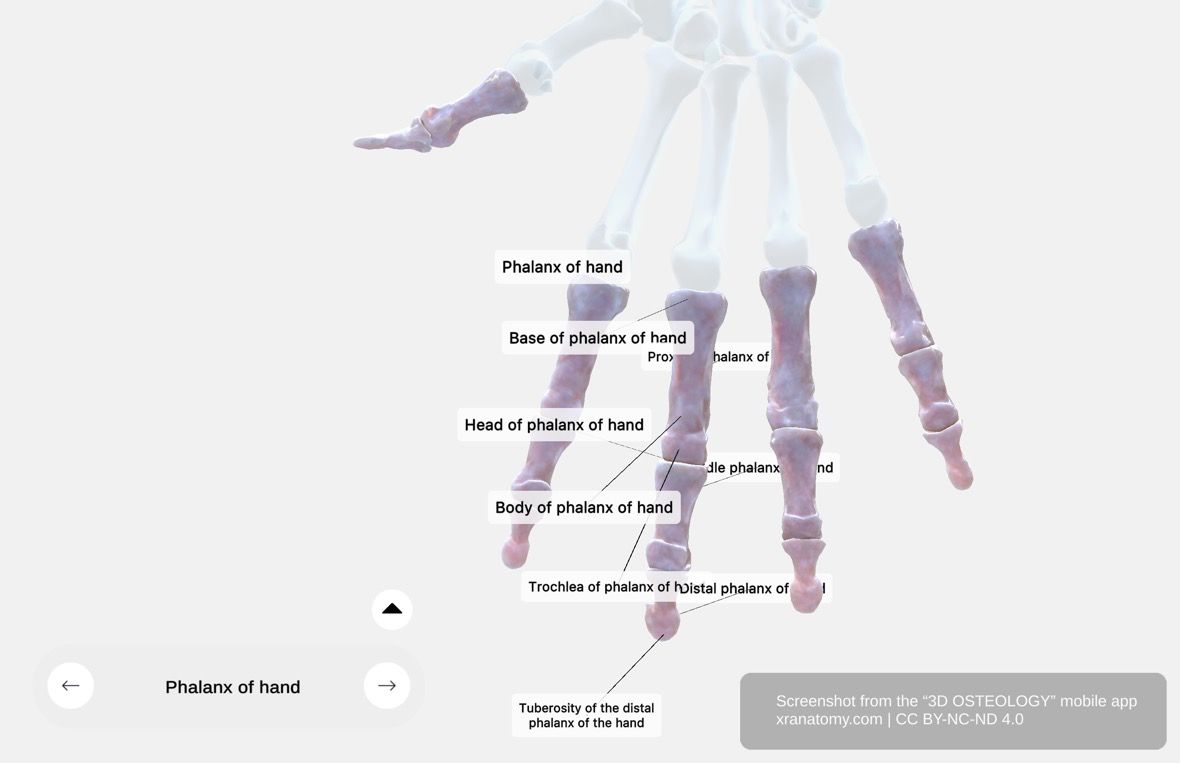
Phalanges of the Hand - Overview, Preview from the app. Download 3D OSTEOLOGY for full 3D control—multiple views, x-ray mode, and unlimited zoom.
WHY THIS MATTERS
Your hand contains 14 phalanges that give your fingers and thumb the dexterity and flexibility you rely on every day. Understanding how each phalanx is built, from its tapering body to its articular base and condylar head, helps you see how these small bones enable grip, manipulation, and fine motor control.
PHALANX STRUCTURE
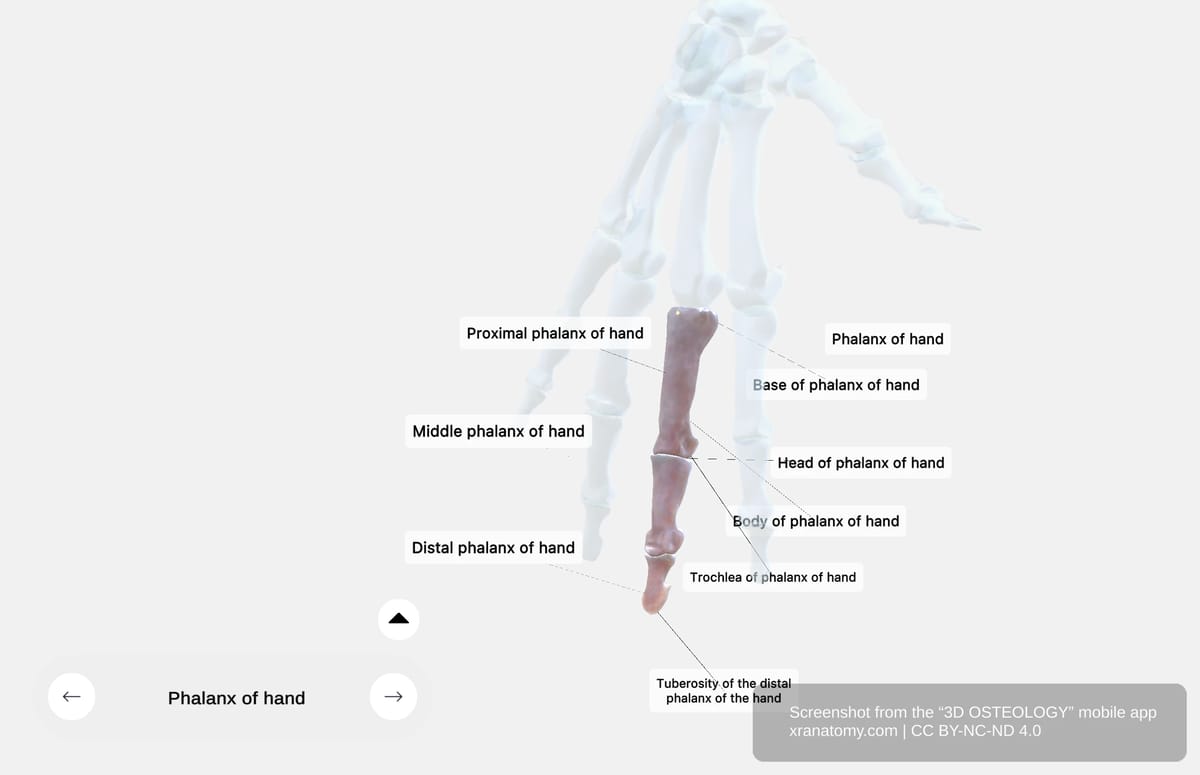
Each phalanx features three main parts. The body is the tapering shaft with convex dorsal and concave volar surfaces. The base at the proximal end provides the articular surface for the joint above. The head at the distal end terminates in two condyles that articulate with the next bone.
Body
The body of the phalanx tapers towards the distal end. Its dorsal surface is convex, while the volar surface is concave longitudinally and flat from side to side. The sides of the body are marked by rough ridges.
Base (Proximal End)
In the first row of phalanges, the base presents an oval concave articular surface that is broader from side to side than from front to back. In the second and third rows, the base features two concavities separated by a median ridge.
Head (Distal End)
The head is smaller than the base and terminates in two condyles separated by a shallow groove. The articular surface extends farther on the volar side than on the dorsal side, especially in the first row.
PROXIMAL PHALANGES
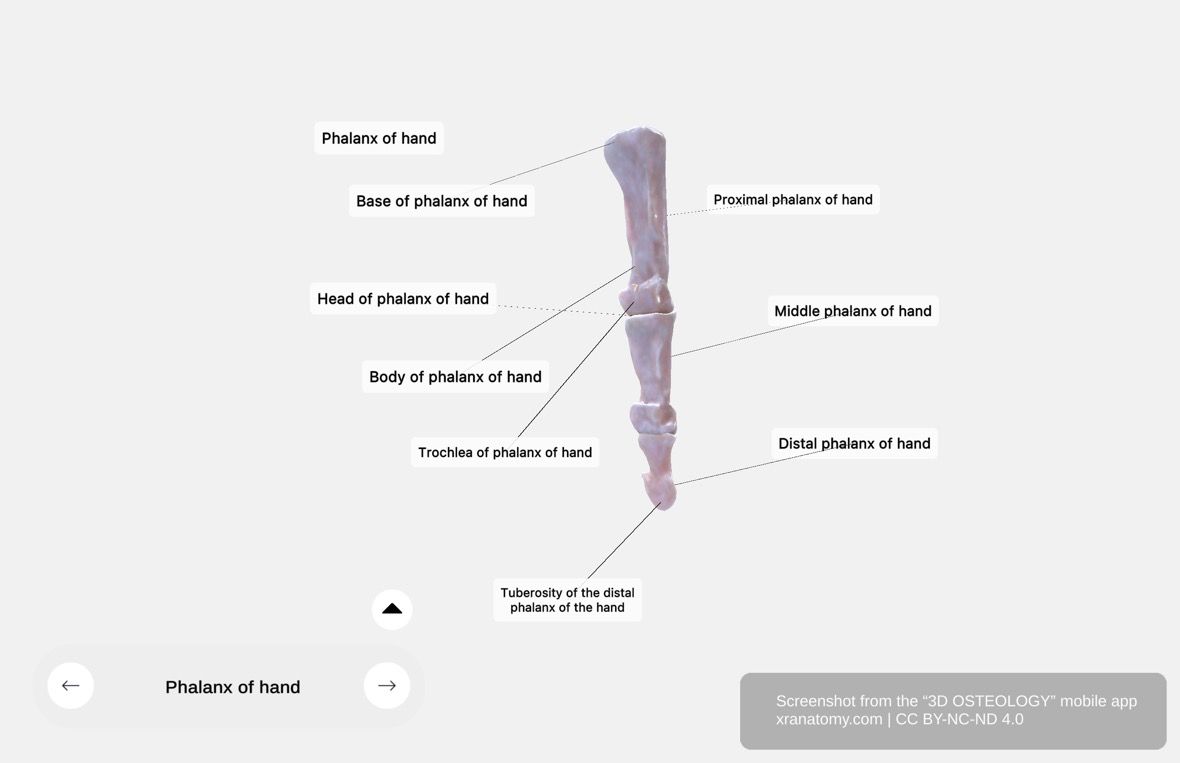
Proximal Phalanx - Individual View, Preview from the app. Download 3D OSTEOLOGY for full 3D control—multiple views, x-ray mode, and unlimited zoom.
Structure
Each proximal phalanx consists of a body and two ends. The proximal end presents an oval concave articular surface.
MIDDLE PHALANGES
The middle phalanges form the second row of finger bones, excluding the thumb. Each one has a characteristic body, proximal end, and distal end, with a base that features two concavities separated by a median ridge.
Location
The middle phalanges sit in the second row of phalanges, excluding the thumb.
Structure
Each middle phalanx consists of a body, proximal end, and distal end.
Features
The base of each middle phalanx presents two concavities separated by a median ridge.
DISTAL PHALANGES
The distal phalanges are the smallest of the phalanges and feature a distinctive horseshoe-shaped tuberosity on the volar surface of your fingertip.
Structure
The distal phalanges are the smallest of the phalanges.
Features
The distal tip features a rough, horseshoe-shaped tuberosity (ungual tuberosity) that supports your fingertip pulp and nail bed. This tuberosity of the distal phalanx is a horseshoe-shaped elevated area on the volar surface of your fingertip.
CHECK YOUR UNDERSTANDING
1. How many phalanges are in the hand, and how are they arranged?
Reveal Answer
The hand contains 14 phalanges: three for each finger (proximal, middle, distal) and two for the thumb (proximal and distal).
2. How does the base differ between first-row and second/third-row phalanges?
Reveal Answer
In the first row, the base has an oval concave articular surface that is broader from side to side than from front to back. In the second and third rows, the base features two concavities separated by a median ridge.
3. What is the tuberosity of the distal phalanx?
Reveal Answer
It is a rough, horseshoe-shaped elevated area (ungual tuberosity) on the volar surface of your fingertip that supports your fingertip pulp and nail bed.
WHAT'S NEXT
Now that you know the phalanges of the hand, the next page covers the Bones of the Lower Limb. You will explore the pelvic girdle (hip bones, sacrum, coccyx) and the free lower limb bones including the femur, tibia, fibula, patella, and foot bones.
Review this page again in 3 days to reinforce what you have learned.
BIBLIOGRAPHY
1. Henry G, Warren HL. Osteology. In: Anatomy of the Human Body. 20th ed. Philadelphia: Lea & Febiger; 1918. p. 129–97.
2. Standring S, editor. Gray's Anatomy: The Anatomical Basis of Clinical Practice. 41st ed. London: Elsevier; 2016.
3. Moore KL, Agur AMR, Dalley AF. Essential Clinical Anatomy. 5th ed. Philadelphia: Wolters Kluwer; 2015.