FIBULA ANATOMY
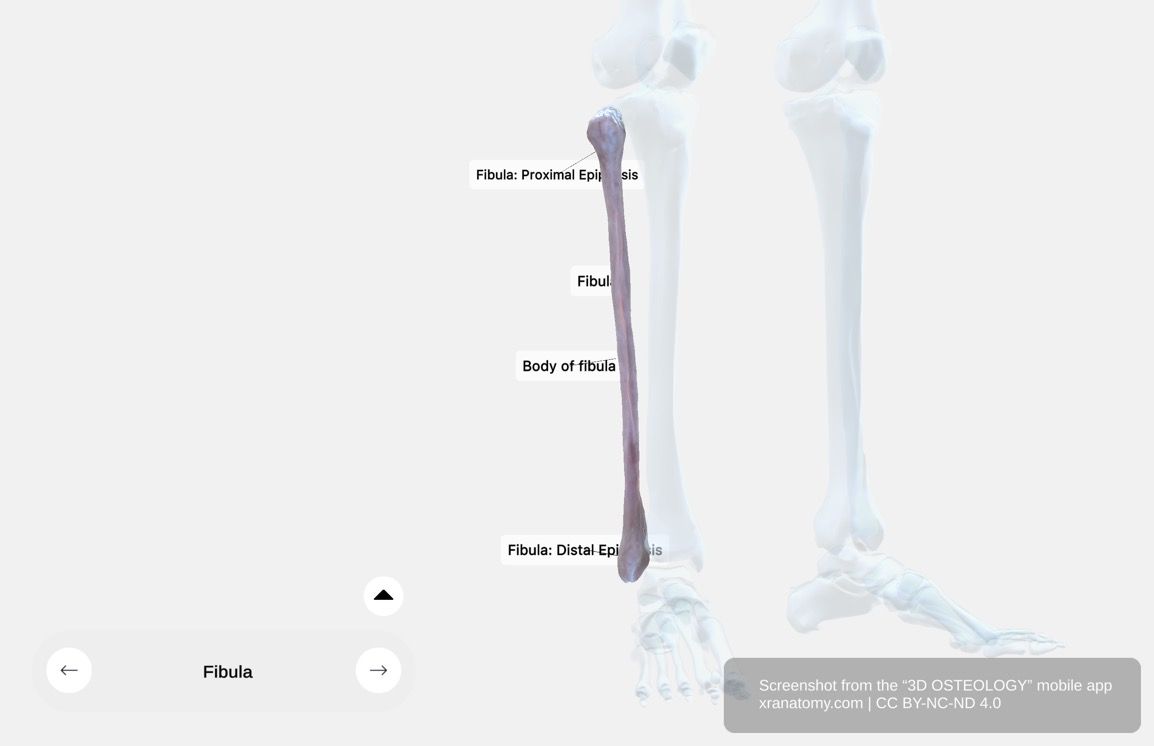
Fibula - X-Ray View, Preview from the app. Download 3D OSTEOLOGY for full 3D control—multiple views, x-ray mode, and unlimited zoom.
WHY THIS MATTERS
The fibula may be slender compared to the tibia, but it is essential for forming your ankle joint and providing lateral stability. Understanding its proximal epiphysis, body, and distal epiphysis helps you see how this bone anchors muscles, ligaments, and the lateral malleolus that stabilizes your ankle.
GENERAL STRUCTURE
The fibula is a slender bone located on the lateral side of the tibia. Smaller and thinner compared to the tibia, it plays a critical role in forming your ankle joint and provides essential structural support for your leg. It consists of three main regions: the proximal epiphysis at the upper end near your knee joint, the body (shaft) connecting the two ends, and the distal epiphysis at the lower end forming your lateral malleolus.
Proximal Epiphysis
The proximal epiphysis sits at the upper end of the bone. It connects to your knee joint and includes the head of the fibula and key features.
Body (Shaft)
The body is the long, slender part of the bone that connects the proximal and distal epiphyses. It is characterized by four distinct borders and surfaces and serves as an attachment site for muscles and ligaments.
Distal Epiphysis
The distal epiphysis sits at the lower part of the bone and forms the lateral malleolus. It connects to your ankle joint and articulates with the talus.
PROXIMAL EPIPHYSIS OF THE FIBULA
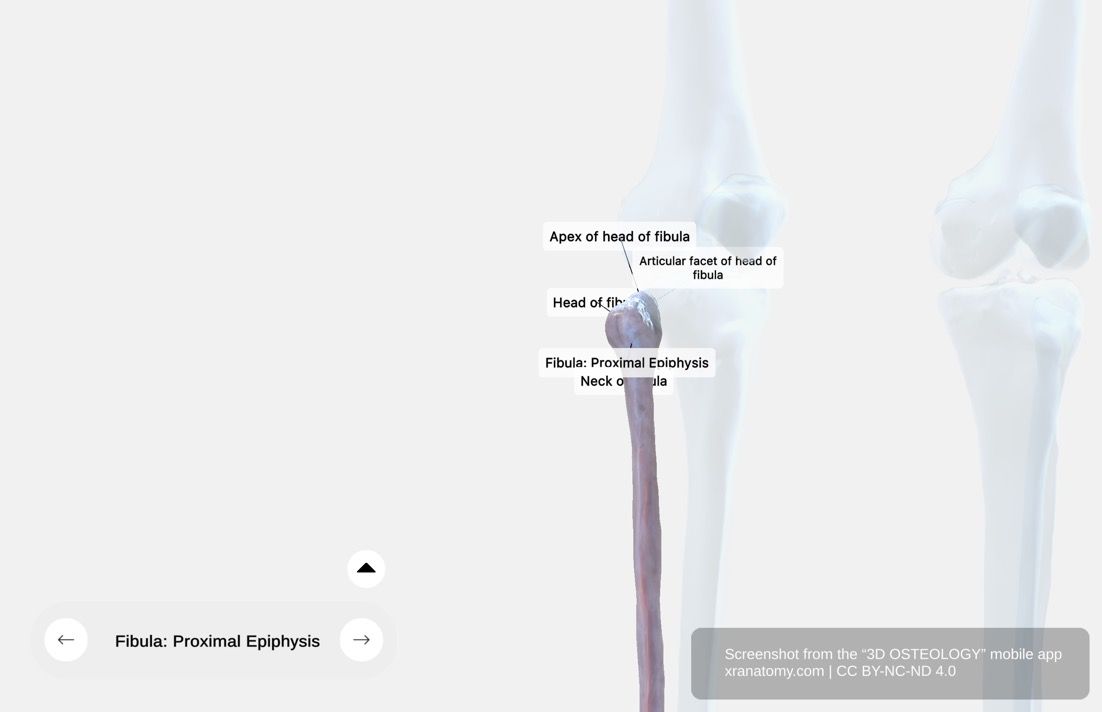
Proximal Epiphysis of the Fibula, Preview from the app. Download 3D OSTEOLOGY for full 3D control—multiple views, x-ray mode, and unlimited zoom.
The proximal epiphysis of the fibula is located at the upper end of the bone, connecting to your knee joint. This irregular and flattened structure articulates with the posterior aspect of the lateral condyle of the tibia. It includes the head of the fibula, the articular facet, the apex (styloid process), and the neck of the fibula, all contributing to joint stability and movement.
Head of the Fibula
The head of the fibula is irregularly shaped with a quadrate form and a flattened articular surface. It is essential for articulation with the tibia and serves as a key attachment point for ligaments stabilizing your lower leg.
Articular Facet
The articular facet sits on the superior surface of the fibular head. It connects with the lateral condyle of the tibia to form the superior tibiofibular joint. This facet is important for stability and smooth movement of your lower leg.
Apex of the Fibula's Head (Styloid Process)
The apex is a prominent bony projection that serves as an anchor point for the biceps femoris tendon and the fibular collateral ligament. It is essential for your knee and leg stability.
Neck of the Fibula
The neck is a narrow, slender region below the head. It serves as a passageway for the common fibular nerve (formerly common peroneal nerve) and is important for your lower leg function.
DISTAL EPIPHYSIS OF THE FIBULA
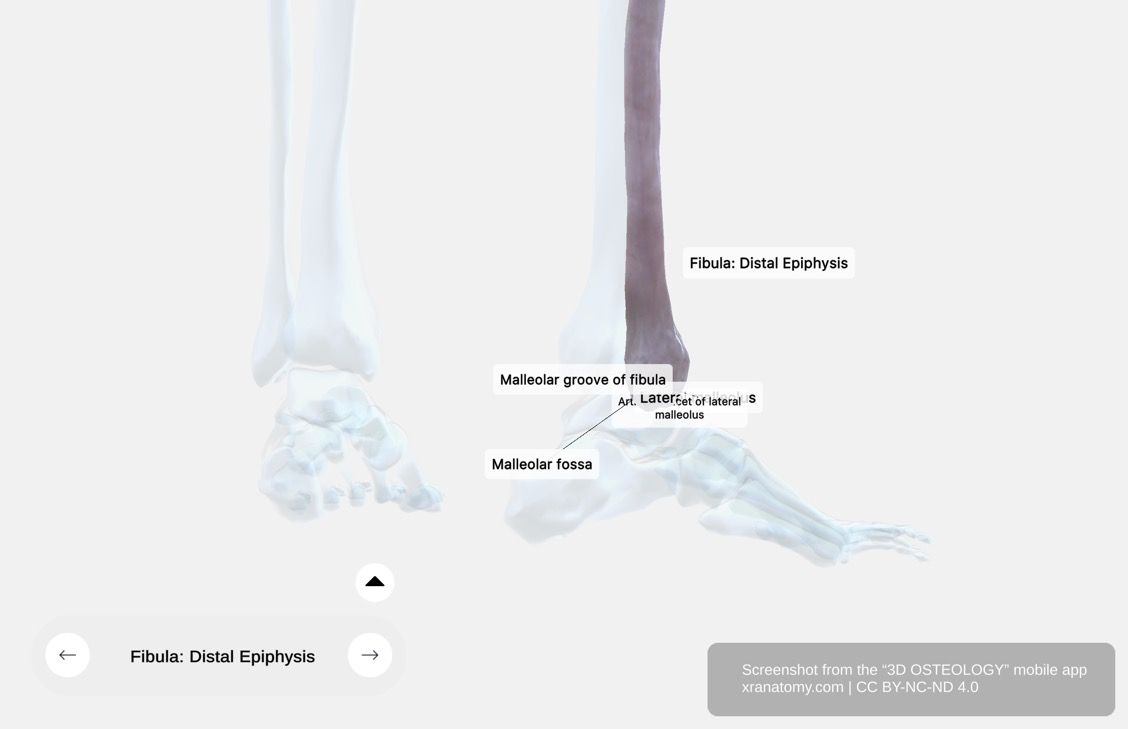
Distal Epiphysis of the Fibula, Preview from the app. Download 3D OSTEOLOGY for full 3D control—multiple views, x-ray mode, and unlimited zoom.
The distal epiphysis of the fibula is located at the lower part of the bone, forming its lower end. It connects to your ankle joint, articulates with the talus, and is essential for maintaining ankle stability. Its key features include the lateral malleolus, the articular facet of the lateral malleolus, the malleolar fossa, and the malleolar groove.
Lateral Malleolus
The lateral malleolus is the lower end of the fibula. It has a pyramidal shape, slightly flattened from side to side. It forms the outer part of your ankle joint, provides lateral stability to your ankle, and serves as an important attachment point for ligaments.
Articular Facet of the Lateral Malleolus
The articular facet is a smooth, triangular surface located on the lateral malleolus. It is convex from top to bottom and articulates with the talus. This facet allows smooth movement and stability of your ankle joint.
Malleolar Fossa
The malleolar fossa is a rough depression behind and distal to the articular surface of the lateral malleolus. It serves as an attachment site for a ligament and is essential for stabilizing your ankle.
Malleolar Groove
The malleolar groove is a shallow vertical groove on the posterior border of the lateral malleolus. It serves as a pathway for tendons and facilitates movement of muscles controlling your foot and ankle.
BODY (SHAFT) OF THE FIBULA
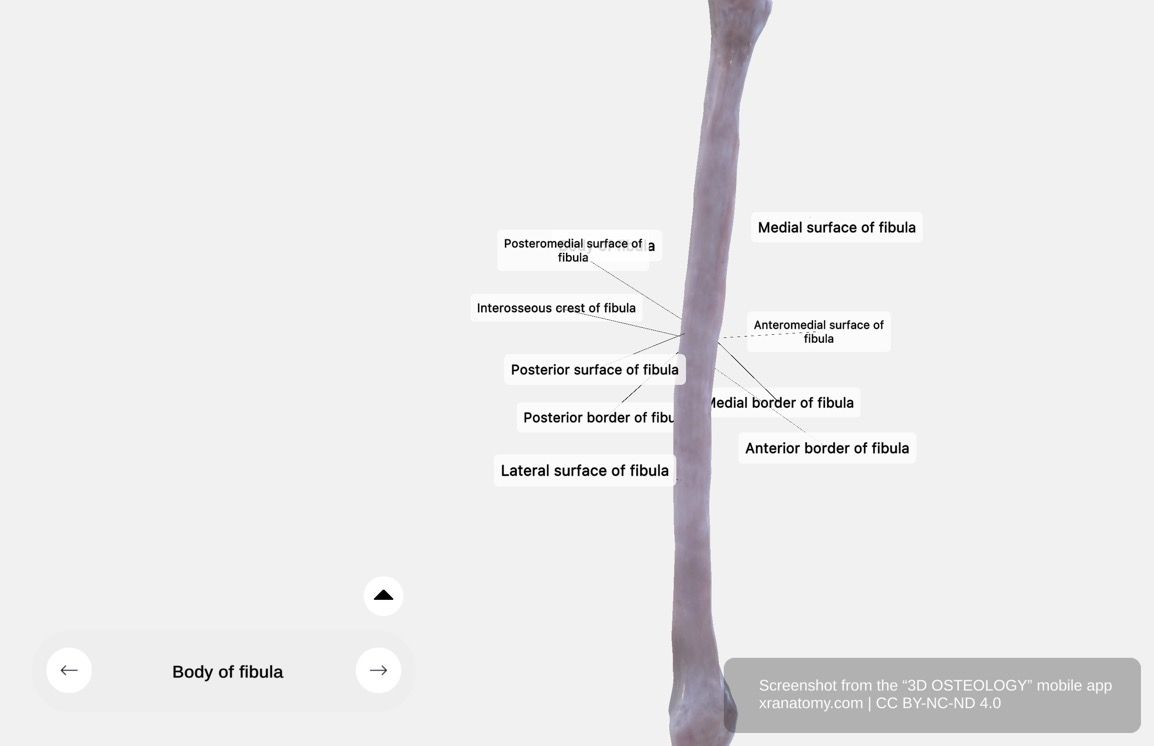
Body of the Fibula, Preview from the app. Download 3D OSTEOLOGY for full 3D control—multiple views, x-ray mode, and unlimited zoom.
The body, or shaft, of the fibula is the long, slender part of the bone that connects the proximal and distal epiphyses. It is the largest section of the fibula, characterized by four distinct borders and surfaces. This structure serves as an attachment site for muscles and ligaments, playing a vital role in stabilizing your lower leg. Its surfaces and borders include the lateral surface, anterior border, medial surface, anteromedial surface, interosseous crest, posteromedial surface, medial border, posterior surface, and posterior border.
Lateral Surface
The lateral surface lies between the anterior and posterior borders. It provides attachment points for muscles involved in your foot and ankle movements.
Anterior Border
The anterior border begins near the head of the fibula and runs down the body to the distal end. It divides the surfaces of the fibula and provides attachment sites for muscles.
Medial Surface
The medial surface is the area bordered by the anterior and medial borders. It serves as an attachment site for muscles and contributes to your leg and foot movements.
Anteromedial Surface
The anteromedial surface is a narrow region between the anterior and medial borders. It offers additional space for muscle attachment.
Interosseous Crest (Medial Border)
The interosseous crest runs along the medial aspect of the bone. It serves as the attachment site for the interosseous membrane, connecting the fibula to the tibia and aiding in your lower leg stability.
Posteromedial Surface
The posteromedial surface sits between the medial and posterior borders. It is important for muscle attachment and helps define the overall structure of the fibula.
Medial Border
The medial border, also referred to as the interosseous crest, runs along the length of the fibula. It provides an attachment site for the interosseous membrane and connects the tibia and fibula.
Posterior Surface
The posterior surface sits between the posteromedial and posterolateral borders. It features an oblique line dividing it and serves as the origin point for several muscles involved in your leg and foot movements.
Posterior Border
The posterior border has a rounded shape. It merges at its lower end with the groove on the lateral malleolus and contributes to your ankle stability and function.
CHECK YOUR UNDERSTANDING
1. What structure does the distal epiphysis of the fibula form, and what role does it play?
Reveal Answer
The distal epiphysis forms the lateral malleolus, which provides lateral stability to your ankle joint and serves as an important attachment point for ligaments.
2. Name the nerve that passes through the neck of the fibula.
Reveal Answer
The common fibular nerve (formerly common peroneal nerve) passes through the neck of the fibula.
3. What connects the fibula to the tibia along the shaft, and which border does it attach to?
Reveal Answer
The interosseous membrane connects the fibula to the tibia. It attaches to the interosseous crest (medial border) along the medial aspect of the bone.
WHAT'S NEXT
Next, explore the Patella (Kneecap). You will study the largest sesamoid bone in your body, embedded within the quadriceps tendon, and learn about its flat triangular shape, articular surface, and role in protecting your knee joint.
Review this page again in 3 days to reinforce what you have learned.
BIBLIOGRAPHY
1. Henry G, Warren HL. Osteology. In: Anatomy of the Human Body. 20th ed. Philadelphia: Lea & Febiger; 1918. p. 129–97.
2. Standring S, editor. Gray's Anatomy: The Anatomical Basis of Clinical Practice. 41st ed. London: Elsevier; 2016.
3. Moore KL, Agur AMR, Dalley AF. Essential Clinical Anatomy. 5th ed. Philadelphia: Wolters Kluwer; 2015.