TIBIA ANATOMY
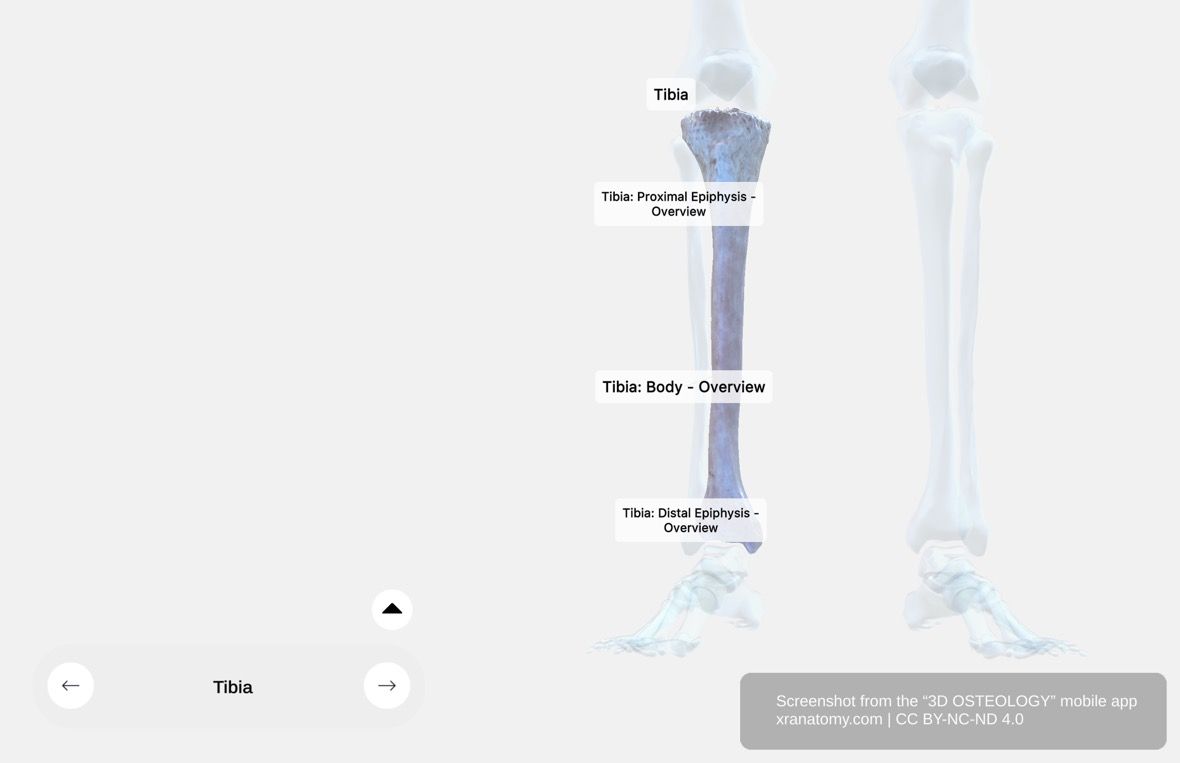
Tibia - X-Ray View, Preview from the app. Download 3D OSTEOLOGY for full 3D control—multiple views, x-ray mode, and unlimited zoom.
WHY THIS MATTERS
The tibia is the second longest bone in your body and the primary weight-bearing bone of your lower leg. Understanding its proximal epiphysis at the knee, its shaft, and its distal epiphysis at the ankle helps you see how this single bone connects two of your most important joints.
GENERAL STRUCTURE
The tibia is the second longest bone in your skeleton, prismoid in form. It features an expanded upper end, a contracted lower one-third, and a slightly enlarged lower end. Located on the medial side of your leg, it serves as a crucial weight-bearing bone and forms part of both your knee and ankle joints. The tibia is divided into three parts: the proximal epiphysis, the body (shaft), and the distal epiphysis.
Proximal Epiphysis
The proximal epiphysis is the upper expanded part of the bone. It connects to your knee joint and includes the medial and lateral condyles.
Body (Shaft)
The body of the tibia is defined by three crests or margins and three surfaces. It begins at the tuberosity at the upper end and extends to the anterior margin of the medial malleolus at the lower end. The shaft provides structural strength and support to your leg.
Distal Epiphysis
The distal epiphysis extends downward on the medial side, forming the medial malleolus. It connects to your ankle joint and articulates with the talus.
PROXIMAL EPIPHYSIS OF THE TIBIA
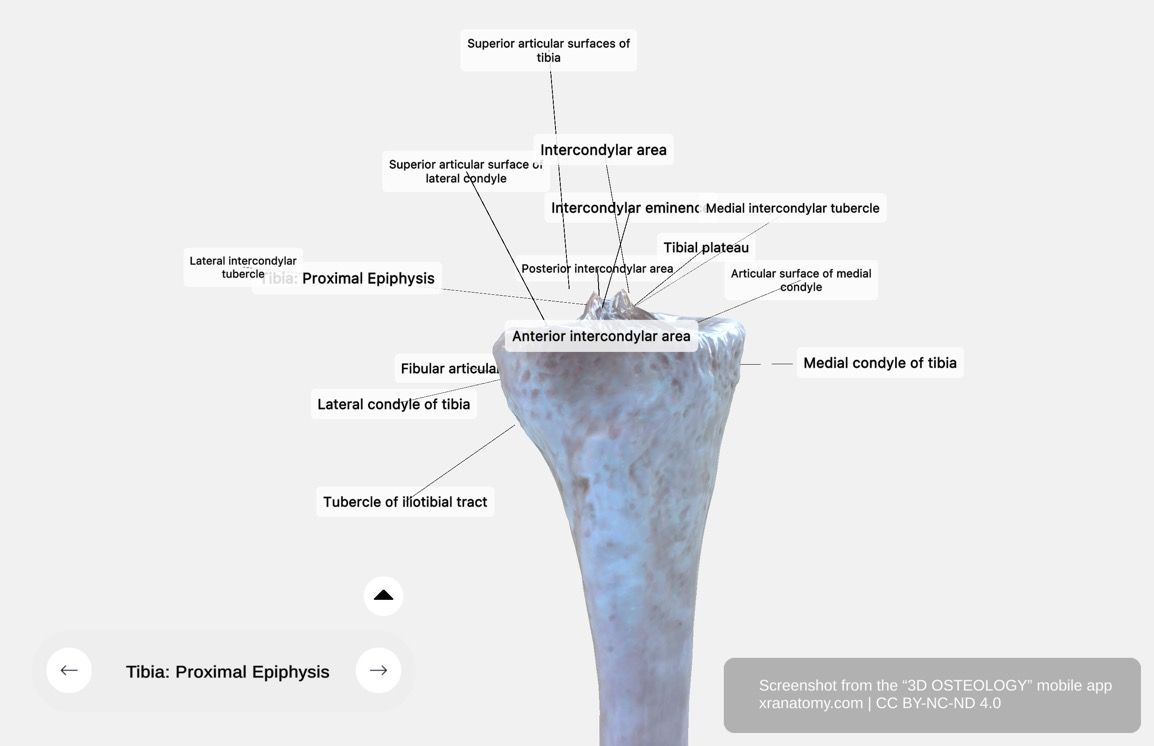
Proximal Epiphysis of the Tibia, Preview from the app. Download 3D OSTEOLOGY for full 3D control—multiple views, x-ray mode, and unlimited zoom.
The proximal epiphysis is the upper expanded part of the tibia. It connects to your knee joint and includes the medial and lateral condyles, whose superior surfaces form articular surfaces that articulate with the femur, enabling knee joint functionality. Key features include the tibial plateau, the superior articular surfaces, the intercondylar area, the medial condyle, the lateral condyle, the fibular articular facet, and the tubercle of the iliotibial tract.
Tibial Plateau
The tibial plateau forms the uppermost surface of the tibia. It features two concave regions: the medial and lateral condyles, separated by the intercondylar area and intercondylar eminence. These condyles articulate with the femoral condyles and provide support for your knee's menisci.
Superior Articular Surfaces
The superior articular surfaces sit on top of the medial and lateral condyles. They connect with the femoral condyles and play a crucial role in knee joint function and meniscal stability.
The medial condyle articular surface is an oval, slightly concave surface on the medial side of the tibia. It allows articulation with the medial condyle of the femur and facilitates smooth joint movement.
The lateral condyle articular surface is a nearly circular, concave surface on the lateral side of the tibia. It connects with the lateral condyle of the femur and is essential for knee joint articulation.
Intercondylar Area
The intercondylar area lies between the medial and lateral tibial condyles. It features the intercondylar eminence.
The anterior intercondylar area is a rough depression in front of the intercondylar eminence. It serves as the attachment site for the anterior cruciate ligament and is important for your knee joint stabilization.
The posterior intercondylar area is located behind the intercondylar eminence. It serves as the attachment site for the posterior cruciate ligament and maintains structural integrity of your knee.
The intercondylar eminence (tibial spine) is positioned between the articular surfaces and features two prominent tubercles. The medial intercondylar tubercle is a prominent bony projection located on the medial aspect of the intercondylar eminence. The lateral intercondylar tubercle is a prominent bony projection located on the lateral aspect of the intercondylar eminence.
Medial Condyle of the Tibia
The medial condyle has a slightly concave articular surface. It aids in articulation with the femur and contributes to your knee movement and stability.
Lateral Condyle
The lateral condyle is a rounded prominence on the upper tibial surface. It articulates with the femur and provides an articulation point for the head of the fibula.
Fibular Articular Facet
The fibular articular facet is a flat, nearly circular surface on the lateral tibial condyle. It articulates with the fibula and allows for movement and your lower limb stability.
Tubercle of the Iliotibial Tract
The tubercle of the iliotibial tract is a prominent structure on the lateral side of the tibia. It serves as the attachment site for the iliotibial tract and plays a key role in stabilizing your knee during lateral movements.
BODY OF THE TIBIA
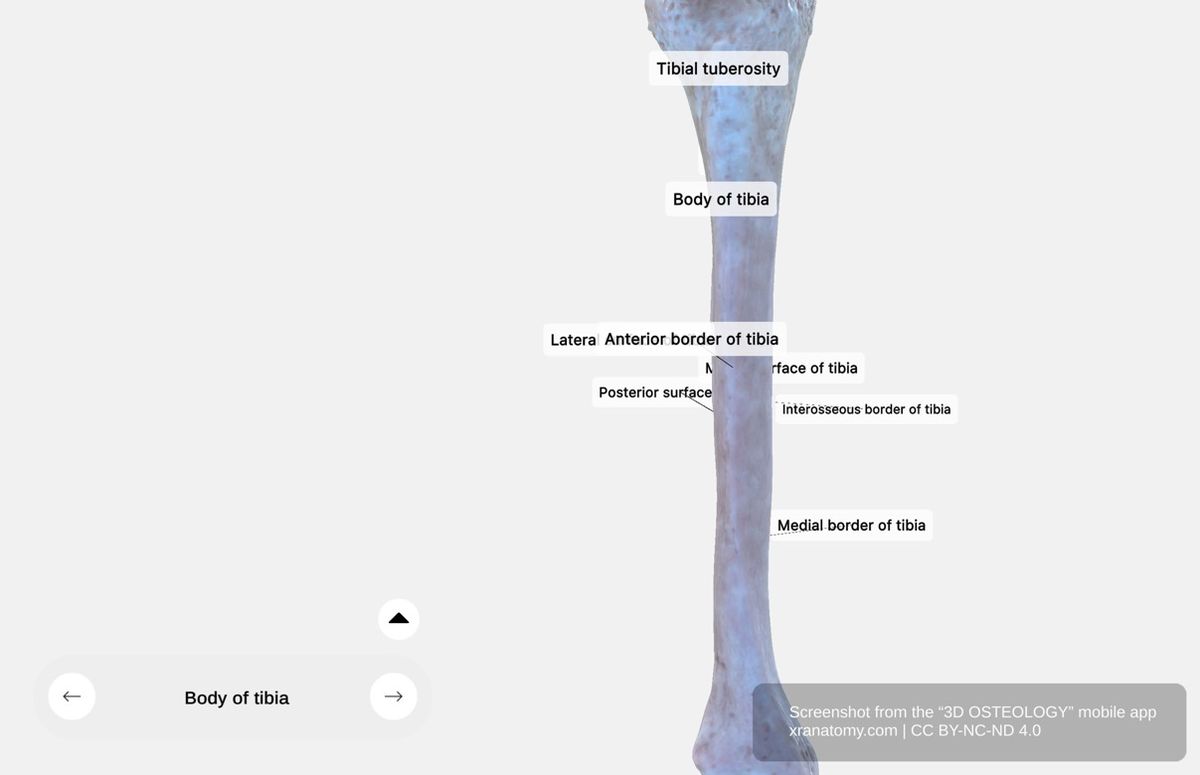
Body of the Tibia, Preview from the app. Download 3D OSTEOLOGY for full 3D control—multiple views, x-ray mode, and unlimited zoom.
The shaft of the tibia is defined by its three crests or margins and three surfaces. It begins at the tuberosity at the upper end and extends to the anterior margin of the medial malleolus at the lower end, providing structural strength and support to your leg. Key features include the tibial tuberosity, the medial surface, the medial border, the posterior surface with its soleal line, the interosseous border, the lateral surface, and the anterior border.
Body of the Tibia
The body of the tibia is the main shaft of the bone, characterized by distinct borders and surfaces. It extends from the tibial tuberosity to the anterior margin of the medial malleolus and provides structural support while facilitating muscle attachment.
Tibial Tuberosity
The tibial tuberosity is a prominent bony elevation below the anterior surface of the tibial condyles. It serves as the attachment point for the patellar ligament and is essential for your knee movement and stability.
Medial Surface
The medial surface has a smooth and convex shape. It is broader at the top and narrows toward the bottom.
Medial Border
The medial border runs along the inner side of the bone. It has a smooth and rounded edge, most pronounced in the middle of the bone. It extends from the medial condyle to the posterior border of the medial malleolus and contributes to the tibia's side profile.
Posterior Surface
The posterior surface runs along the posterior side of the bone and is marked by the soleal line. The soleal line is a prominent ridge on the posterior tibia that extends from the fibular articular facet to the medial border. It serves as the attachment site for your soleus muscle.
Interosseous Border (Crest)
The interosseous border is a sharp ridge along the middle third of the tibia. It serves as the attachment site for the interosseous membrane, which connects the tibia to the fibula. This border helps stabilize your lower leg bones.
Lateral Surface
The lateral surface is located between the anterior and lateral borders. It provides attachment points for muscles.
Anterior Border (Shin)
The anterior border is a sharp ridge running from the tibial tuberosity to the medial malleolus. It is prominent in the upper two-thirds of the tibia and serves as the attachment site for the deep fascia of your leg.
DISTAL EPIPHYSIS OF THE TIBIA
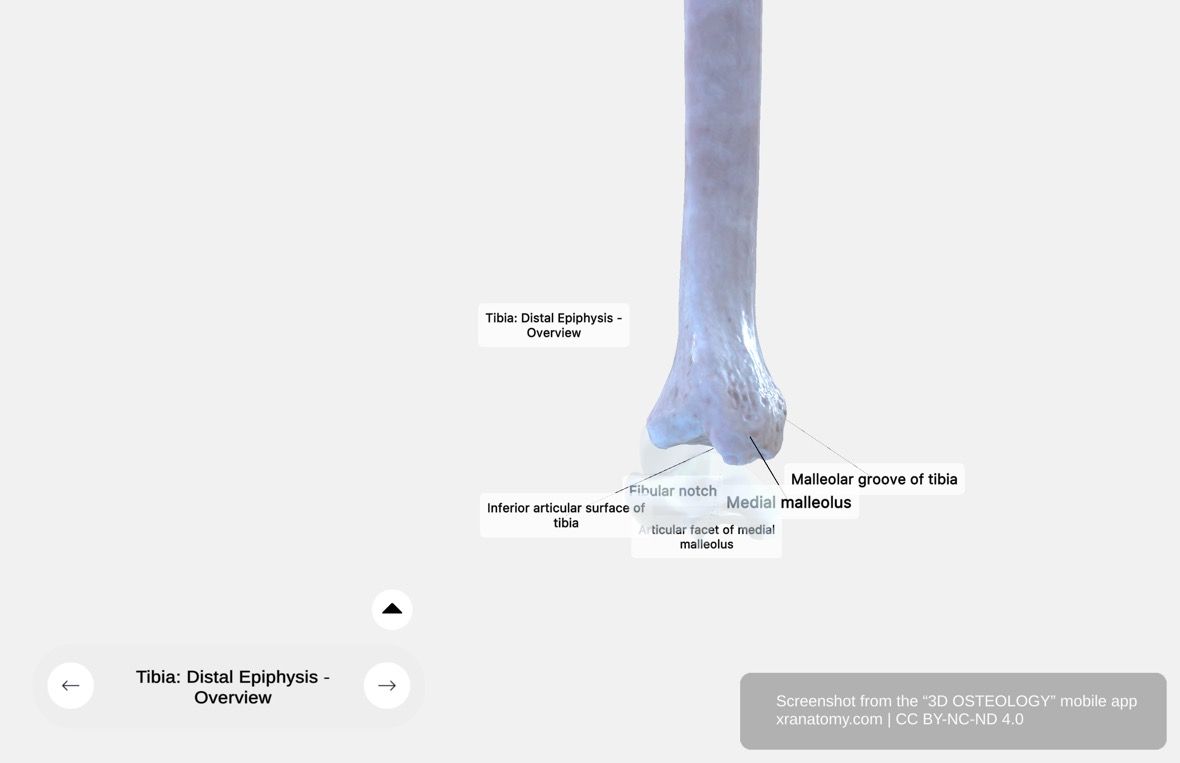
Distal Epiphysis of the Tibia, Preview from the app. Download 3D OSTEOLOGY for full 3D control—multiple views, x-ray mode, and unlimited zoom.
The distal epiphysis of the tibia extends downward on the medial side, forming the medial malleolus. Located at the lower part of the tibia, it connects to your ankle joint. Its inferior articular surface is quadrilateral in shape and articulates with the talus, playing a key role in the stability and functionality of your ankle joint. Key structures here include the medial malleolus, the malleolar groove, the articular facet of the medial malleolus, the fibular notch, and the inferior articular surface.
Medial Malleolus
The medial malleolus is a prominent pyramidal structure projecting from the medial side. It is critical for the inner contour of your ankle and articulates with the talus bone.
Malleolar Groove
The malleolar groove is located on the posterior edge of the medial malleolus and descends diagonally. It creates a passageway for the posterior tibialis tendon and the flexor digitorum longus tendon.
Articular Facet of the Medial Malleolus
The articular facet of the medial malleolus is a concave surface that forms part of your ankle joint. It articulates with the trochlear surface of the talus and ensures smooth ankle mobility.
Fibular Notch
The fibular notch is a roughened triangular area on the tibia. It connects with the fibula via a ligament.
Inferior Articular Surface of the Tibia
The inferior articular surface is quadrilateral in shape, wider at the front and narrowing towards the back. It articulates with the superior surface of the talus and allows smooth ankle movements.
CHECK YOUR UNDERSTANDING
1. What are the three main parts of the tibia?
Reveal Answer
The proximal epiphysis (upper expanded end at the knee joint), the body or shaft (defined by three crests and three surfaces), and the distal epiphysis (lower end forming the medial malleolus at the ankle joint).
2. Name the two ligaments that attach to the intercondylar area of the tibia.
Reveal Answer
The anterior cruciate ligament attaches to the anterior intercondylar area, and the posterior cruciate ligament attaches to the posterior intercondylar area.
3. What is the soleal line, and where is it located?
Reveal Answer
The soleal line is a prominent ridge on the posterior surface of the tibia. It extends from the fibular articular facet to the medial border and serves as the attachment site for the soleus muscle.
WHAT'S NEXT
Next, explore the Fibula, the slender bone on the lateral side of your lower leg. You will study its head, body, and distal epiphysis, including the lateral malleolus that forms the outer bony prominence of your ankle.
Review this page again in 3 days to reinforce what you have learned.
BIBLIOGRAPHY
1. Henry G, Warren HL. Osteology. In: Anatomy of the Human Body. 20th ed. Philadelphia: Lea & Febiger; 1918. p. 129–97.
2. Standring S, editor. Gray's Anatomy: The Anatomical Basis of Clinical Practice. 41st ed. London: Elsevier; 2016.
3. Moore KL, Agur AMR, Dalley AF. Essential Clinical Anatomy. 5th ed. Philadelphia: Wolters Kluwer; 2015.