FEMUR ANATOMY
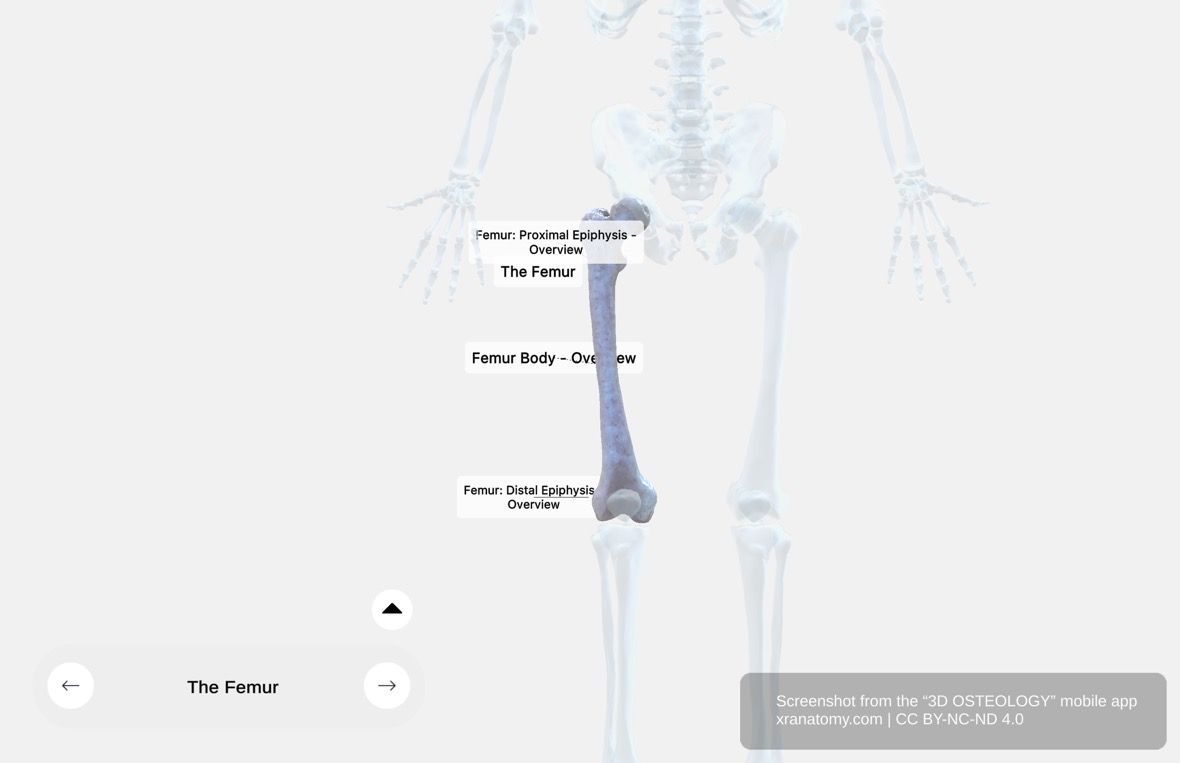
Femur - X-Ray View, Preview from the app. Download 3D OSTEOLOGY for full 3D control—multiple views, x-ray mode, and unlimited zoom.
WHY THIS MATTERS
The femur is the longest and strongest bone in your body. It bears your weight during standing and walking, connects your hip joint to your knee joint, and provides attachment sites for the major muscles that move your hip and thigh. Understanding its proximal epiphysis, shaft, and distal epiphysis helps you see how this single bone supports both mobility and stability.
GENERAL STRUCTURE
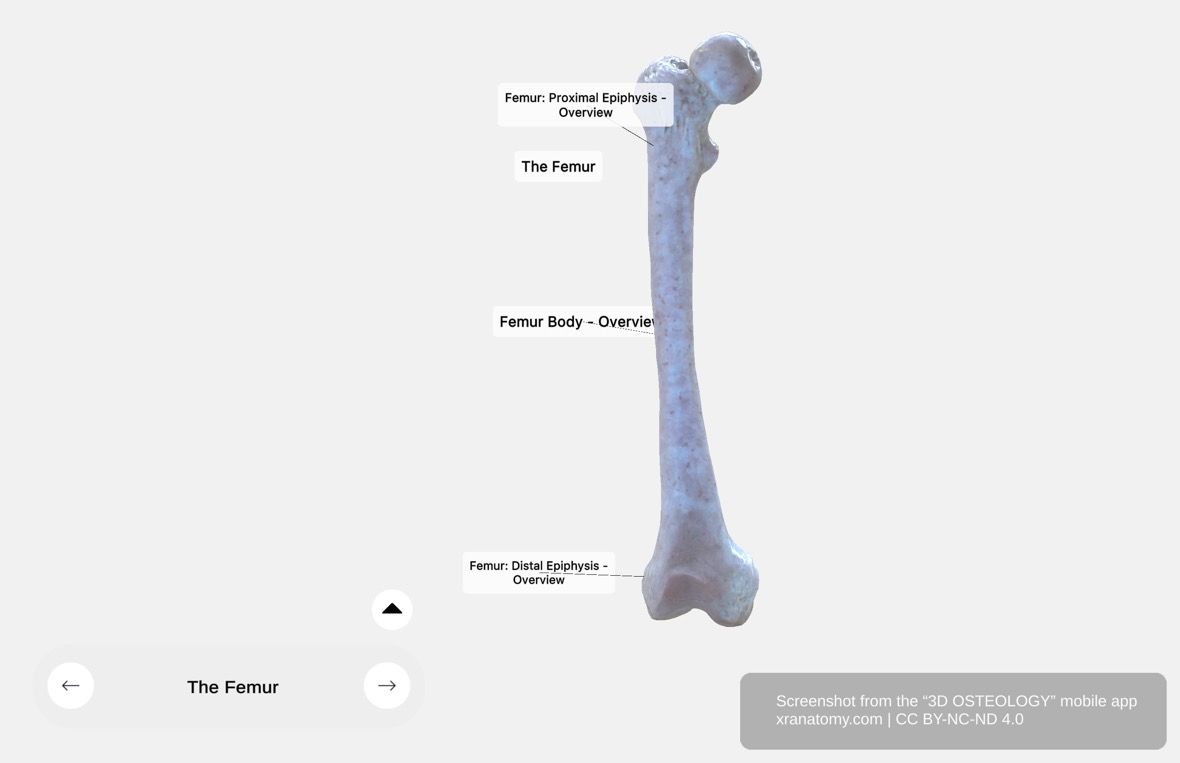
Femur - General Structure, Preview from the app. Download 3D OSTEOLOGY for full 3D control—multiple views, x-ray mode, and unlimited zoom.
The femur is the longest and strongest bone in your body, characterized as a long bone with a central shaft and two ends. It plays a vital role in bearing your weight and enabling movement. Your femur divides into three main regions: the proximal epiphysis (upper part, forming part of your hip joint), the body (shaft, supporting weight-bearing and muscular attachments), and the distal epiphysis (lower part, forming part of your knee joint).
Body (Shaft)
The femur shaft is a long, cylindrical, and slightly curved structure that connects the upper and lower ends of your femur. It supports weight-bearing and facilitates your movement. A notable feature is the linea aspera, a ridge located on the back of the shaft that serves as an attachment site for muscles.
Proximal Epiphysis
The proximal epiphysis is the upper part of your femur. It forms part of your hip joint.
Distal Epiphysis
The distal epiphysis is the lower part of your femur. It forms part of your knee joint.
PROXIMAL EPIPHYSIS OF THE FEMUR
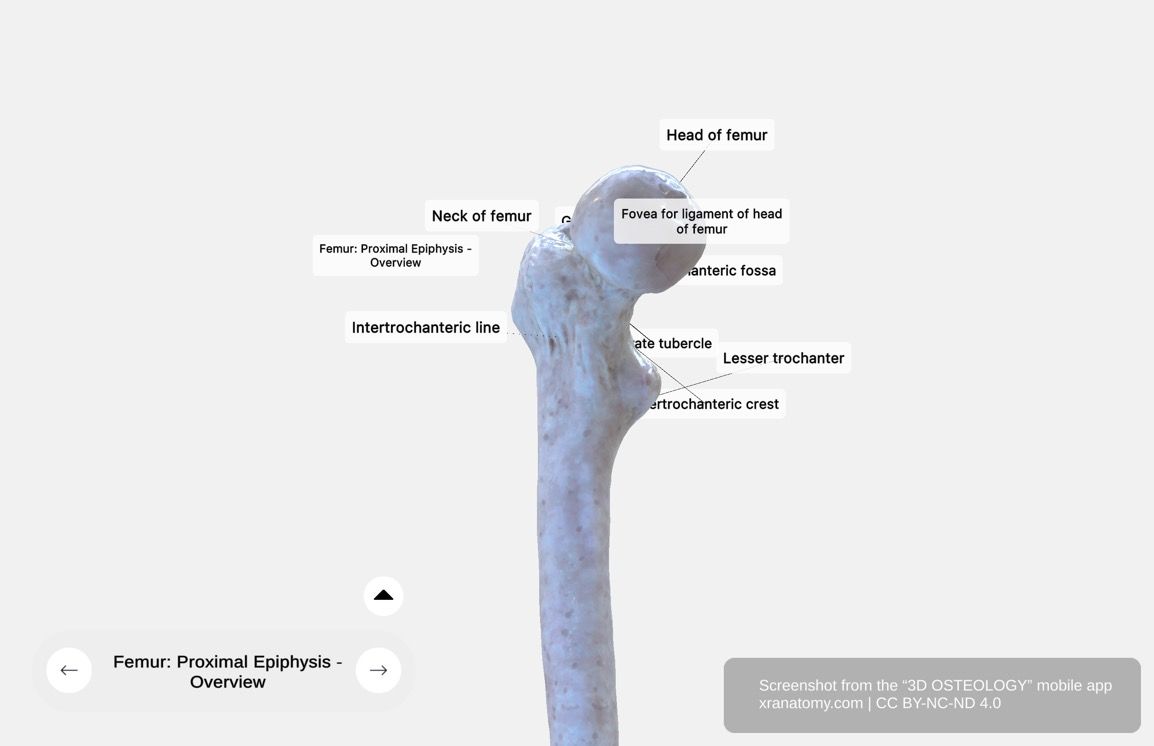
Proximal Epiphysis of the Femur, Preview from the app. Download 3D OSTEOLOGY for full 3D control—multiple views, x-ray mode, and unlimited zoom.
The proximal epiphysis is the upper part of your femur. It connects to your hip joint and supports your mobility and stability. Its structures include the head, neck, greater trochanter, lesser trochanter, intertrochanteric line, intertrochanteric crest, and quadrate tubercle.
Head of the Femur
The head of the femur is nearly spherical, forming more than half of a sphere. It forms the ball of the ball-and-socket hip joint (articulatio coxae) with the acetabulum of your hip bone. The head points slightly upwards and towards your body's center. It fits into the acetabulum (hip socket) for smooth hip joint movement.
On its surface, you will find the fovea for the ligament of the head, a small depression located slightly below and behind the center. This fovea serves as the attachment site for a ligament that stabilizes your hip joint.
Neck of the Femur
The neck of the femur is a narrow, flattened region. It connects the head of the femur to its body and forms an angle with the femur's body for proper hip movement and stability.
Greater Trochanter
The greater trochanter is a large, irregular bony prominence that projects upwards and outwards from your femur. It serves as a major attachment point for several muscles involved in your hip and thigh movement.
On its inner surface you will find the trochanteric fossa, which provides an attachment point for a tendon aiding your hip movement.
Lesser Trochanter
The lesser trochanter is a smaller, cone-shaped projection located at the junction of the femur's body and neck, towards the back. It serves as the attachment point for muscles like the psoas major, aiding your hip flexion.
Intertrochanteric Line
The intertrochanteric line runs along the front surface of your femur, descending downward and inward from the greater trochanter to the lesser trochanter. It marks the boundary between the neck and body of the femur and provides attachment points for muscles and ligaments.
Intertrochanteric Crest
The intertrochanteric crest runs along the back surface of your femur, diagonally between the greater and lesser trochanters. It provides an area for muscle attachment and serves as a key anatomical landmark.
Quadrate Tubercle
The quadrate tubercle sits along the intertrochanteric crest, about halfway between the greater and lesser trochanters. It serves as the attachment point for the quadratus femoris muscle, aiding in your hip stabilization.
BODY OF THE FEMUR
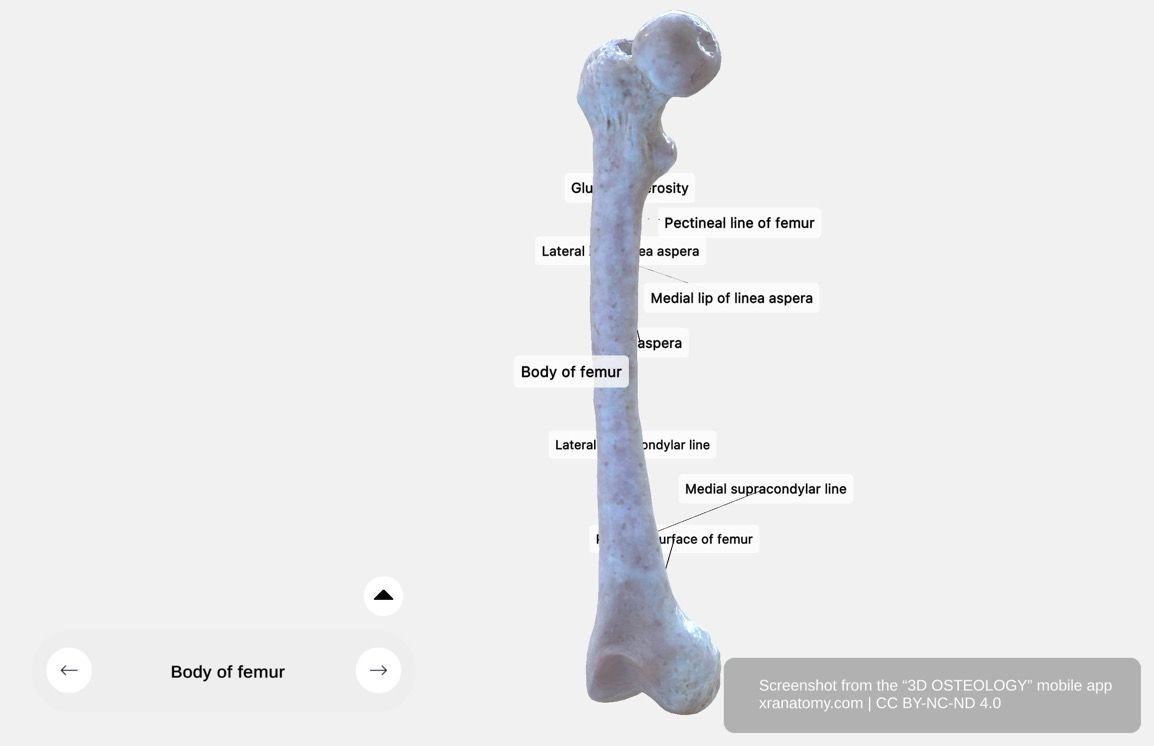
Body of the Femur, Preview from the app. Download 3D OSTEOLOGY for full 3D control—multiple views, x-ray mode, and unlimited zoom.
The shaft of your femur is almost cylindrical for most of its length, broadening above its midpoint and flattening near the distal end. Its structures include the linea aspera, pectineal line, gluteal tuberosity, popliteal surface, medial supracondylar line, and lateral supracondylar line.
Linea Aspera
The linea aspera is a longitudinal ridge running down the posterior surface of your femur. It serves as an attachment point for muscles like your adductors and quadriceps. The linea aspera features two distinct edges: the medial lip, which defines the inner margin and provides an attachment site for your vastus medialis muscle, and the lateral lip, which forms the outer edge and provides an attachment site for your vastus lateralis muscle.
Pectineal Line
The pectineal line extends upwards from the linea aspera toward the lesser trochanter. It serves as an attachment site for a muscle and transitions into the anterior part of your femur, blending with the intertrochanteric line.
Gluteal Tuberosity
The gluteal tuberosity sits on the upper posterior part of your femur, rising toward the base of the greater trochanter. It serves as the attachment point for the gluteus maximus muscle and supports your hip extension and movement.
Popliteal Surface
The popliteal surface is a triangular area at the distal posterior end of your femur, bordered by the diverging edges of the linea aspera. It relates to muscle and ligament attachments near your knee joint.
Medial Supracondylar Line
The medial supracondylar line descends from the medial lip of the linea aspera to the medial condyle. It serves as an attachment site for muscles and provides structural support.
Lateral Supracondylar Line
The lateral supracondylar line extends from the lateral lip of the linea aspera to the lateral epicondyle. It provides muscle attachment points and defines the contour of your femur's lower posterior part.
DISTAL EPIPHYSIS OF THE FEMUR
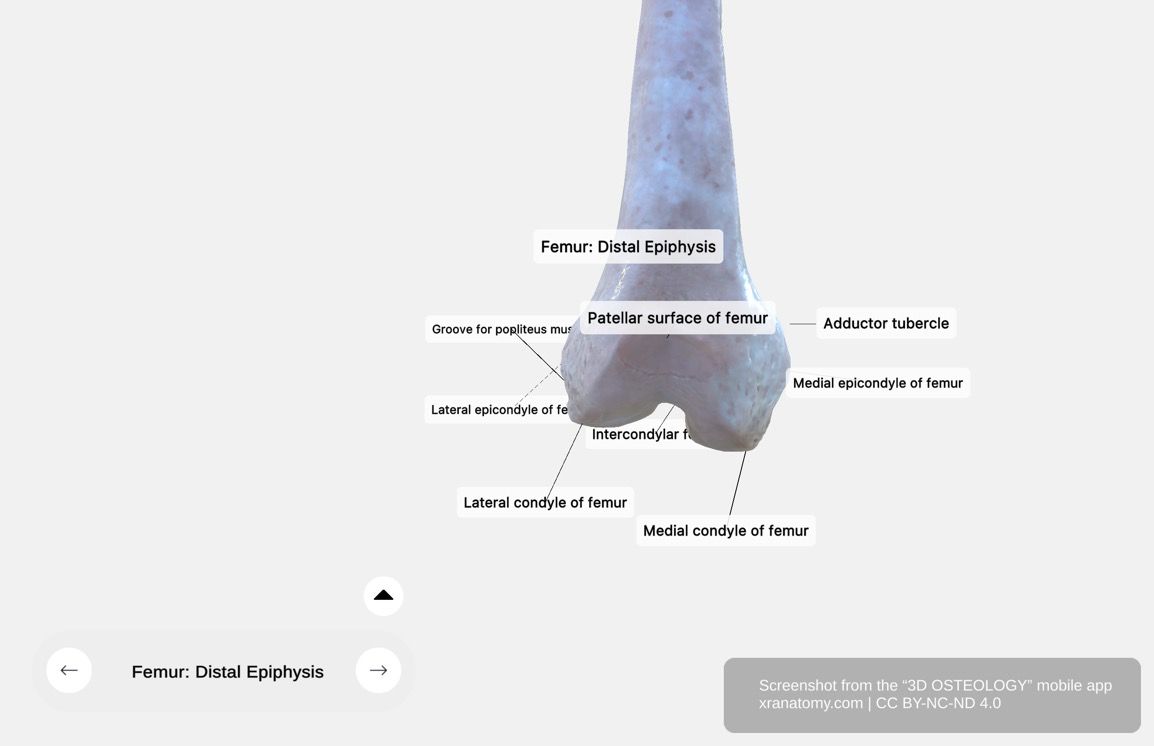
Distal Epiphysis of the Femur, Preview from the app. Download 3D OSTEOLOGY for full 3D control—multiple views, x-ray mode, and unlimited zoom.
The lower part of your femur connects to your knee joint and features structures that articulate with your tibia and patella. Its structures include the medial condyle, lateral condyle, patellar surface, intercondylar fossa, and intercondylar line.
Medial Condyle
The medial condyle is a prominent, rounded projection on the lower, inner side of your femur. It extends further back than the lateral condyle and articulates with your tibia to form part of your knee joint.
Above the medial condyle sits the medial epicondyle, which serves as an attachment point for a ligament. On the medial condyle itself, you will find the adductor tubercle, a small, raised area that provides an attachment point for a muscle involved in your thigh adduction.
Lateral Condyle
The lateral condyle is broader and more anterior than the medial condyle. It articulates with your tibia to form part of your knee joint.
Above the lateral condyle sits the lateral epicondyle, which serves as an attachment point for a ligament connecting your femur to the fibula. On the back of the lateral condyle, you will find the groove for the popliteus muscle, an oblique, deep groove that provides passage for your popliteus muscle, separated from the articular surface by a rounded ridge.
Patellar Surface
The patellar surface sits at the front of your femur, between the medial and lateral condyles. It is a smooth, shallow depression that articulates with your patella and allows smooth movement during your knee flexion and extension.
Intercondylar Fossa
The intercondylar fossa is a deep notch on the posterior side of your femur, between the condyles. It houses attachment points for your cruciate ligaments, which are essential for your knee stability.
Intercondylar Line
The intercondylar line is a ridge running across the back of your femur, above the intercondylar fossa. It connects to the posterior margin of the patellar surface and serves as a boundary for the intercondylar fossa.
CHECK YOUR UNDERSTANDING
1. Name the three main regions of the femur.
Reveal Answer
The proximal epiphysis (upper part, forming part of the hip joint), the body or shaft (cylindrical middle portion), and the distal epiphysis (lower part, forming part of the knee joint).
2. What is the linea aspera and what muscles attach to it?
Reveal Answer
The linea aspera is a longitudinal ridge running down the posterior surface of the femur shaft. It provides attachment for the adductors and quadriceps. Its medial lip attaches the vastus medialis and its lateral lip attaches the vastus lateralis.
3. What structure within the intercondylar fossa is essential for knee stability?
Reveal Answer
The intercondylar fossa houses attachment points for the cruciate ligaments, which are essential for knee stability.
WHAT'S NEXT
Now that you understand the femur, the next page covers the Tibia. You will explore the second longest bone in your body, including the tibial plateau, tibial tuberosity, medial malleolus, and how it forms part of both your knee and ankle joints.
Review this page again in 3 days to reinforce what you have learned.
BIBLIOGRAPHY
1. Henry G, Warren HL. Osteology. In: Anatomy of the Human Body. 20th ed. Philadelphia: Lea & Febiger; 1918. p. 129–97.
2. Standring S, editor. Gray's Anatomy: The Anatomical Basis of Clinical Practice. 41st ed. London: Elsevier; 2016.
3. Moore KL, Agur AMR, Dalley AF. Essential Clinical Anatomy. 5th ed. Philadelphia: Wolters Kluwer; 2015.