HIP BONE ANATOMY
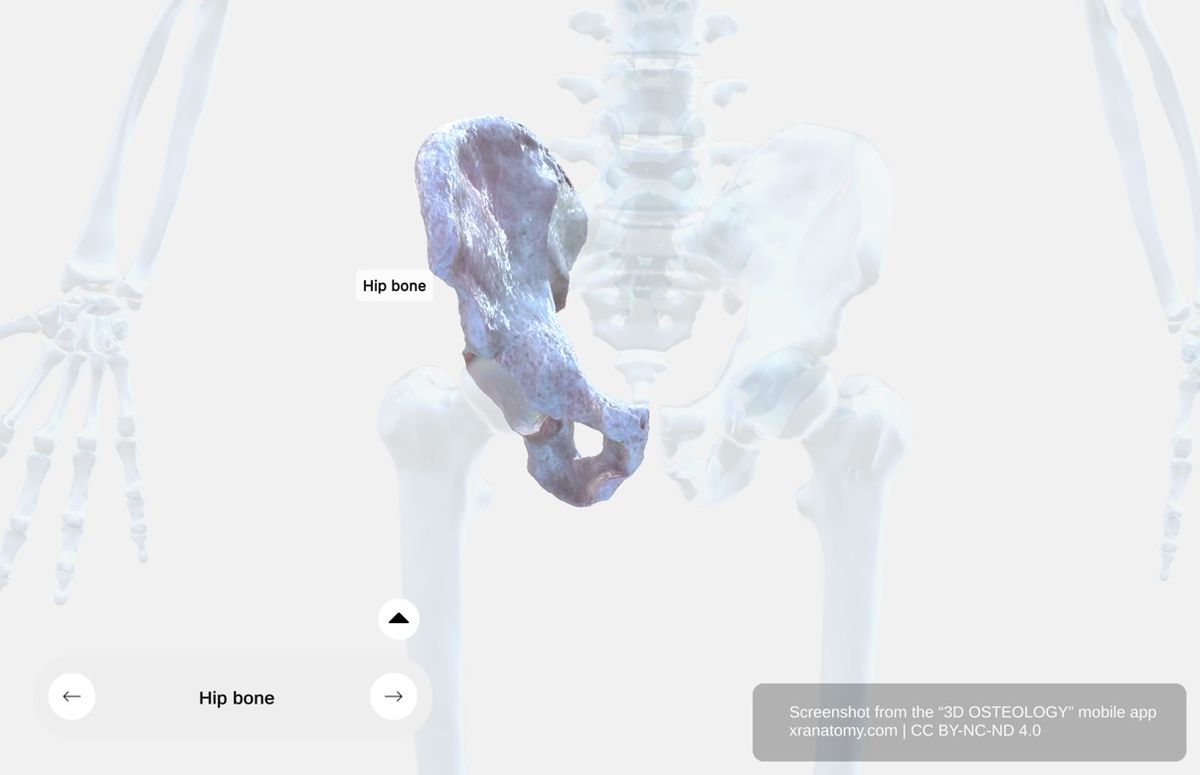
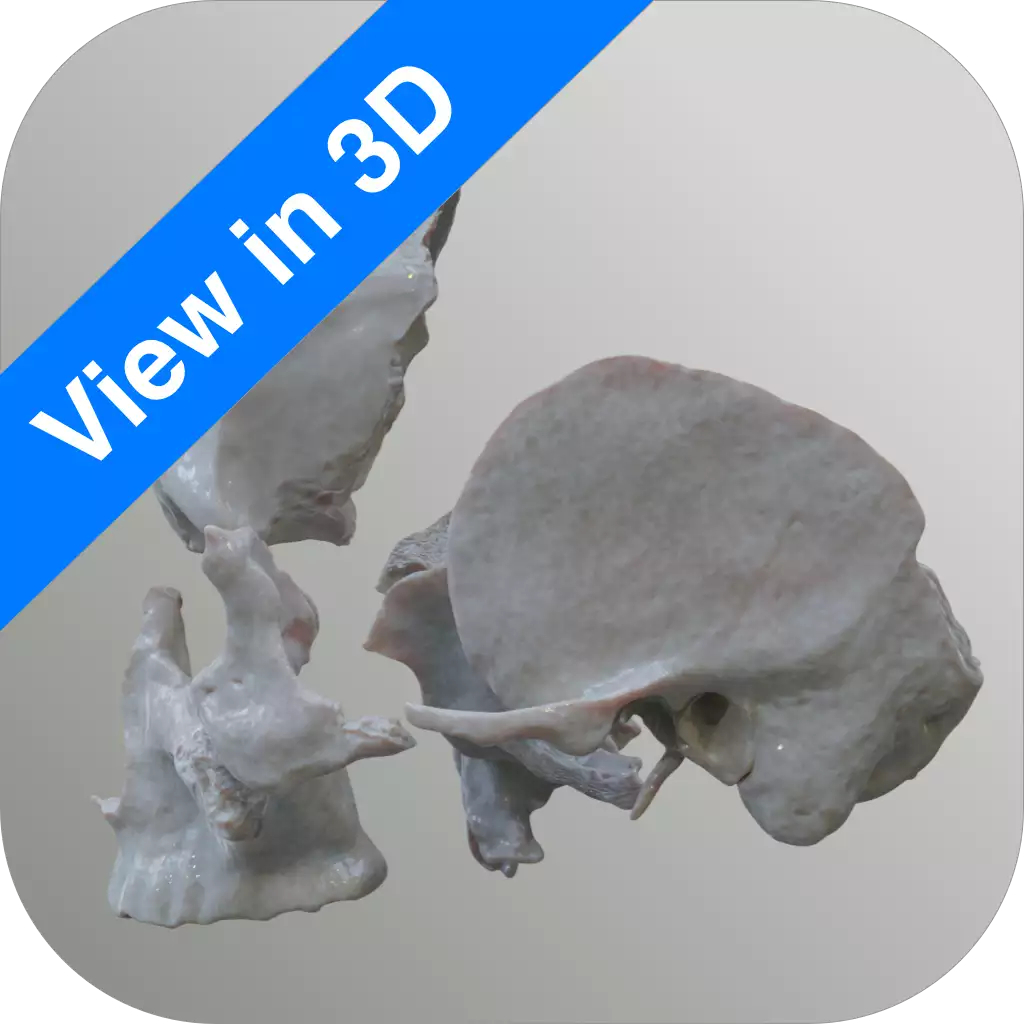
Hip Bone - X-Ray View, Preview from the app. Download 3D OSTEOLOGY for full 3D control—multiple views, x-ray mode, and unlimited zoom.
WHY THIS MATTERS
Your hip bone (os coxae) is a large, irregularly shaped bone that forms your pelvic girdle, providing support and stability to your lower body. It is built from three fused components, the ilium, ischium, and os pubis, which meet at the acetabulum, the socket that receives the head of your femur. Understanding these components helps you see how the hip bone anchors your trunk to your lower limbs.
HIP BONE OVERVIEW
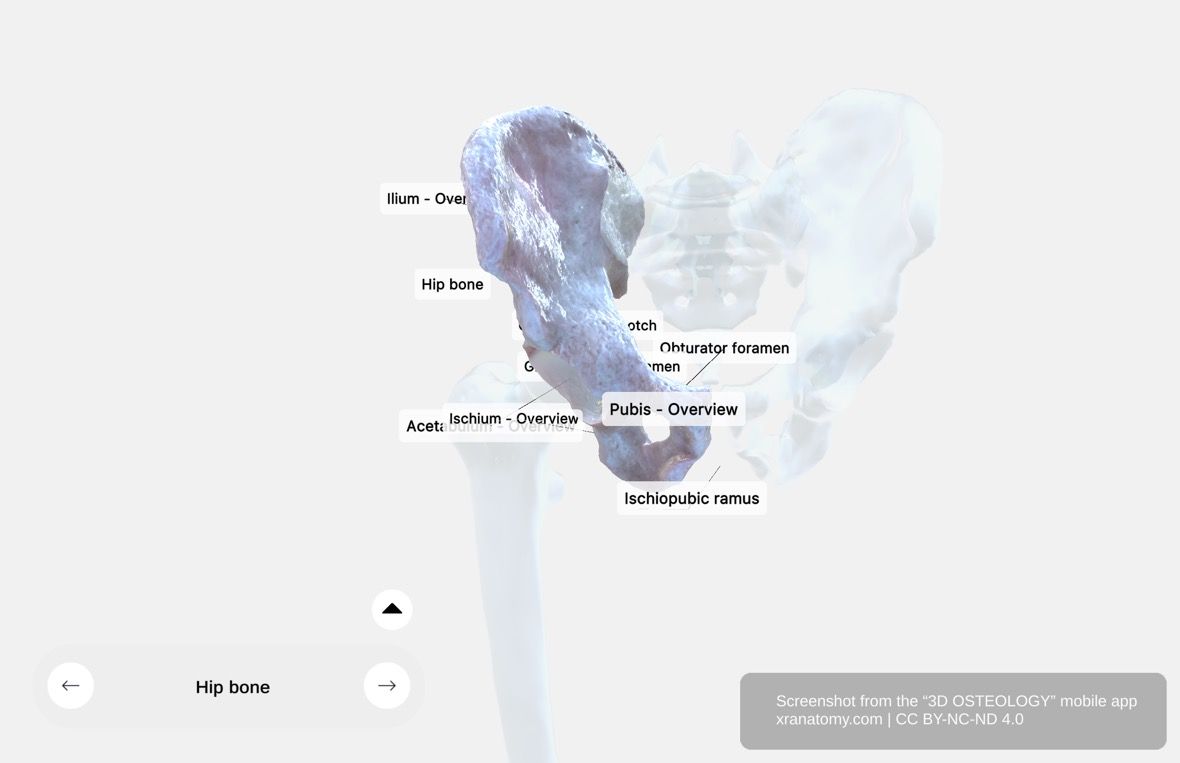
Hip Bone - Overview, Preview from the app. Download 3D OSTEOLOGY for full 3D control—multiple views, x-ray mode, and unlimited zoom.
The hip bone is a large, flattened, irregularly shaped bone that is constricted in the center and expanded above and below. It articulates with the opposite hip bone to form your pelvic girdle, providing support and stability to your lower body. Key features of the hip bone include the ischiopubic ramus, the obturator foramen, the greater sciatic notch, and the greater sciatic foramen.
Ischiopubic Ramus
The ischiopubic ramus sits where the inferior ramus of the ischium joins the inferior ramus of the os pubis. It forms part of the boundary of the obturator foramen and serves as an attachment point for muscles of the perineal region and locomotion.
Obturator Foramen
The obturator foramen lies between the ischium and os pubis. It is large and oval in males, but smaller and triangular in females. The obturator membrane covers it and contains a ligament forming a canal for the obturator vessels and nerve.
Greater Sciatic Notch
The greater sciatic notch sits beneath the posterior inferior spine of the ilium. It serves as a passageway for key neurovascular structures.
Greater Sciatic Foramen
The greater sciatic foramen is created by the greater sciatic notch and the sacrospinous ligament. It allows passage of important nerves and vessels.
HIP BONE COMPONENTS
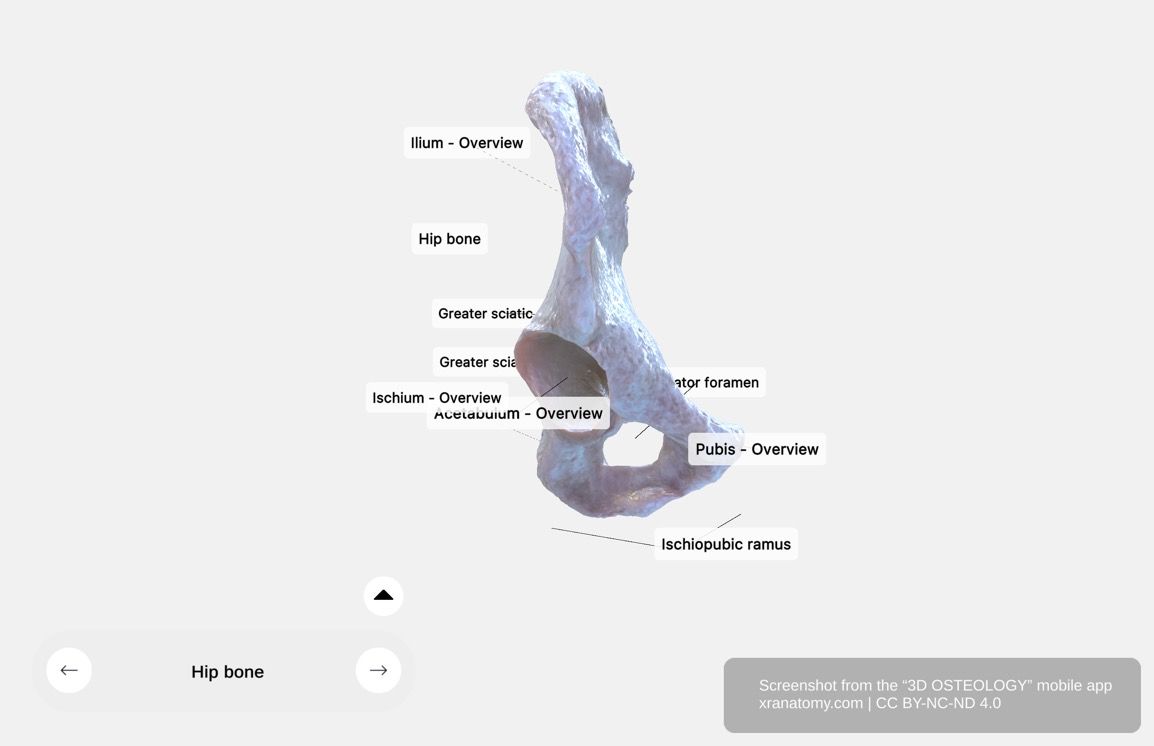
Hip Bone - Components, Preview from the app. Download 3D OSTEOLOGY for full 3D control—multiple views, x-ray mode, and unlimited zoom.
Your hip bone consists of three main components: the ilium, ischium, and os pubis. They fuse in adulthood, taking part in the formation of the acetabulum.
Ilium
The ilium is a broad, expanded portion of your hip bone. It divides into the body, which forms part of the acetabulum, and the ala, a large expanded portion forming the greater pelvis.
Ischium
The ischium is the lowest part of your hip bone. It consists of a body and superior and inferior rami. It contributes over two-fifths of the acetabulum and forms the walls of your lesser pelvis.
Os Pubis
The os pubis forms one-fifth of the acetabulum. It articulates with the opposite os pubis at the pubic symphysis and divides into the body, superior ramus, and inferior ramus.
Acetabulum
The acetabulum sits in the middle of the outer surface of your hip bone. It is a large, cup-shaped articular cavity formed by the ilium, ischium, and os pubis. A prominent rim surrounds it. Its key features include the lunate surface, which articulates with the head of your femur, and the acetabular fossa, a non-articular area at the bottom.
ACETABULUM
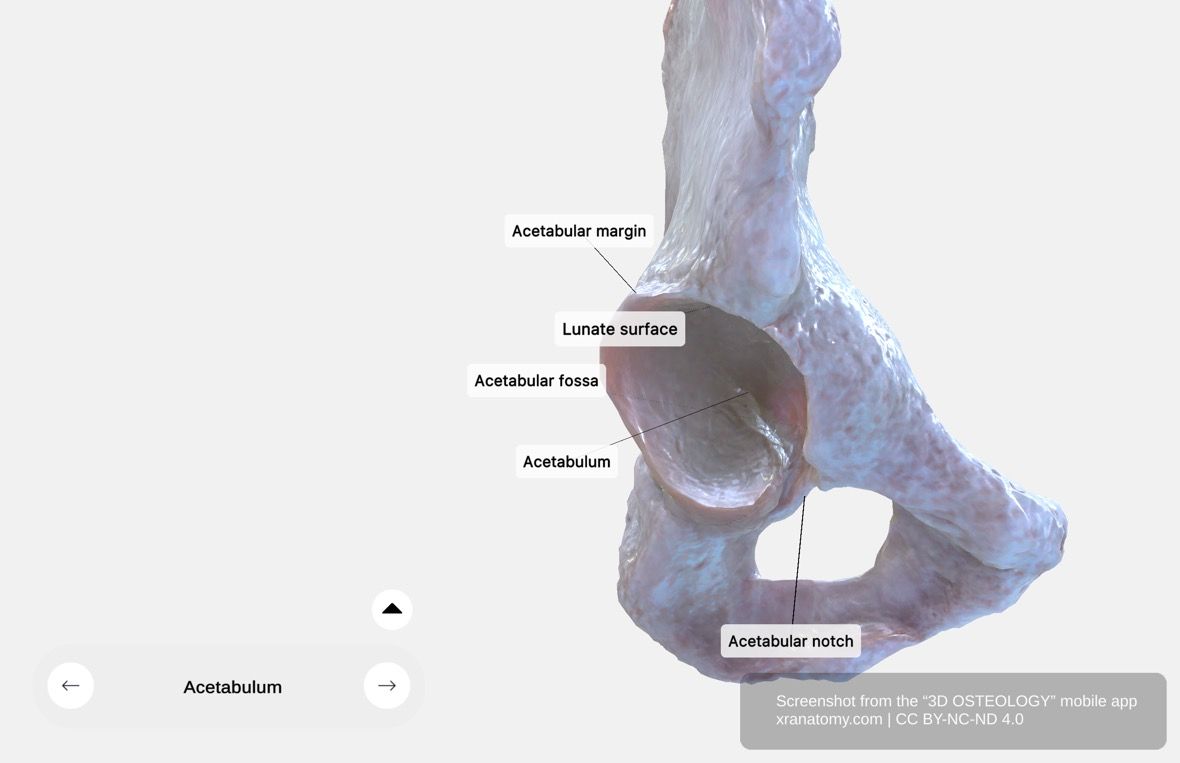
Acetabulum, Preview from the app. Download 3D OSTEOLOGY for full 3D control—multiple views, x-ray mode, and unlimited zoom.
The acetabulum is formed by the union of three bones: the ilium, ischium, and os pubis. It features a prominent, uneven rim known as the acetabular margin and comprises two key components: the lunate surface (articular) and the acetabular fossa (non-articular). Below the fossa you find the acetabular notch.
Acetabular Margin
The acetabular margin is a robust, uneven rim surrounding the acetabulum. It is thick and strong above and serves as the attachment site for the acetabular labrum.
Acetabular Fossa
The acetabular fossa is a non-articular depression at the base of the acetabulum. It serves as the attachment site for the ligamentum teres.
Acetabular Notch
The acetabular notch is a deep indentation below the acetabular fossa. The transverse acetabular ligament converts it into a foramen.
Lunate Surface
The lunate surface is a curved, smooth, articular surface that forms the majority of the acetabulum. It articulates with the head of your femur.
ILIUM
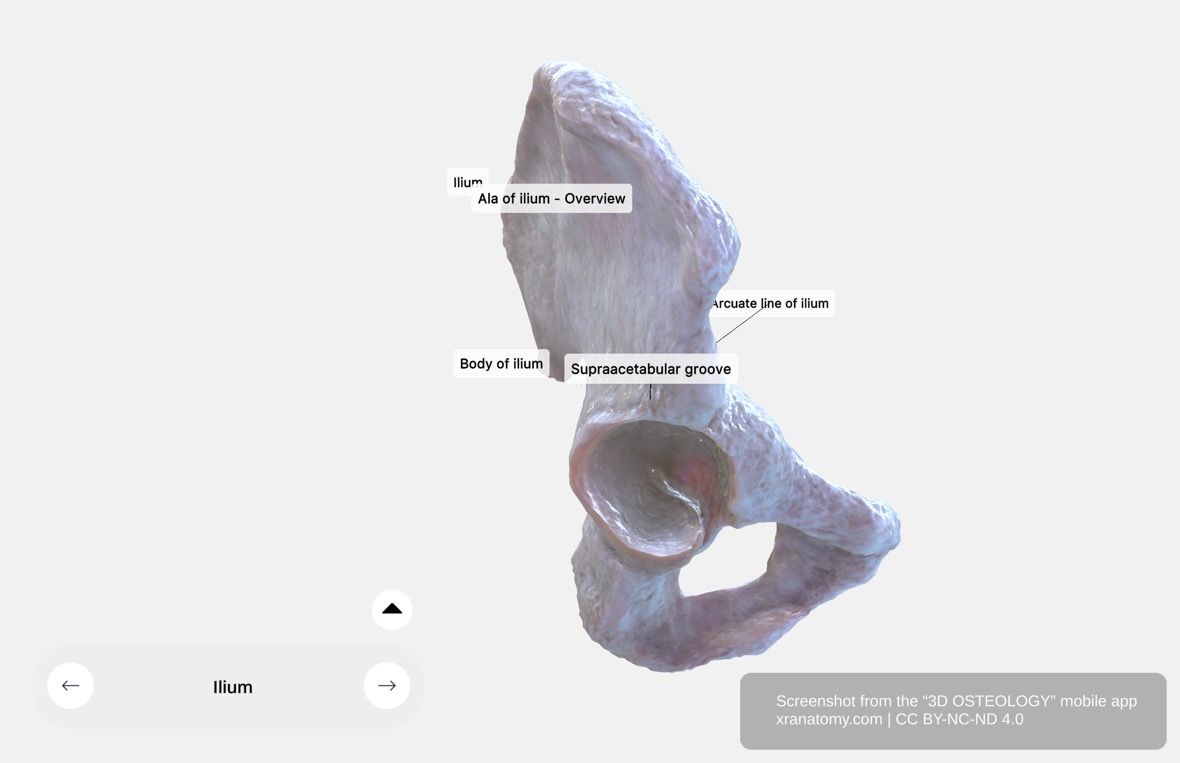
Ilium, Preview from the app. Download 3D OSTEOLOGY for full 3D control—multiple views, x-ray mode, and unlimited zoom.
The ilium is a broad, expanded portion of your hip bone extending upward from the acetabulum. It divides into the body and the ala. The body forms part of the acetabulum and transitions into the arcuate line. The ala (wing) expands outward with gluteal and sacropelvic surfaces.
Arcuate Line
The arcuate line sits on the internal surface of the ilium. It separates the body and the ala of the ilium.
Ala of the Ilium
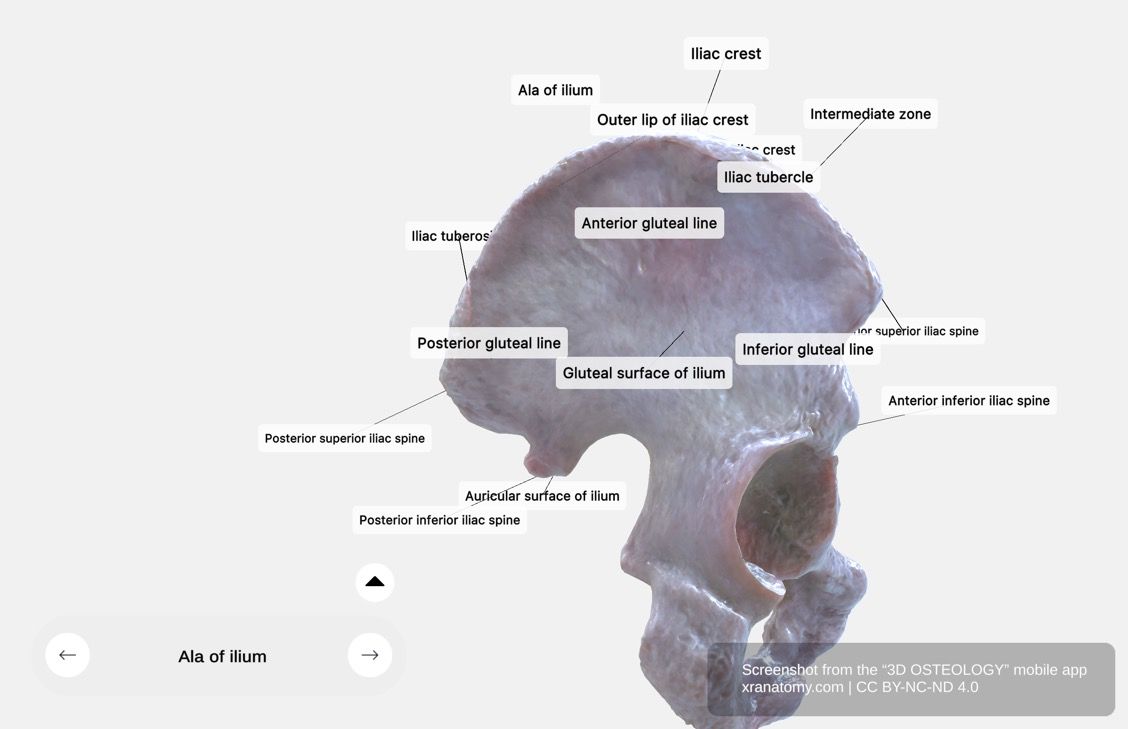
Ala of the Ilium, Preview from the app. Download 3D OSTEOLOGY for full 3D control—multiple views, x-ray mode, and unlimited zoom.
The ala is a large, wing-like portion of the bone. It features an external surface and an internal surface and includes the crest as well as anterior and posterior borders. Its key landmarks include the iliac crest, the iliac spines, and the iliac fossa.
Iliac Crest
The iliac crest is a convex, sinuously curved structure you can feel at the top of your hip, concave in front and convex behind. It consists of the outer lip, intermediate zone, and inner lip. It is thinner at the center than at the extremities and provides support and attachment for muscles and ligaments.
The outer lip of the iliac crest is the outermost part, providing attachment to muscles. It features the iliac tubercle, a prominent bony landmark ~5 cm posterior to the anterior superior iliac spine. The intermediate zone sits between the inner and outer lips. The inner lip of the iliac crest is the most medial part and serves as an attachment site for several muscles.
Iliac Spines
The anterior superior iliac spine is a prominent projection at the junction of your iliac crest and anterior border; it serves as an attachment point for several muscles. The anterior inferior iliac spine sits below it and the notch, serving as an attachment point for important structures.
The posterior superior iliac spine is a projection serving as an anchorage point for the long posterior sacroiliac ligament. The posterior inferior iliac spine sits below it and forms the upper boundary of the greater sciatic notch.
Iliac Fossa
The iliac fossa has a smooth, concave surface. It gives origin to your iliacus muscle.
Gluteal Surface of Ilium
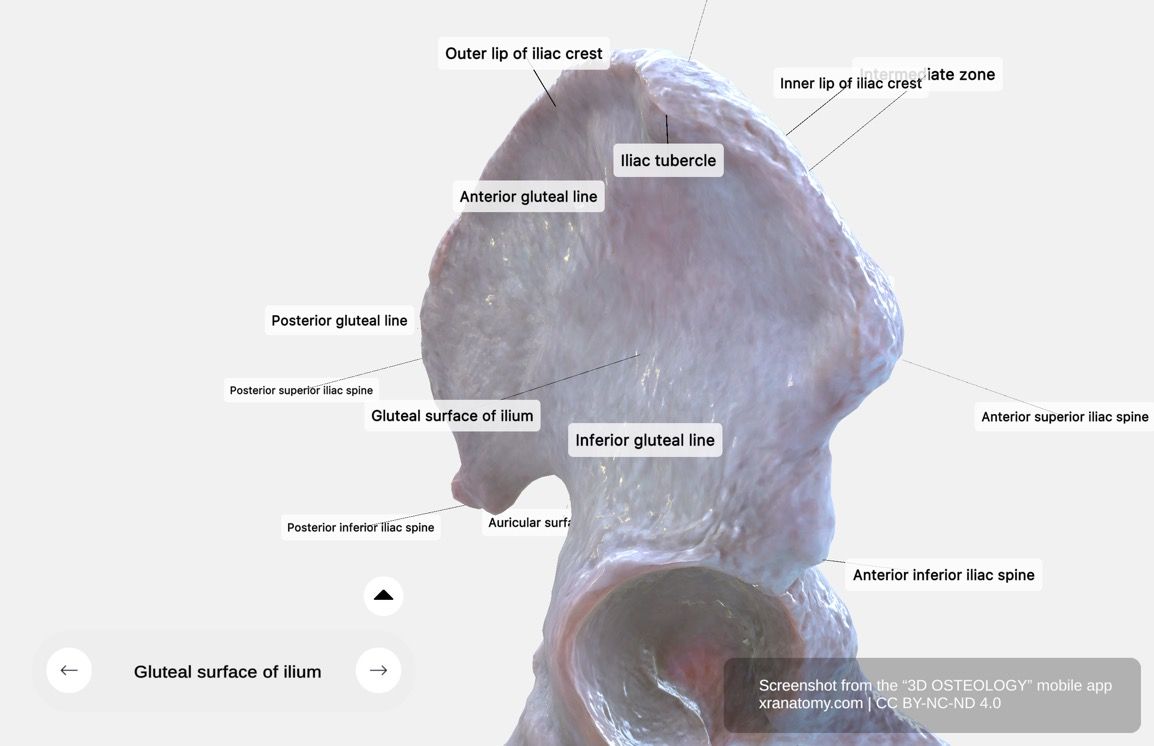
Gluteal Surface of Ilium, Preview from the app. Download 3D OSTEOLOGY for full 3D control—multiple views, x-ray mode, and unlimited zoom.
The gluteal surface faces backward and laterally behind, and laterally and downward in front. It is smooth, convex in front and concave behind, and is crossed by three gluteal lines.
Gluteal Lines
The anterior gluteal line is the longest of the gluteal lines. It starts at the iliac crest ~4 cm behind its anterior extremity and curves backward and downward, ending at the upper part of the greater sciatic notch.
The posterior gluteal line is the shortest of the gluteal lines. It starts at the iliac crest ~5 cm in front of its posterior extremity and ends at the upper part of the greater sciatic notch.
The inferior gluteal line is the least distinct of the gluteal lines. It starts at the notch on the anterior border of the ilium and curves backward and downward, ending near the middle of the greater sciatic notch.
Sacropelvic Surface of Ilium
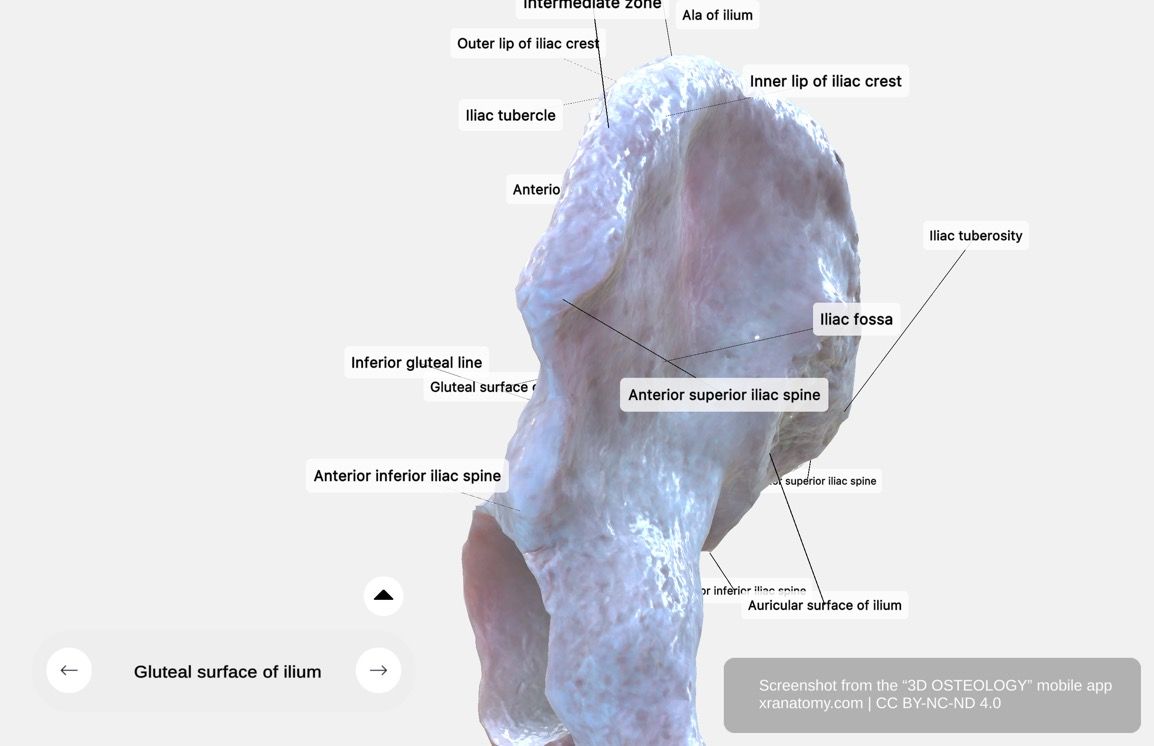
Sacropelvic Surface of Ilium, Preview from the app. Download 3D OSTEOLOGY for full 3D control—multiple views, x-ray mode, and unlimited zoom.
The sacropelvic surface is a rough surface behind the iliac fossa. Its shape resembles the auricula (external ear), and it articulates with your sacrum. Its key landmark is the iliac tuberosity.
Iliac Tuberosity
The iliac tuberosity sits in the superior portion of this area. It is elevated and rough and serves as an attachment site for a ligament.
ISCHIUM
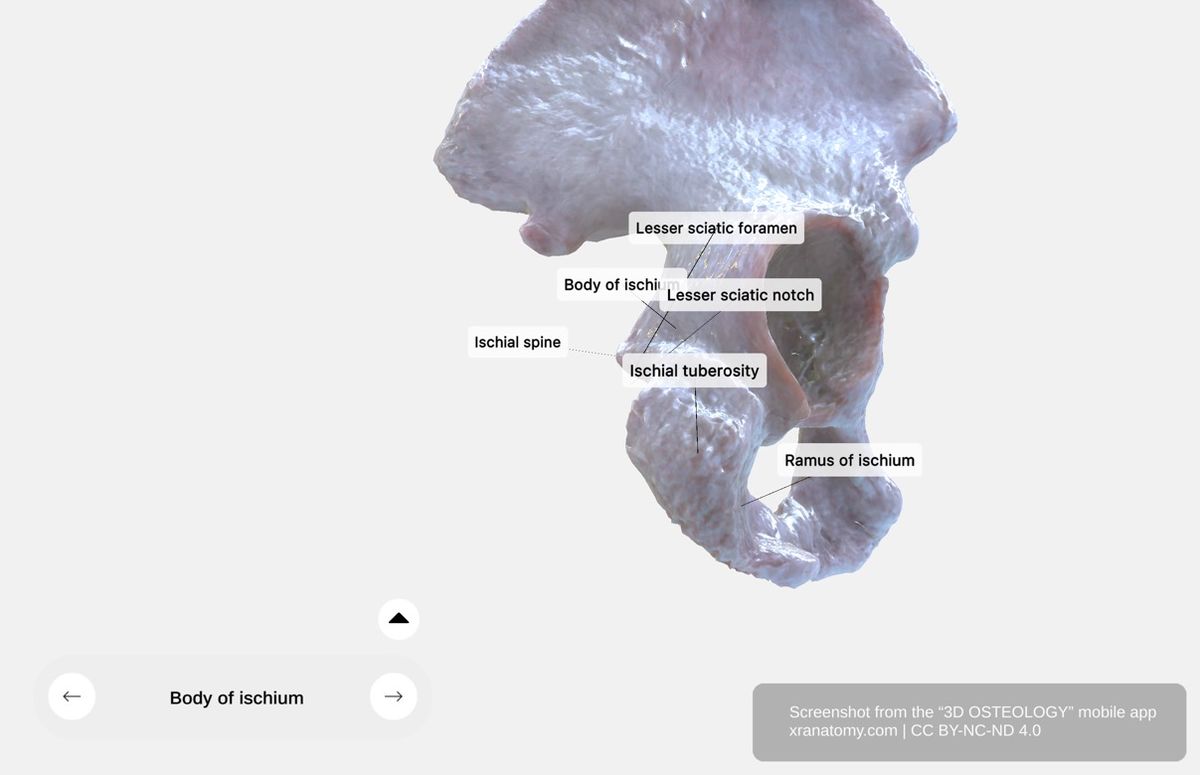
Ischium, Preview from the app. Download 3D OSTEOLOGY for full 3D control—multiple views, x-ray mode, and unlimited zoom.
The ischium forms more than two-fifths of the acetabulum and contributes to the lunate surface and acetabular fossa. Its main parts include the body, the ramus, the ischial spine, and the lesser sciatic notch.
Body of Ischium
The body of the ischium forms a little more than two-fifths of the acetabulum. Its external surface contributes to the lunate surface and the acetabular fossa.
Ramus of the Ischium
The ramus of the ischium extends from the body of the ischium and contributes to the formation of the obturator foramen.
Ischial Tuberosity
The ischial tuberosity is formed by the posterior surface of the superior ramus. It divides into a rough and triangular lower portion and a smooth and quadrilateral upper portion.
Ischial Spine
The ischial spine is a pointed, triangular eminence extending backward and medially from the ischium. It serves as an attachment site for important structures.
Lesser Sciatic Notch
The lesser sciatic notch sits below the ischial spine. Ligaments convert it into the lesser sciatic foramen, which allows passage of specific muscles, nerves, and vessels.
OS PUBIS
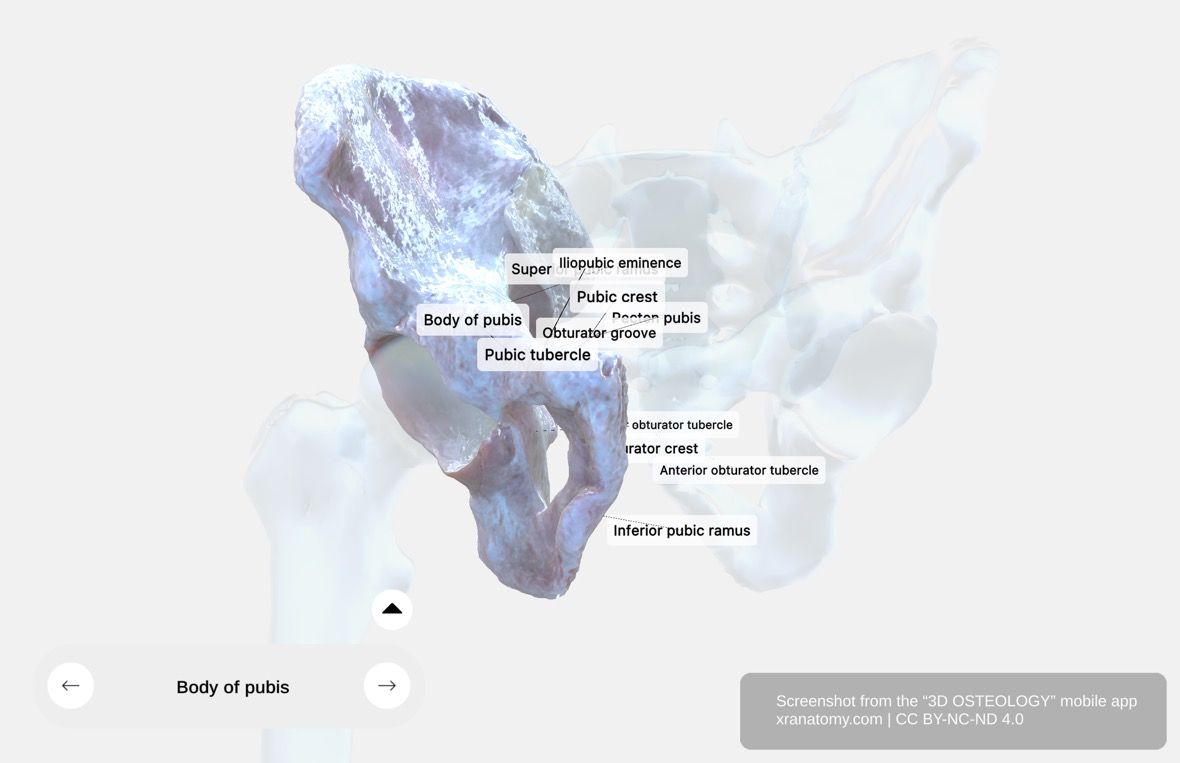
Os Pubis, Preview from the app. Download 3D OSTEOLOGY for full 3D control—multiple views, x-ray mode, and unlimited zoom.
The os pubis forms one-fifth of the acetabulum and contributes to the lunate surface and acetabular fossa. Its internal surface also forms part of the wall of your lesser pelvis. Key landmarks include the pubic tubercle, the pubic crest, the superior ramus, and the inferior pubic ramus.
Pubic Tubercle (Pubic Spine)
The pubic tubercle is a prominent projection on the upper border of the pubis. It serves as an attachment point for your inguinal ligament.
Pubic Crest
The pubic crest sits medial to the pubic tubercle, extending to the medial border. It serves as an attachment site for several muscles.
Superior Ramus
The superior ramus extends from the body of the pubis to the median plane. It articulates with the opposite superior ramus to form the pubic symphysis. Its key features include the iliopubic eminence, pecten pubis, obturator crest, and obturator groove.
Iliopubic Eminence
The iliopubic eminence sits at the junction of the ilium and pubis. It serves as an attachment site for your iliacus muscle.
Pecten Pubis
The pecten pubis is a well-defined ridge above the pubic tubercle. It forms part of the brim of your lesser pelvis.
Obturator Crest
The obturator crest is the anterior margin of the superior ramus. It extends from the pubic tubercle to the acetabulum and forms part of the circumference of the obturator foramen.
Obturator Groove
The obturator groove sits on the inferior aspect of the superior ramus. It forms part of the upper boundary of the obturator foramen. It features two tubercles: the anterior obturator tubercle, located anteriorly and serving as a landmark in the pelvic region, and the posterior obturator tubercle, located posteriorly and serving as an attachment site for the obturator membrane.
Inferior Pubic Ramus
The inferior pubic ramus is a thin, flattened portion of the os pubis. It extends laterally and backward and connects with the inferior ramus of the ischium below the obturator foramen.
CHECK YOUR UNDERSTANDING
1. Name the three bones that fuse to form the hip bone, and where do they meet?
Reveal Answer
The ilium, ischium, and os pubis. They fuse at the acetabulum.
2. How does the obturator foramen differ between males and females?
Reveal Answer
It is large and oval in males, but smaller and triangular in females.
3. Which component of the hip bone contributes the most to the acetabulum, and how much does it form?
Reveal Answer
The ischium contributes the most, forming more than two-fifths of the acetabulum.
WHAT'S NEXT
Now that you understand the hip bone, move on to the Femur. You will explore the longest and strongest bone in your body, from the proximal epiphysis with its head, neck, and trochanters, through the shaft with its linea aspera, to the distal epiphysis with its condyles.
Review this page again in 3 days to reinforce what you have learned.
BIBLIOGRAPHY
1. Henry G, Warren HL. Osteology. In: Anatomy of the Human Body. 20th ed. Philadelphia: Lea & Febiger; 1918. p. 129–97.
2. Standring S, editor. Gray's Anatomy: The Anatomical Basis of Clinical Practice. 41st ed. London: Elsevier; 2016.
3. Moore KL, Agur AMR, Dalley AF. Essential Clinical Anatomy. 5th ed. Philadelphia: Wolters Kluwer; 2015.