RIB CAGE ANATOMY
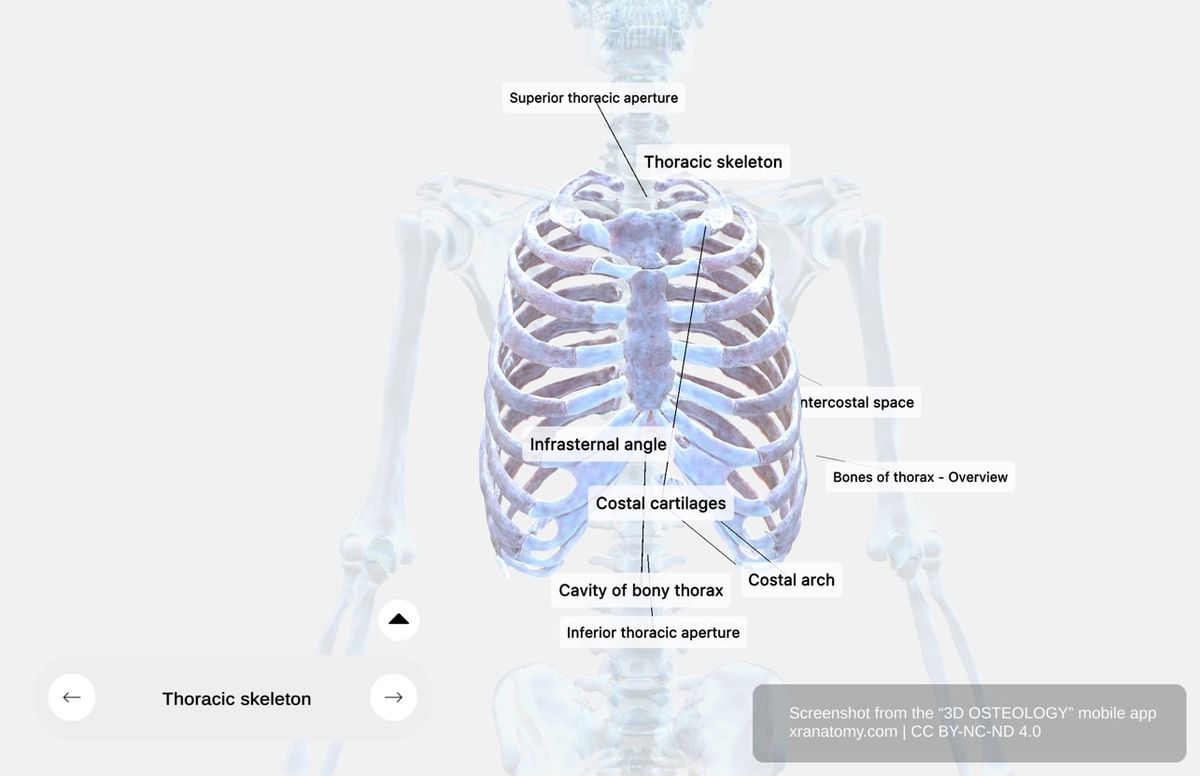
Rib Cage - Overview, Preview from the app. Download 3D OSTEOLOGY for full 3D control—multiple views, x-ray mode, and unlimited zoom.
WHY THIS MATTERS
Your rib cage protects your heart and lungs while flexing with every breath you take. Understanding how its twelve pairs of ribs, costal cartilages, and costal arch work together shows you how your thorax balances protection with the flexibility needed for respiration.
TABLE OF CONTENTS
RIB CAGE
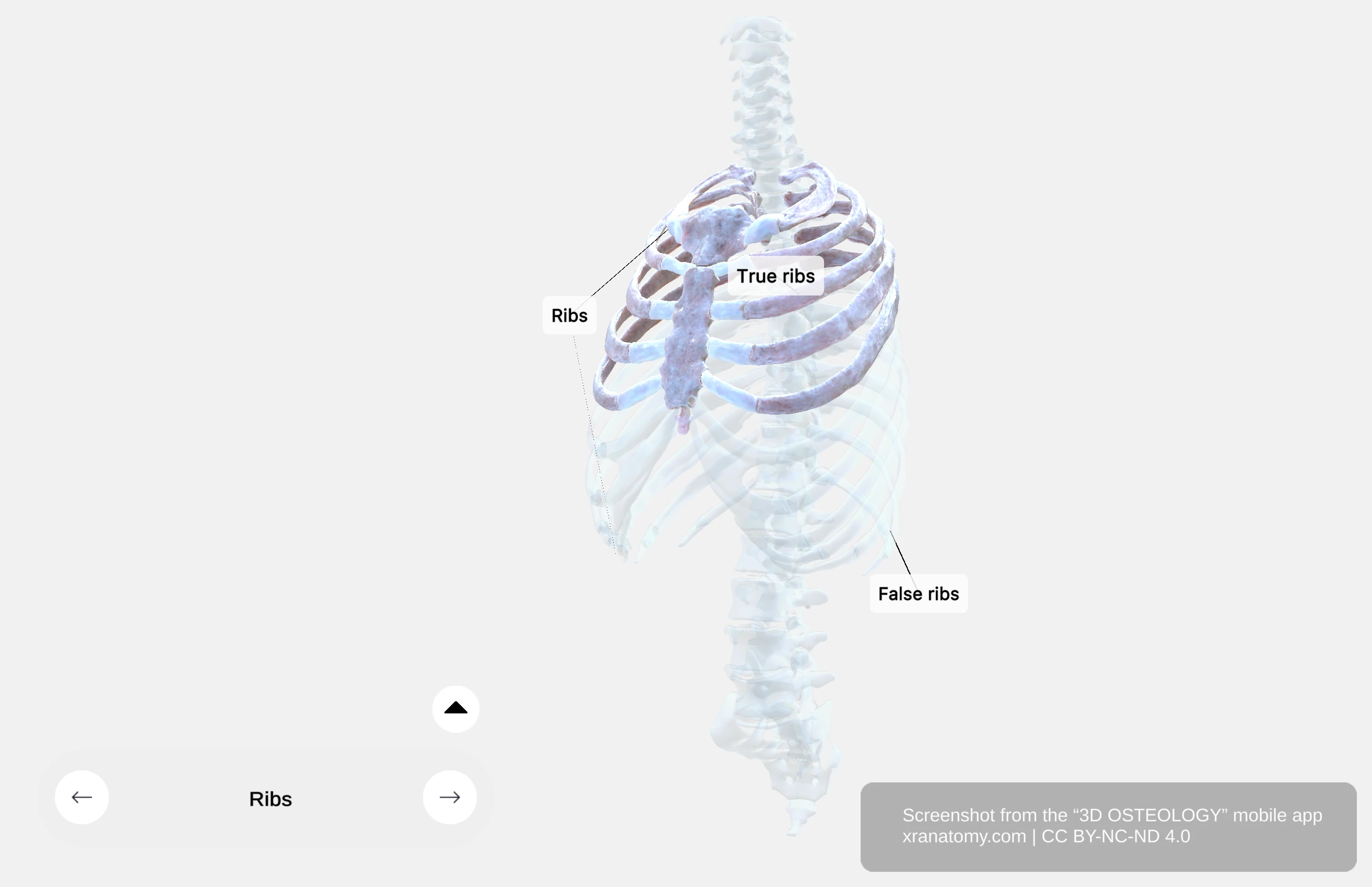
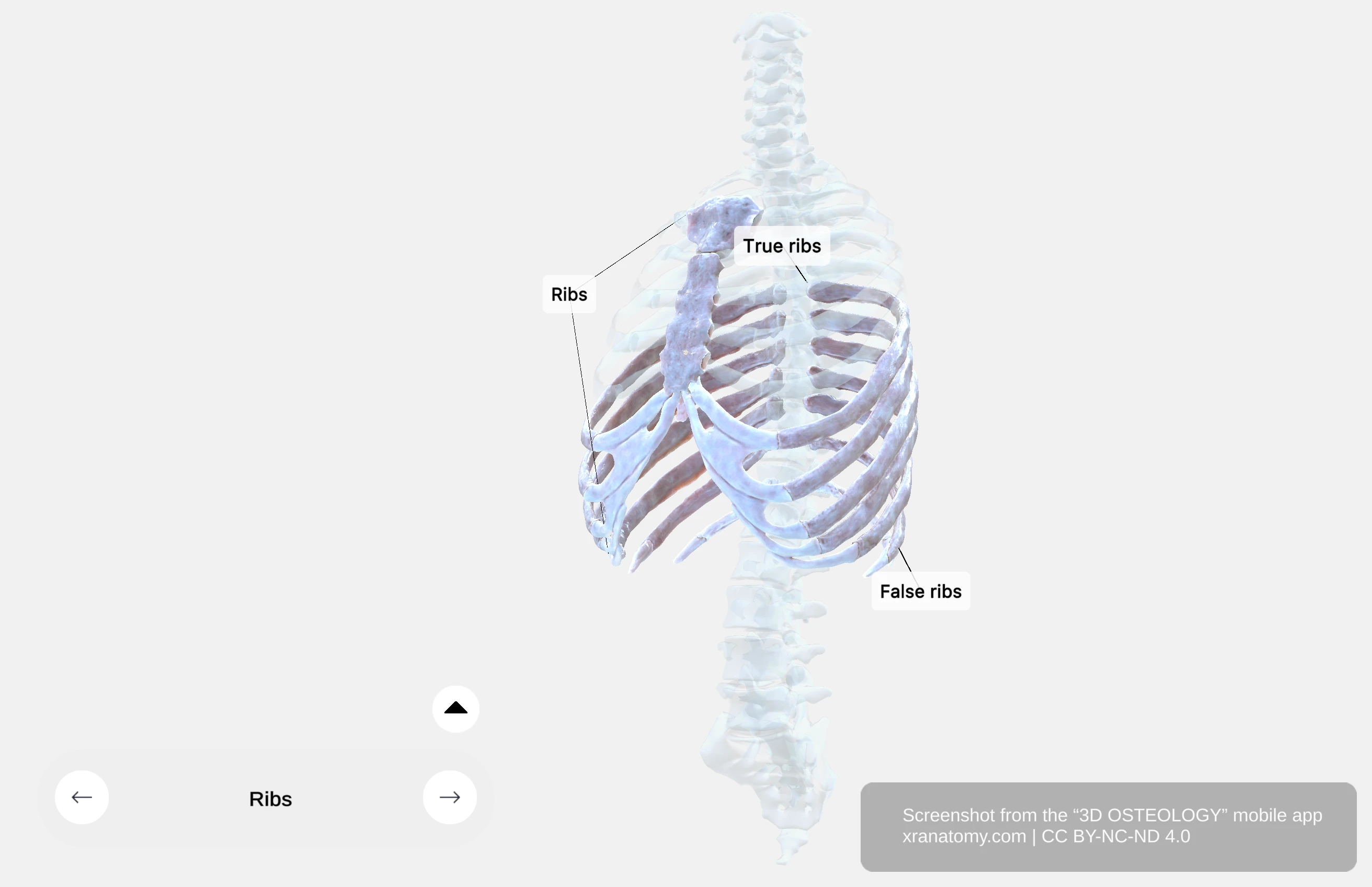
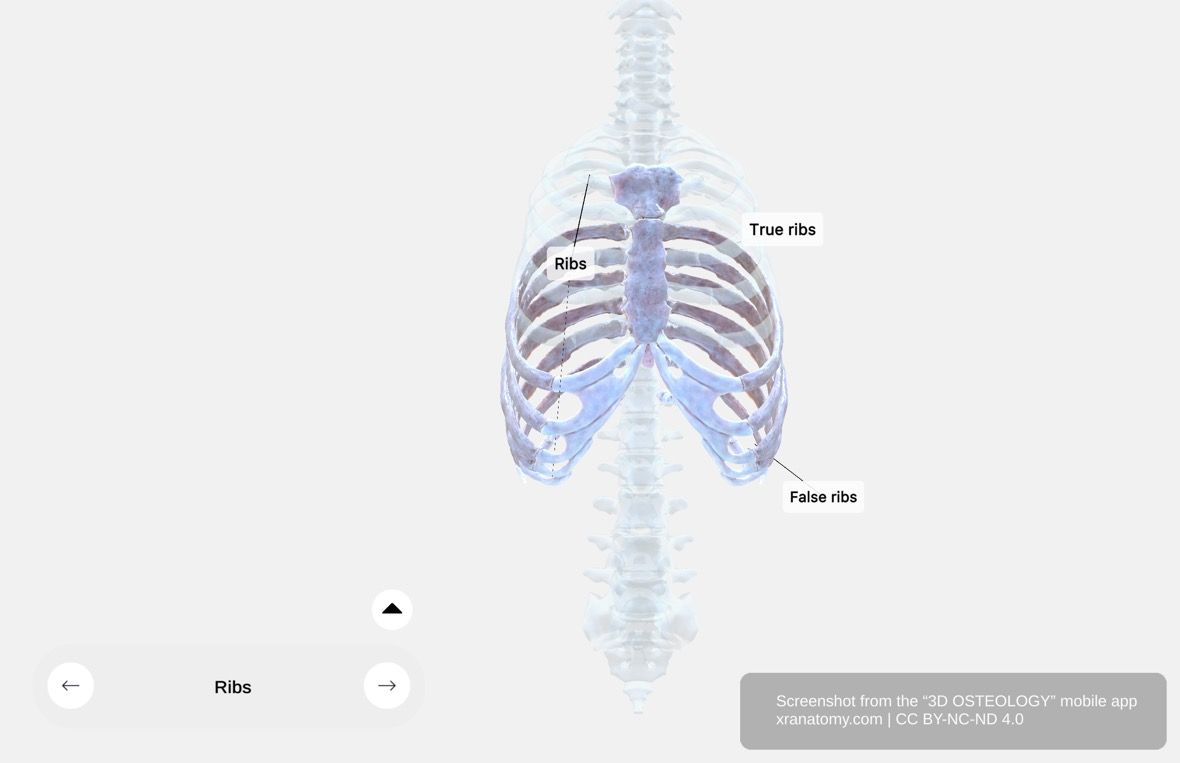
Your rib cage typically consists of twelve pairs of ribs, with occasional variation. The first seven pairs are the true ribs, which attach directly to the sternum via costal cartilages and form a supportive, flexible structure that aids your respiration and protects your vital organs. The lower five pairs are false ribs: ribs eight to ten (vertebrochondral ribs) attach indirectly to the sternum via shared cartilage, while ribs eleven and twelve (floating ribs) have no sternal connection at all.
True Ribs (Ribs 1-7)
The true ribs are the first seven pairs of ribs. They attach directly to the sternum via individual costal cartilages and are also called vertebrosternal ribs. These ribs provide primary structural support to your thoracic cage.
False Ribs (Ribs 8-10)
The false ribs are ribs eight, nine, and ten. They attach indirectly to the sternum via the cartilage of the rib above and are also called vertebrochondral ribs. These ribs contribute to the costal arch formation.
Floating Ribs (Ribs 11-12)
The floating ribs are ribs eleven and twelve. They have no sternal attachment and are also called vertebral ribs. Their pointed ends are free in the musculature, and they provide protection for your kidneys.
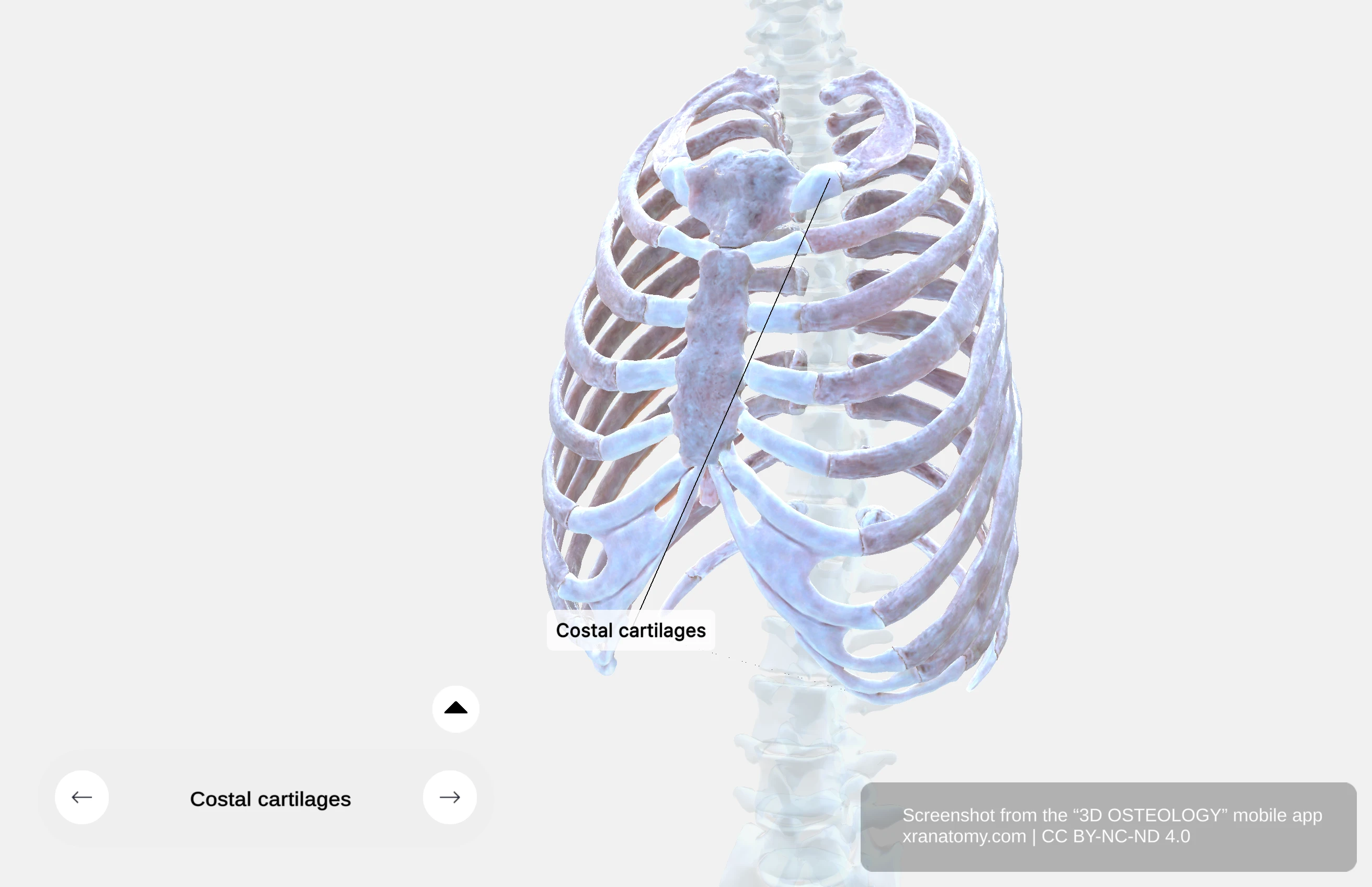
COSTAL CARTILAGES
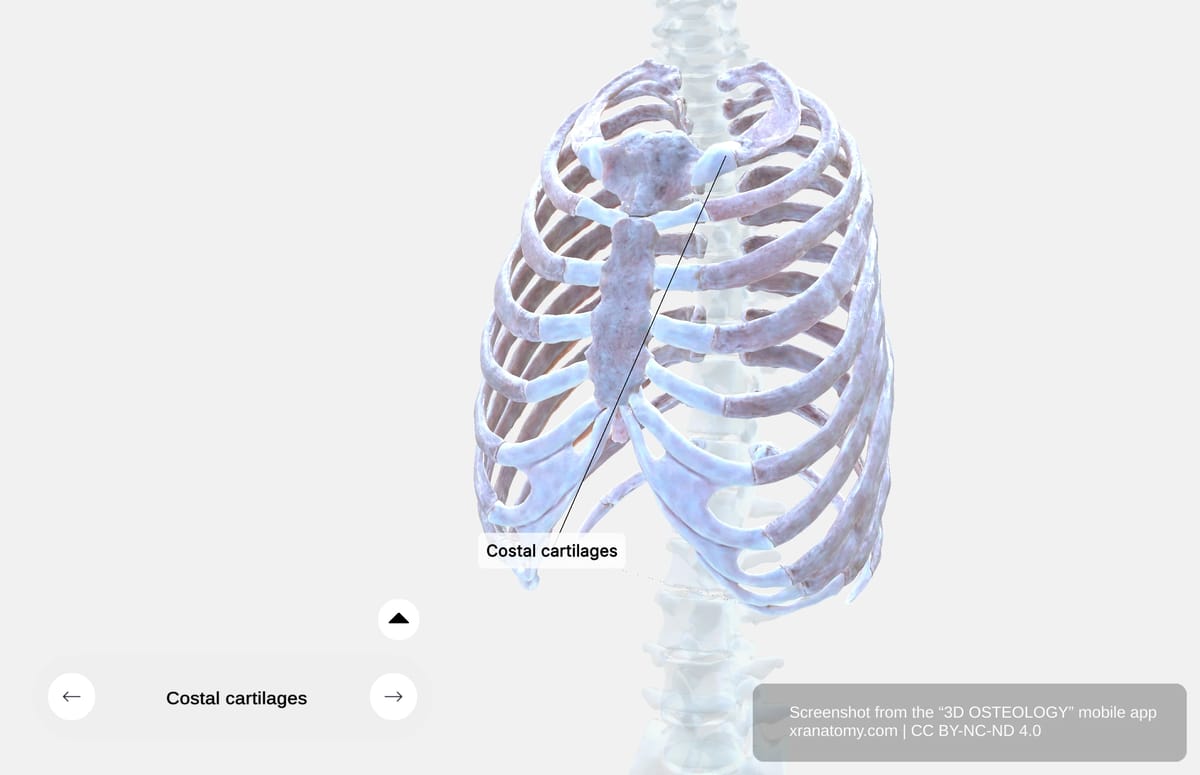
Costal cartilages are bars of hyaline cartilage that connect your ribs to the sternum or to each other. They provide flexibility to your thoracic wall, which is necessary for respiration. Each costal cartilage has distinct connections depending on the rib type, and together they enable your thoracic wall to expand during breathing.
Connections
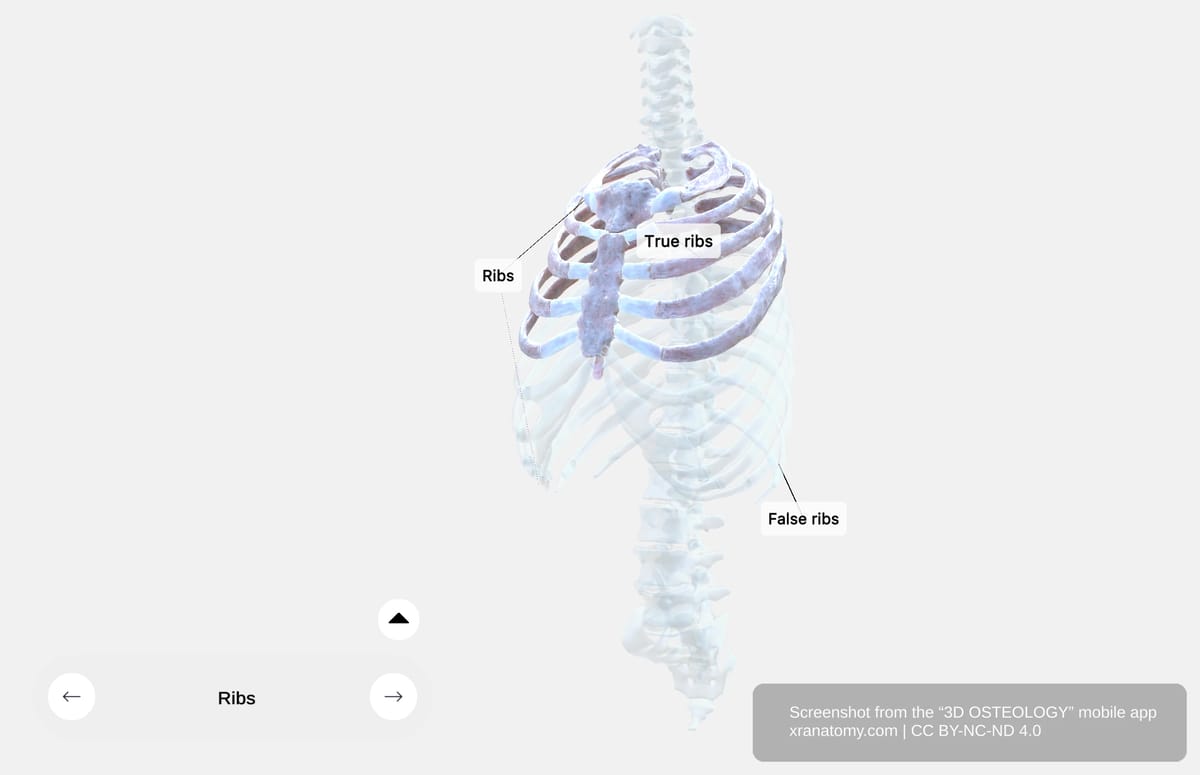
The first seven pairs of costal cartilages connect directly to the sternum. The eighth, ninth, and tenth ribs attach to the cartilage above. The eleventh and twelfth pairs (floating ribs) have pointed ends without sternum attachment.
Function
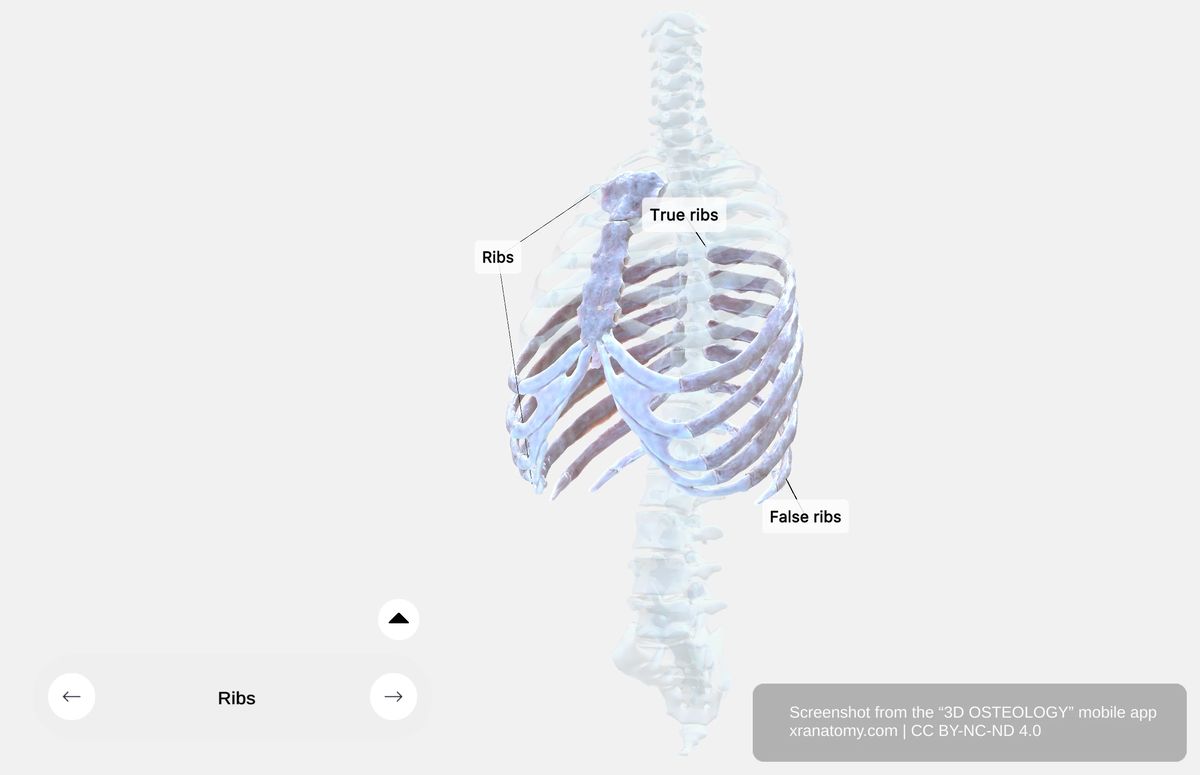
Costal cartilage provides flexibility to your thoracic wall and facilitates thoracic wall expansion during your respiration.
COSTAL ARCH
Costal Arch - False Ribs, Preview from the app. Download 3D OSTEOLOGY for full 3D control—multiple views, x-ray mode, and unlimited zoom.
The costal arch is formed by the cartilages of the seventh to tenth ribs. It curves upward and forward to meet at the xiphoid process. The arch contributes to the flexibility of your thoracic wall and accommodates your lung expansion during breathing. Its lower edge, the costal margin, forms an important clinical landmark.
Costal Margin
The costal margin is the lower edge of your costal arch. It forms the infrasternal angle at the xiphoid process and serves as an important anatomical landmark for clinical examination.
CHECK YOUR UNDERSTANDING
1. How do true ribs, false ribs, and floating ribs differ in their sternal attachment?
Reveal Answer
True ribs (1-7) attach directly to the sternum via individual costal cartilages. False ribs (8-10) attach indirectly via the cartilage of the rib above. Floating ribs (11-12) have no sternal attachment at all.
2. What are costal cartilages made of, and what is their primary function?
Reveal Answer
Costal cartilages are bars of hyaline cartilage. They provide flexibility to the thoracic wall, which is necessary for respiration.
3. Which ribs form the costal arch, and where does it meet anteriorly?
Reveal Answer
The costal arch is formed by the cartilages of the seventh to tenth ribs. It curves upward and forward to meet at the xiphoid process.
WHAT'S NEXT
Now that you understand the rib cage as a whole, the next page focuses on the Ribs. You will explore the classification of individual ribs into true, false, and floating categories, as well as the distinction between typical and atypical ribs.
Review this page again in 3 days to reinforce what you have learned.
BIBLIOGRAPHY
1. Henry G, Warren HL. Osteology. In: Anatomy of the Human Body. 20th ed. Philadelphia: Lea & Febiger; 1918. p. 129–97.
2. Standring S, editor. Gray's Anatomy: The Anatomical Basis of Clinical Practice. 41st ed. London: Elsevier; 2016.
3. Moore KL, Agur AMR, Dalley AF. Essential Clinical Anatomy. 5th ed. Philadelphia: Wolters Kluwer; 2015.