SCAPULA ANATOMY
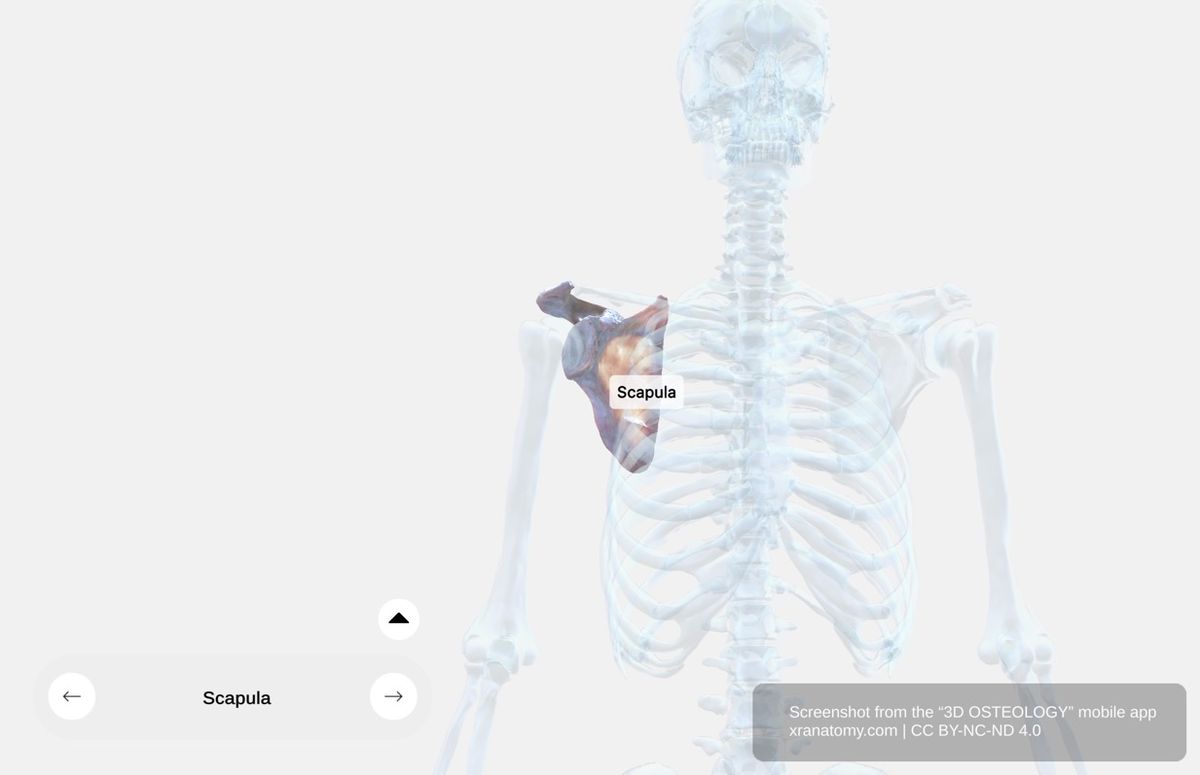
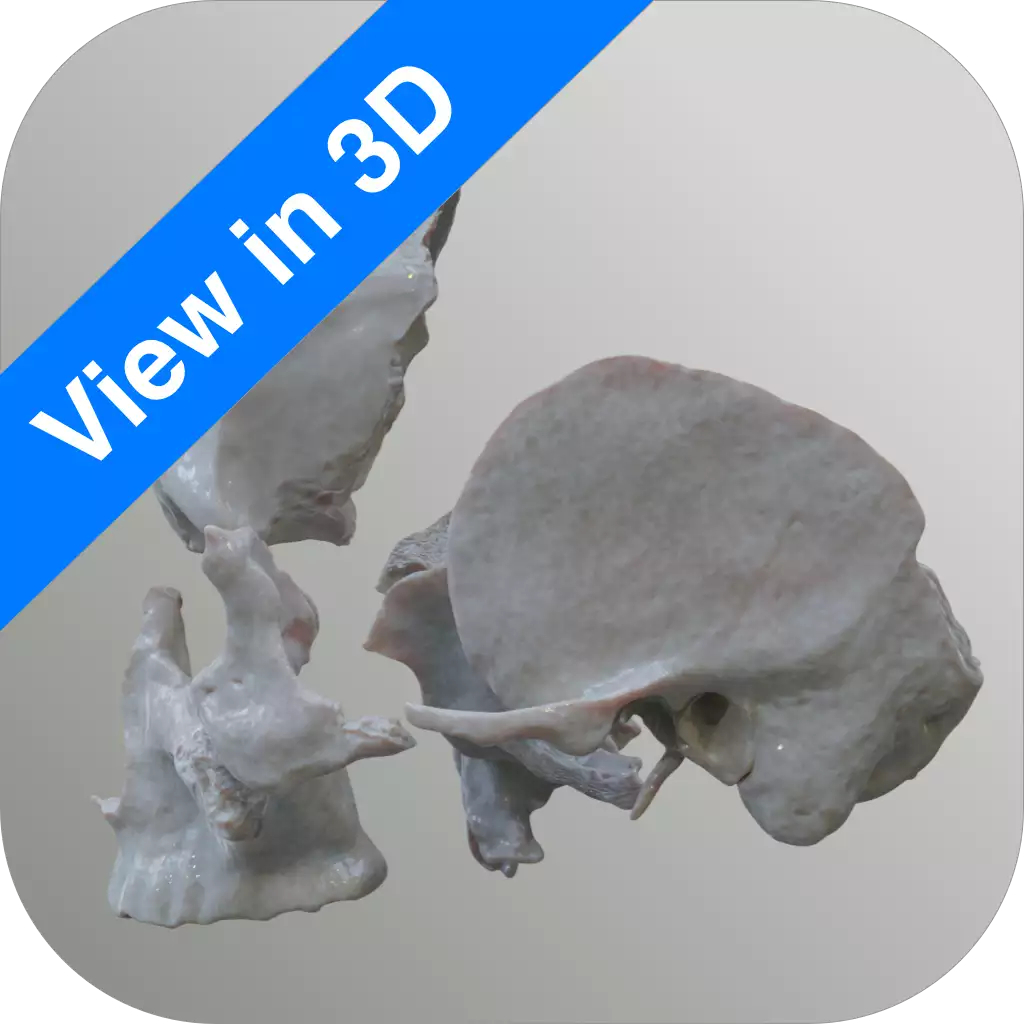
Scapula - General Overview, Preview from the app. Download 3D OSTEOLOGY for full 3D control—multiple views, x-ray mode, and unlimited zoom.
WHY THIS MATTERS
Your scapula connects your upper limb to your trunk through the shoulder girdle. Its glenoid cavity forms your shoulder joint, while the spine, acromion, and coracoid process anchor the muscles that move and stabilize your arm.
GENERAL CHARACTERISTICS
The scapula (shoulder blade) is a large, flat, triangular bone forming part of your shoulder girdle. It features two surfaces, three processes, three borders, and three angles. The lateral angle houses the glenoid cavity, which articulates with the head of your humerus. The costal surface faces your ribs, while the posterior surface features a prominent spinal ridge. The acromion extends from the spine, protruding sideways, bending forward and upward.
COSTAL SURFACE OF THE SCAPULA
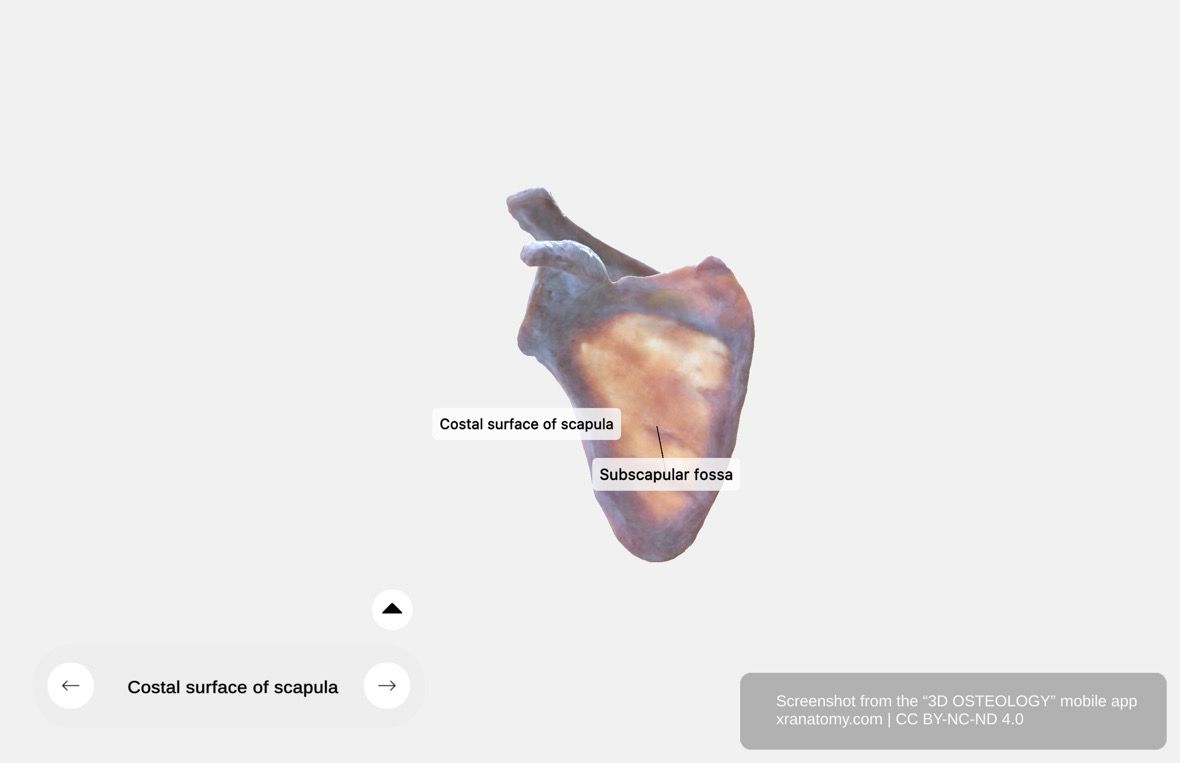
Costal Surface of the Scapula, Preview from the app. Download 3D OSTEOLOGY for full 3D control—multiple views, x-ray mode, and unlimited zoom.
The costal surface is the front surface of your scapula, facing your ribs. It accommodates and provides attachment for the Subscapularis muscle. Its main feature is the subscapular fossa, a large concave depression.
Subscapular Fossa
The subscapular fossa is a large, concave depression located on the costal (anterior) side of your scapula. It is marked by oblique ridges. The medial two-thirds are ridged, providing attachment for the Subscapularis muscle. The lateral one-third is smooth and sits in contact with the muscle.
POSTERIOR SURFACE OF THE SCAPULA (DORSAL SURFACE)
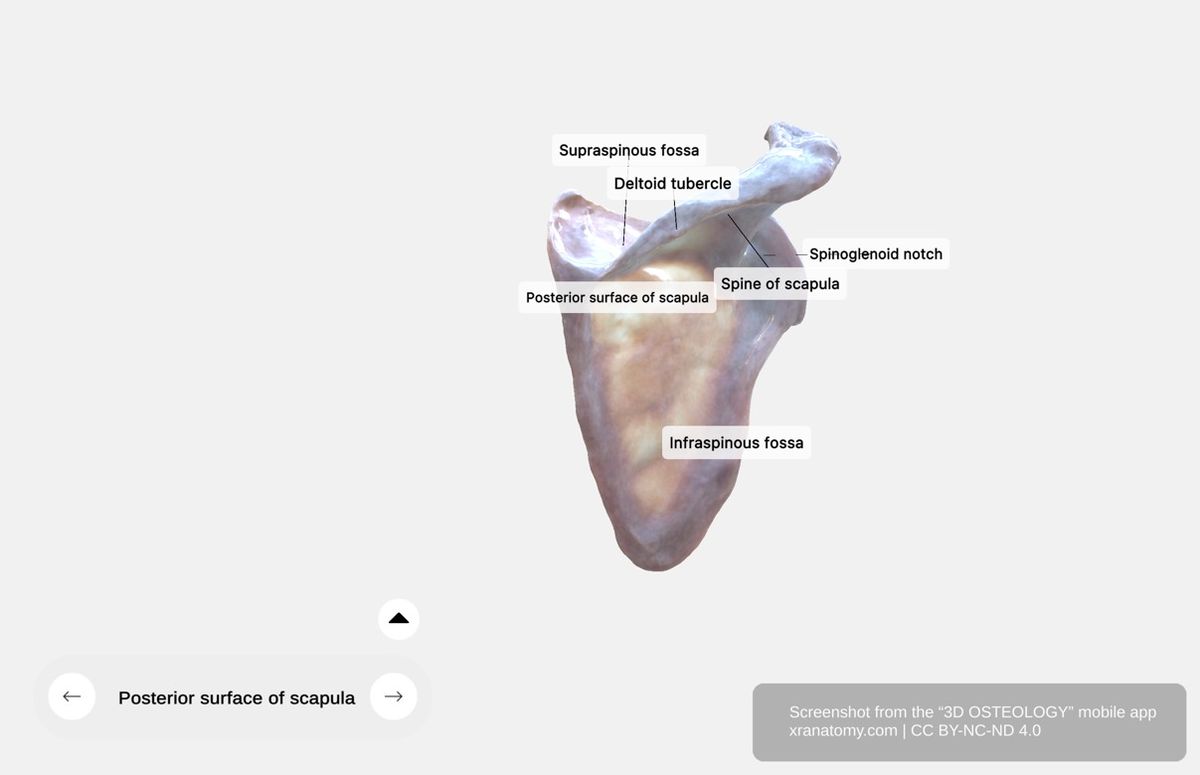
Posterior Surface of the Scapula, Preview from the app. Download 3D OSTEOLOGY for full 3D control—multiple views, x-ray mode, and unlimited zoom.
The posterior surface is arched and divided by the spine into two regions: the supraspinous fossa above and the infraspinous fossa below. Key features include the spine of the scapula, the deltoid tubercle, and the spinoglenoid notch, along with multiple muscle attachment points.
Spine of the Scapula
The spine of the scapula is a prominent, triangular plate running obliquely across the dorsal surface. It divides your scapula into the supraspinous and infraspinous fossae. At its lateral end, the spine elevates and forms the acromion.
Deltoid Tubercle
The deltoid tubercle sits on the medial portion of the superior lip of the posterior border of the spine. It serves as an attachment point for your lower Trapezius and Deltoideus muscles.
Spinoglenoid Notch
The spinoglenoid notch is located at the lateral border or base of the spine. It serves as a passageway between the supraspinous and infraspinous fossae.
Supraspinous Fossa
The supraspinous fossa is located above the spine on the dorsal surface. It is smooth and concave and gives origin to your Supraspinatus muscle.
Infraspinous Fossa
The infraspinous fossa is located below the spine on the dorsal surface. It is larger and more extensive than the supraspinous fossa and gives origin to your Infraspinatus muscle.
BORDERS OF THE SCAPULA
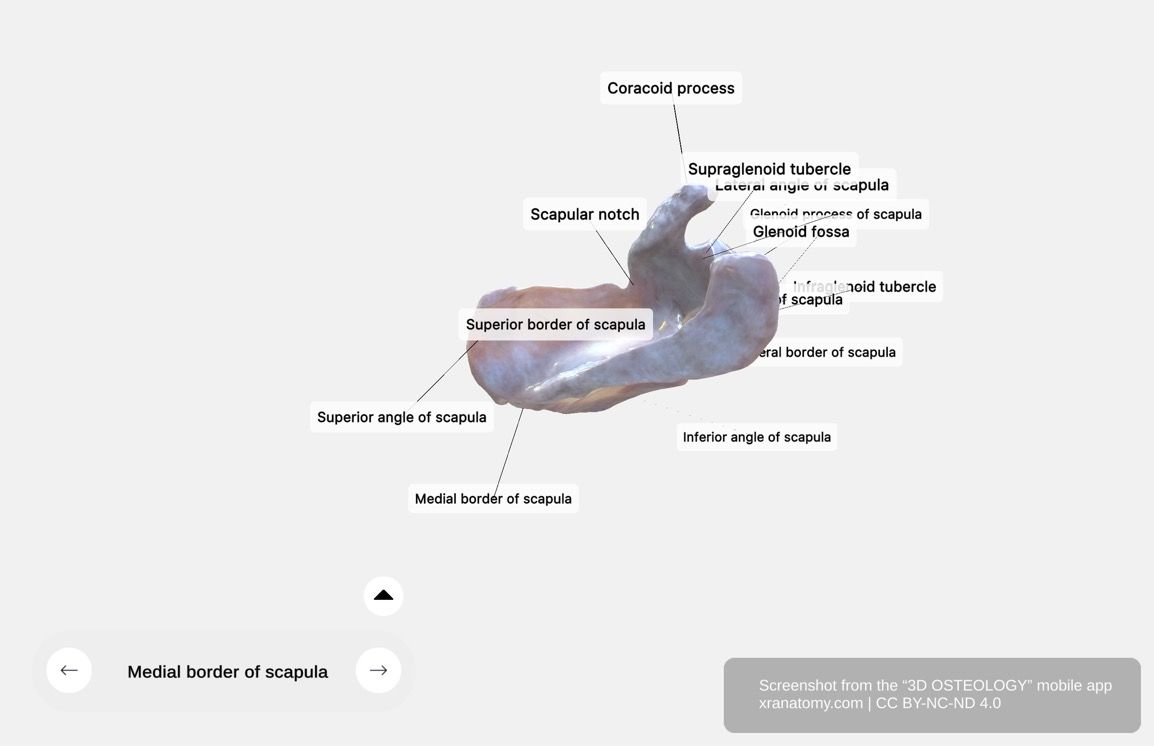
Borders and Angles of the Scapula, Preview from the app. Download 3D OSTEOLOGY for full 3D control—multiple views, x-ray mode, and unlimited zoom.
Your scapula has three borders: the medial (vertebral) border, the superior border, and the lateral (axillary) border. At the lateral aspect, you will also find important features including the glenoid cavity, the coracoid process, the supraglenoid tubercle, the infraglenoid tubercle, and the neck of the scapula.
Medial (Vertebral) Border
The medial border is the longest edge of your scapula, extending from the medial to the inferior angle. Above the spine, it forms an obtuse angle with the portion below. It provides insertion for various muscles.
Superior Border
The superior border is the shortest and thinnest of the three borders. It is concave, extending from the medial angle to the base of the coracoid process. It includes the scapular notch at its lateral part.
The scapular notch is located along the superior border and is partly formed by the base of the coracoid process. It becomes a foramen when bridged by a ligament for nerve passage.
Lateral (Axillary) Border
The lateral border is the thickest part of the bone. It runs from the lower margin of the glenoid cavity to the inferior angle and provides origin for muscles.
Lateral Features of the Scapula
Glenoid Cavity
The glenoid cavity sits at the lateral angle of your scapula. It is a shallow cavity, wider at the bottom, and rimmed by fibrocartilage (glenoid labrum) for joint stabilization. It articulates with the head of your humerus, forming the shoulder joint.
Coracoid Process
The coracoid process is a hook-like projection that starts broad and curves up and forward. It is located above the glenoid cavity and serves as an attachment point for various muscles and ligaments.
Supraglenoid Tubercle
The supraglenoid tubercle is located at the apex of the glenoid cavity. It serves as the origin point for the long head of your Biceps brachii muscle.
Infraglenoid Tubercle
The infraglenoid tubercle is located below the glenoid cavity and measures about 2.5 cm in length. It serves as the origin point for the long head of your Triceps brachii muscle.
Neck of the Scapula
The neck of the scapula lies between the body and the head of the bone. It corresponds with the scapular notch above and the upper end of the infraglenoid tubercle below.
ANGLES OF THE SCAPULA
Your scapula has three angles: the superior angle, the inferior angle, and the lateral angle (also called the head of the scapula).
Superior Angle
The superior angle is located at the junction of the superior and medial borders. It is thin and smooth and provides attachment to a few muscle fibers.
Inferior Angle
The inferior angle is located at the junction of the vertebral and axillary borders. It is thick and rough and serves as an origin point for muscles.
Lateral Angle (Head of the Scapula)
The lateral angle is the thickest part of the bone. It supports the coracoid process and contains the glenoid cavity. It articulates with the head of your humerus.
CHECK YOUR UNDERSTANDING
1. What two fossae does the spine of the scapula divide on the posterior surface?
Reveal Answer
The supraspinous fossa (above the spine) and the infraspinous fossa (below the spine).
2. Which border of the scapula is the longest, and which is the shortest?
Reveal Answer
The medial (vertebral) border is the longest edge, while the superior border is the shortest and thinnest.
3. What structure at the lateral angle of the scapula articulates with the head of the humerus?
Reveal Answer
The glenoid cavity, a shallow cavity rimmed by fibrocartilage (glenoid labrum) for joint stabilization, forming the shoulder joint.
WHAT'S NEXT
Next, you will study the Clavicle, a slender S-shaped bone that connects your sternum to your scapula. You will explore its sternal end, body, acromial end, conoid tubercle, and trapezoid line.
Review this page again in 3 days to reinforce what you have learned.
BIBLIOGRAPHY
1. Henry G, Warren HL. Osteology. In: Anatomy of the Human Body. 20th ed. Philadelphia: Lea & Febiger; 1918. p. 129–97.
2. Standring S, editor. Gray's Anatomy: The Anatomical Basis of Clinical Practice. 41st ed. London: Elsevier; 2016.
3. Moore KL, Agur AMR, Dalley AF. Essential Clinical Anatomy. 5th ed. Philadelphia: Wolters Kluwer; 2015.