RADIUS ANATOMY
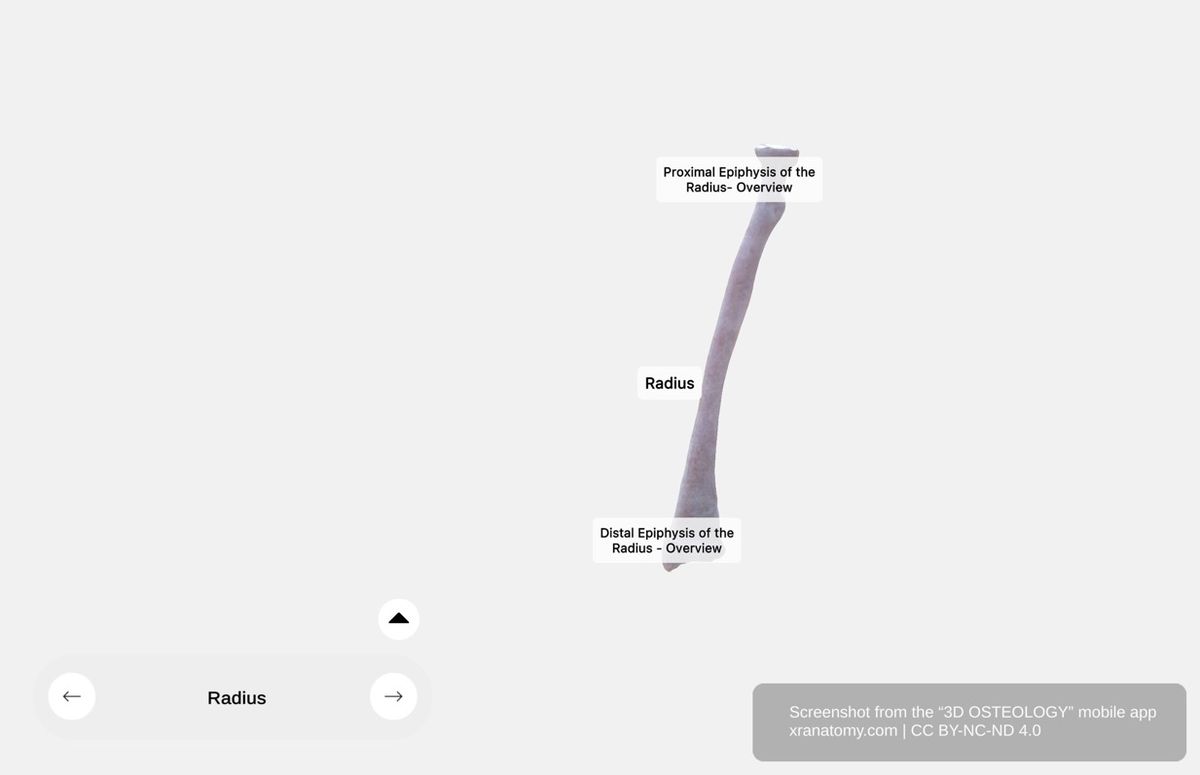
Radius - General Structure, Preview from the app. Download 3D OSTEOLOGY for full 3D control—multiple views, x-ray mode, and unlimited zoom.
WHY THIS MATTERS
The radius is the lateral bone of your forearm and plays a central role in both your elbow and wrist joints. Its disc-shaped head allows smooth pronation and supination, while the broader distal end forms the major part of your wrist joint, connecting with the scaphoid and lunate. Understanding the radius helps you see how your forearm rotates and how your hand connects to your arm.
GENERAL CHARACTERISTICS
What Is the Radius
The radius sits on the thumb side of your forearm (the lateral side). It is classified as a long bone with a prism-like shape and features a gentle curve along its length. You can divide it into three main sections: the body (shaft), the proximal epiphysis (upper end), and the distal epiphysis (lower end).
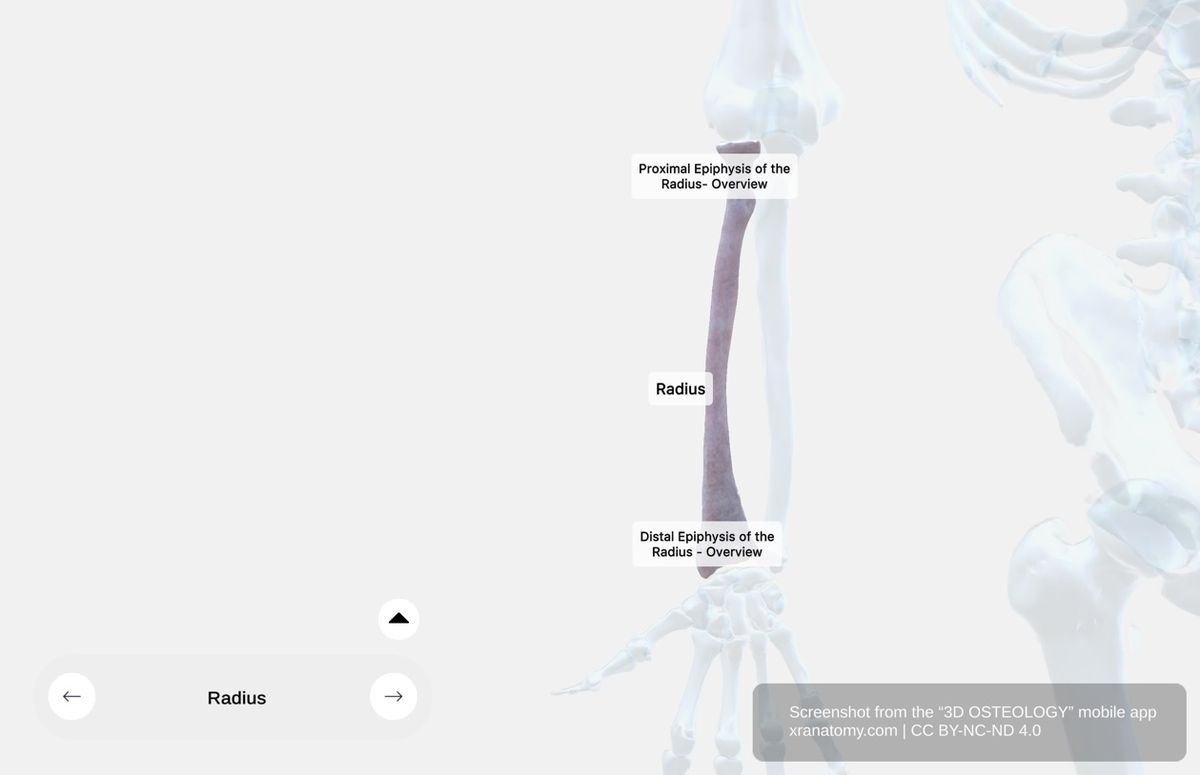
Radius - X-Ray View, Preview from the app. Download 3D OSTEOLOGY for full 3D control—multiple views, x-ray mode, and unlimited zoom.
PROXIMAL EPIPHYSIS (UPPER END)
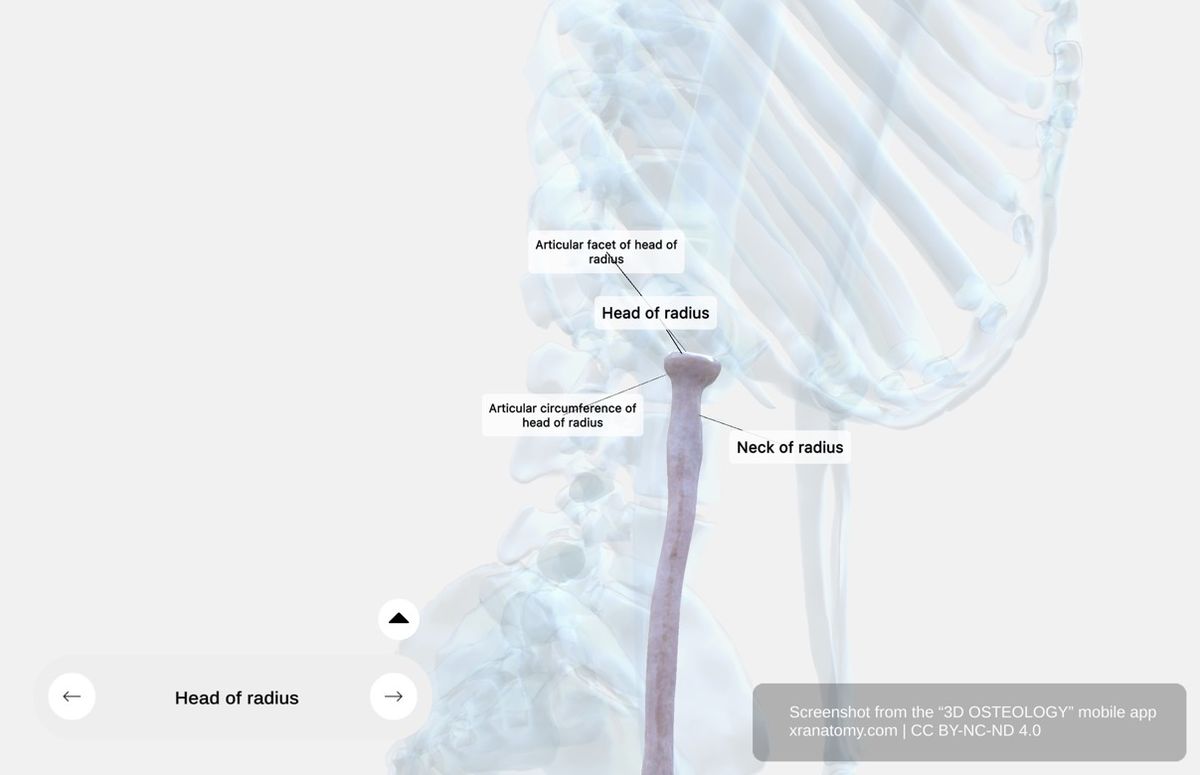
Proximal Epiphysis of the Radius, Preview from the app. Download 3D OSTEOLOGY for full 3D control—multiple views, x-ray mode, and unlimited zoom.
The proximal end is relatively small, contributing minimally to your elbow joint structure. Despite its size, it plays a functional role in elbow joint formation. It features the head of the radius with its articular facet and articular circumference, plus the neck of the radius supporting the head below.
Head of the Radius
The head of the radius is disc-shaped. It articulates with the capitulum of the humerus and the radial notch of the ulna. The annular ligament encircles the head for stability and allows smooth movements of your forearm during pronation and supination.
Articular Facet of the Head
The articular facet sits on the proximal surface of the head. It is a shallow, cup-like depression that articulates with the capitulum of the humerus, aiding your elbow joint movement.
Articular Circumference of the Head
The articular circumference is the smooth, circular boundary of the head. It is wider on the medial side. This surface articulates with the radial notch of the ulna and is supported by the annular ligament, ensuring rotational stability of your forearm.
Neck of the Radius
The neck of the radius is a narrow, smooth, and slightly constricted portion below the head. It supports the head of the radius and provides structural integrity and flexibility for your forearm movements.
BODY OF THE RADIUS
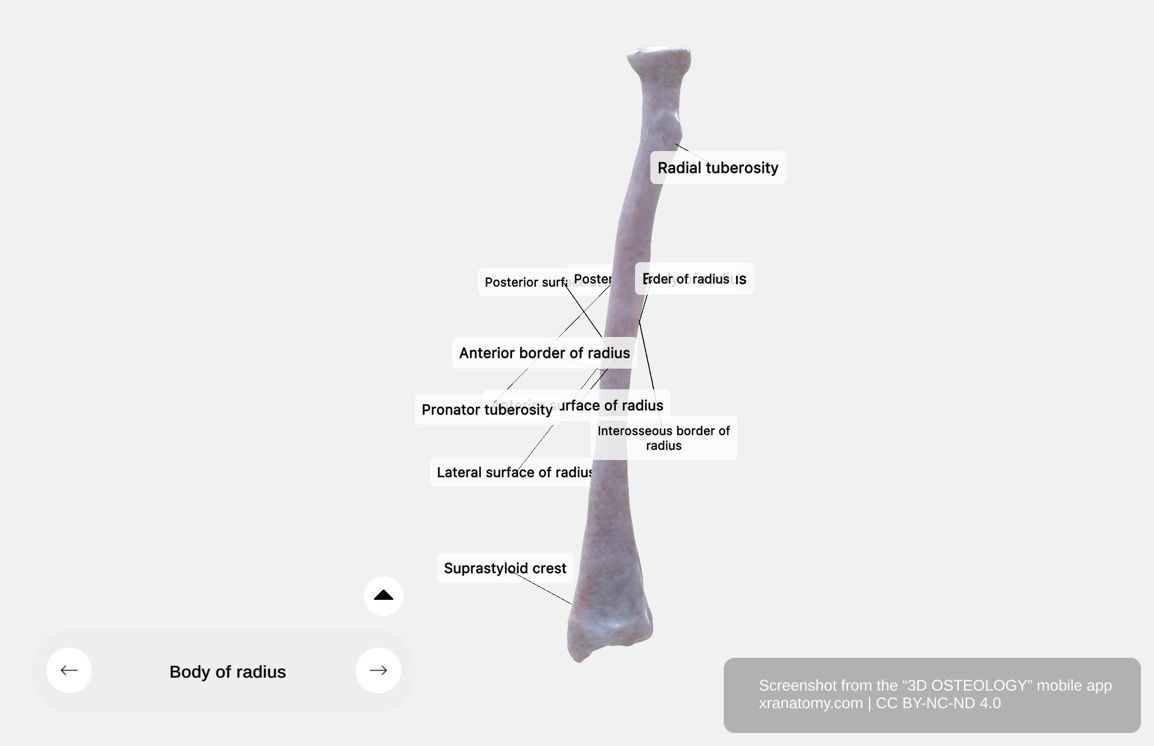
Body of the Radius, Preview from the app. Download 3D OSTEOLOGY for full 3D control—multiple views, x-ray mode, and unlimited zoom.
The body has a prismoid shape, tapering from a narrower upper end to a broader lower end. It features a slight outward curve creating lateral convexity and provides both structural strength and flexibility for your forearm movements. Key landmarks include the radial tuberosity, three surfaces (anterior, posterior, and lateral), three borders (interosseous, posterior, and anterior), and additional features such as the pronator tuberosity and suprastyloid crest.
Radial Tuberosity
The radial tuberosity sits just below the neck on the medial side. Its posterior surface is rough, providing attachment for the Biceps brachii tendon. Its anterior surface is smooth and accommodates a bursa to reduce friction. The tuberosity serves as the attachment site for the Biceps brachii tendon.
Surfaces of the Body
Anterior Surface
The anterior surface is gently concave along most of its length and flattens and broadens near the distal quarter. It provides origin for the Flexor pollicis longus muscle and serves as an attachment site for the Pronator quadratus muscle, aiding your forearm rotation.
Posterior Surface
The posterior surface has a convex and smooth upper third, while the middle third becomes more defined, aiding in muscle and tendon passage. It anchors muscle attachments.
Lateral Surface
The lateral surface has a convex shape. Its upper portion serves as the insertion point for the Supinator muscle, while the middle section features a rough ridge for additional muscle attachments.
Borders of the Body
Interosseous Border
The interosseous border runs along the medial edge of the radius. It divides the anterior (volar) and posterior (dorsal) surfaces and provides strong attachment for the interosseous membrane, stabilizing your forearm.
Posterior Border
The posterior border is a defined ridge along the middle portion. It separates the dorsal surface from the lateral surface and serves as a guide for muscle and ligament attachments.
Anterior Border
The anterior border is a sharp ridge extending from the radial tuberosity to the styloid process. It separates the anterior and lateral surfaces and serves as an attachment site for muscles and tendons.
Additional Features
Pronator Tuberosity
The pronator tuberosity is a raised area for the attachment of the Pronator teres muscle. It facilitates your forearm rotation during pronation.
Suprastyloid Crest
The suprastyloid crest is a small ridge above the styloid process. It serves as an attachment site for ligaments, stabilizing your wrist joint.
DISTAL EPIPHYSIS (LOWER END)
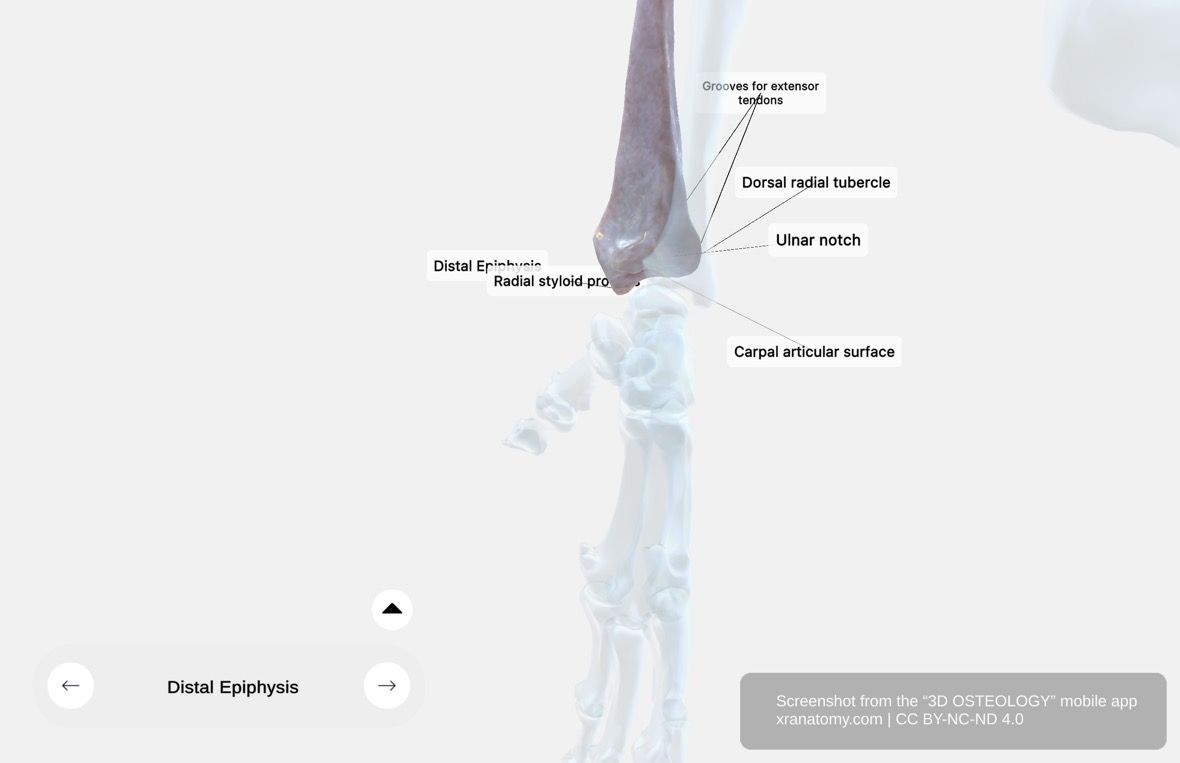
Distal Epiphysis of the Radius, Preview from the app. Download 3D OSTEOLOGY for full 3D control—multiple views, x-ray mode, and unlimited zoom.
The distal end is broader and more substantial than the proximal end and plays a crucial role in forming your wrist joint. It connects with the carpal bones, the scaphoid and lunate, to enable your wrist movements: flexion, extension, radial deviation, and ulnar deviation. Key structures here include the radial styloid process, dorsal radial tubercle, grooves for extensor tendons, ulnar notch, and the carpal articular surface.
Radial Styloid Process
The radial styloid process is a prominent conical projection on the lateral surface. It provides an attachment point for a muscle and ligament and supports wrist stability and your hand movements.
Dorsal Radial Tubercle
The dorsal radial tubercle sits on the back surface of the radius. It is characterized by three grooves for tendon guidance. The second groove is deep and narrow, bordered by a sharp ridge, guiding the tendon for your thumb extension. Overall, it facilitates tendon movement for hand and thumb extension.
Grooves for Extensor Tendons
The grooves for extensor tendons sit on the dorsal surface of the radius. The first groove is broad and shallow. The second groove is deep and narrow. The third groove channels tendons aiding in your finger extension. Together, they guide tendons for hand and finger extension.
Ulnar Notch
The ulnar notch is a concave depression on the medial side. It articulates with the head of the ulna and forms part of the distal radioulnar joint. This joint allows rotational movements like pronation and supination.
Carpal Articular Surface
The carpal articular surface is a triangular, smooth surface at the distal end. It is divided into two areas: one articulates with the scaphoid, and the other articulates with the lunate. This surface ensures smooth wrist motion during your hand movements.
CHECK YOUR UNDERSTANDING
1. What are the three main sections of the radius?
Reveal Answer
The body (shaft), the proximal epiphysis (upper end), and the distal epiphysis (lower end).
2. What attaches to the radial tuberosity, and how do its two surfaces differ?
Reveal Answer
The Biceps brachii tendon attaches to the radial tuberosity. The posterior surface is rough for tendon attachment, while the anterior surface is smooth and accommodates a bursa to reduce friction.
3. Name the two carpal bones that articulate with the carpal articular surface of the radius.
Reveal Answer
The scaphoid and the lunate.
WHAT'S NEXT
Now that you understand the radius, move on to the Bones of the Hand. You will explore all 27 bones of the hand, including the 8 carpal bones, 5 metacarpals, and 14 phalanges, along with sesamoid bones.
Review this page again in 3 days to reinforce what you have learned.
BIBLIOGRAPHY
1. Henry G, Warren HL. Osteology. In: Anatomy of the Human Body. 20th ed. Philadelphia: Lea & Febiger; 1918. p. 129–97.
2. Standring S, editor. Gray's Anatomy: The Anatomical Basis of Clinical Practice. 41st ed. London: Elsevier; 2016.
3. Moore KL, Agur AMR, Dalley AF. Essential Clinical Anatomy. 5th ed. Philadelphia: Wolters Kluwer; 2015.