ULNA ANATOMY
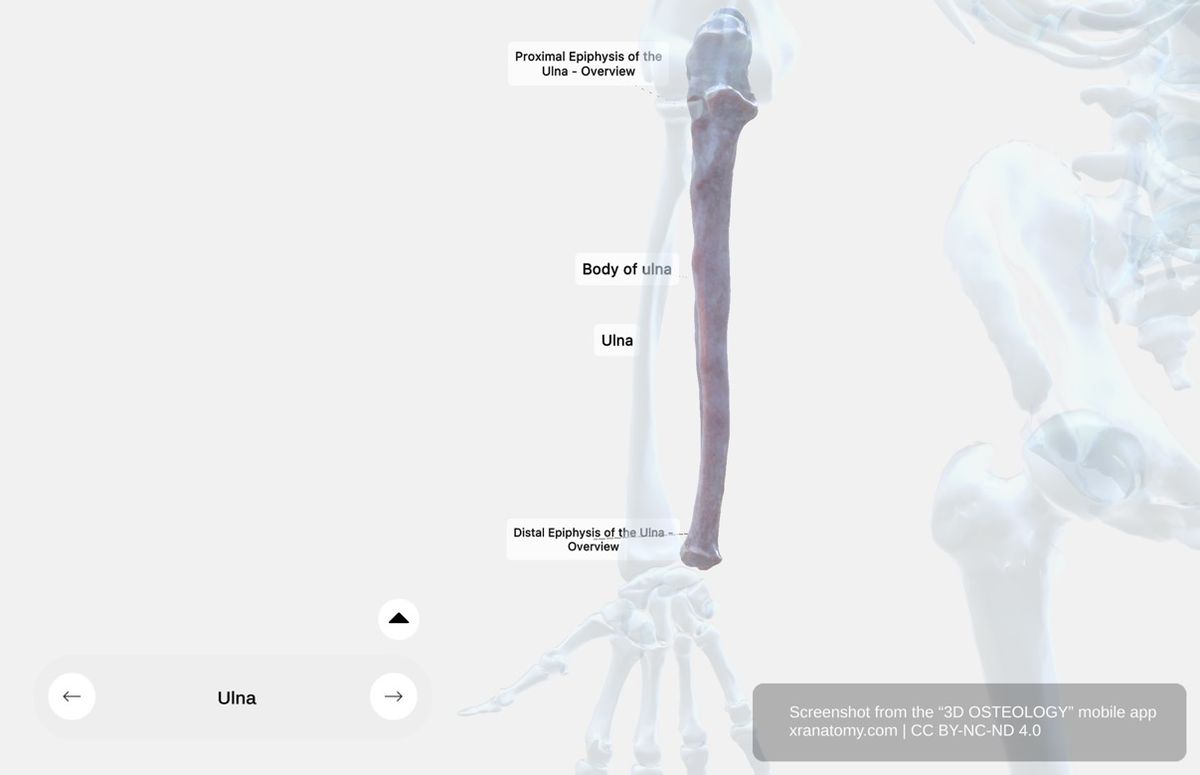
Ulna - X-ray View, Preview from the app. Download 3D OSTEOLOGY for full 3D control—multiple views, x-ray mode, and unlimited zoom.
WHY THIS MATTERS
The ulna is the medial bone of your forearm and plays a crucial role in forming your elbow joint. Its proximal end contains the olecranon and coronoid process that create the hinge mechanism for flexion and extension, while its distal end contributes to wrist stability and works with the radius to enable rotational movements of your forearm.
GENERAL CHARACTERISTICS
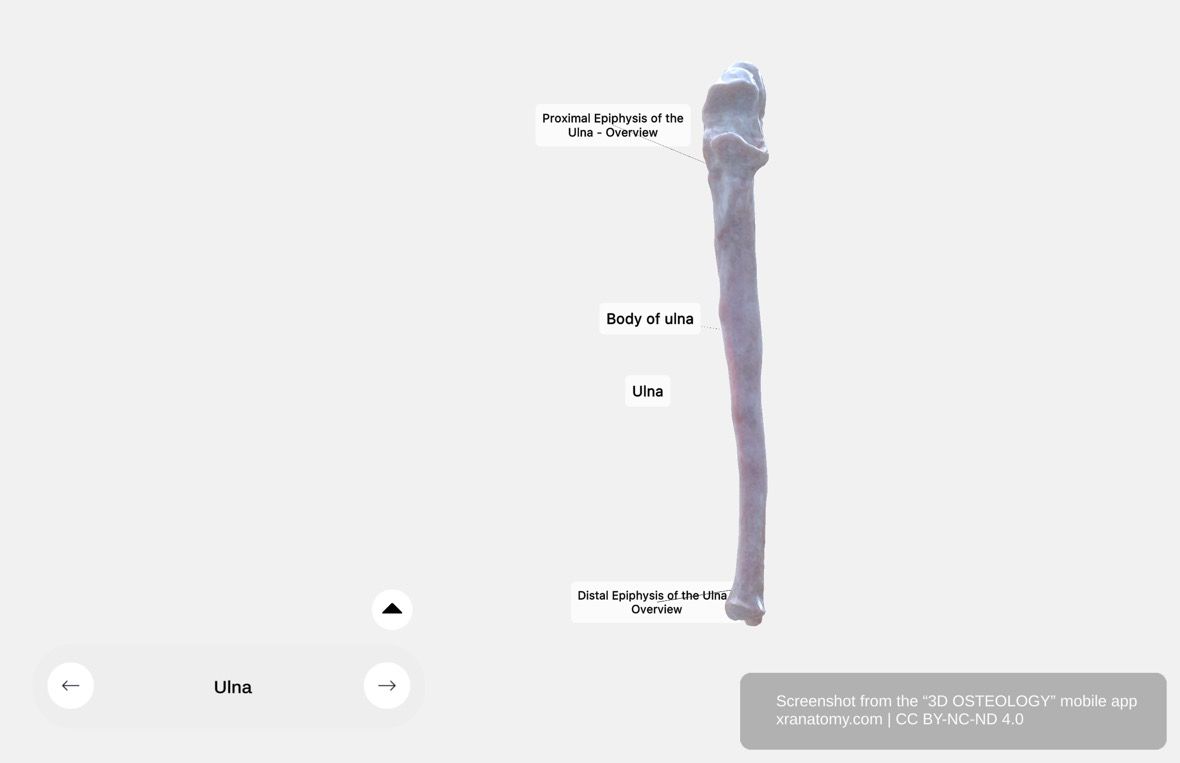
Ulna - General Overview, Preview from the app. Download 3D OSTEOLOGY for full 3D control—multiple views, x-ray mode, and unlimited zoom.
The ulna is the medial bone of your forearm, located opposite your thumb side. It plays a crucial role in forming your elbow joint at its upper end. The ulna stabilizes your forearm and wrist, and works with the radius to enable rotational movements.
The ulna is divided into three main sections: the body (shaft), the proximal epiphysis (upper end), and the distal epiphysis (lower end).
BODY OF THE ULNA
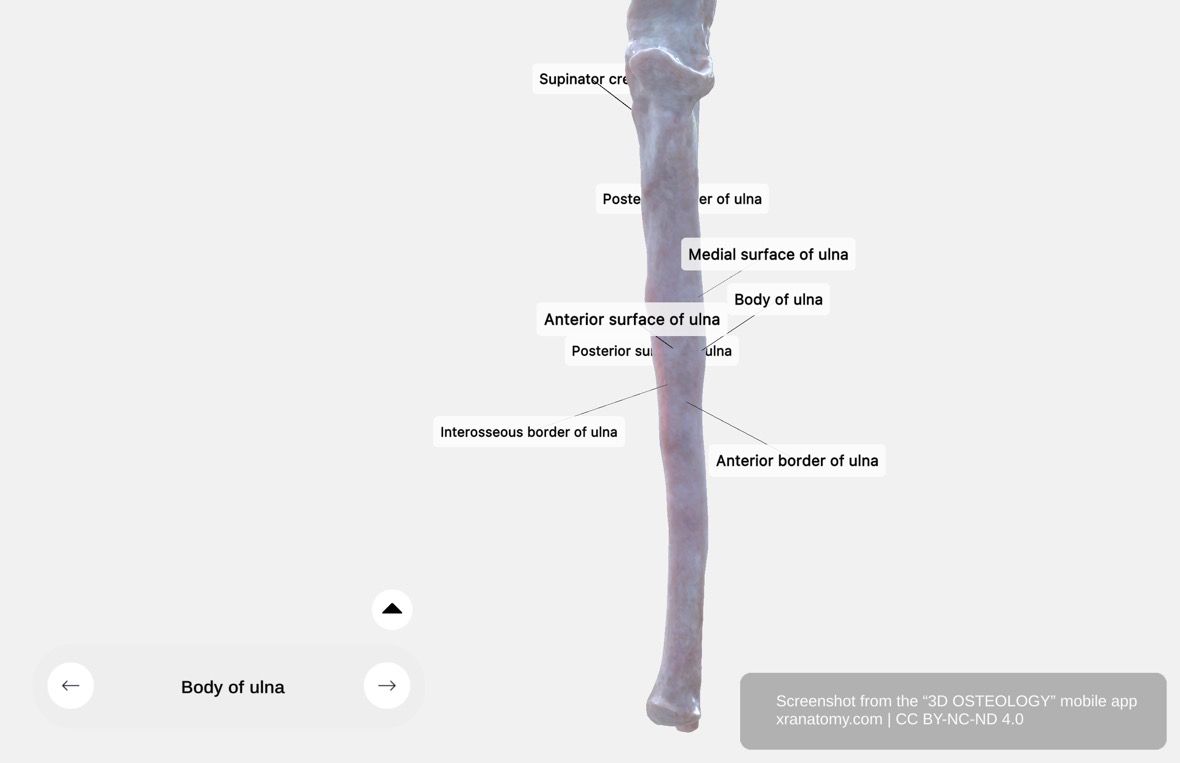
Body of the Ulna, Preview from the app. Download 3D OSTEOLOGY for full 3D control—multiple views, x-ray mode, and unlimited zoom.
The body of the ulna features several key surfaces and borders. The supinator crest runs obliquely along the posterior surface. The anterior surface provides origin for flexor muscles, while the interosseous border connects the ulna to the radius via membrane. The posterior surface and posterior border serve as landmarks and muscle attachment sites. The medial surface gives origin to additional flexor muscles, and the anterior border separates the volar surface from the medial surface.
Overview
The body of the ulna has a prismoid shape, tapering from a thicker upper end to a thinner lower end. It features three borders and three surfaces. The shaft curves dorsalwards and lateralwards, transitioning from prismoid at the proximal end to more rounded distally. This shape provides strength and support while maintaining flexibility for your forearm movements.
Supinator Crest
The supinator crest sits on the posterior surface of the ulna. It runs as an oblique ridge from the dorsal end of the radial notch to the dorsal border. The upper portion provides attachment for the Supinator muscle, while the triangular area above it gives insertion for the Anconeus muscle.
Anterior Surface (Volar Surface)
The anterior surface is primarily concave in its upper three-quarters and becomes broader and flatter in the lower one-fourth. The upper portion gives origin to the Flexor digitorum profundus muscle. The lower portion provides attachment for the Pronator quadratus muscle, which contributes to your forearm rotation.
Interosseous Border (Lateral Border)
The interosseous border separates the volar and dorsal surfaces of the ulna. It originates at the apex of the radial notch. This border provides attachment for the antibrachial interosseous membrane, connecting the ulna to the radius. A triangular area along it contributes to the origin of the Supinator muscle.
Posterior Surface (Dorsal Surface)
The posterior surface is broad and convex in the upper region and tapers to become narrower toward the lower part. An oblique ridge on this surface provides attachment for the Supinator muscle. The triangular surface above the ridge gives insertion for the Anconeus muscle.
Posterior Border (Dorsal Border)
The posterior border is well-marked in the middle one-third of the bone. It forms the boundary between the posterior and medial surfaces and serves as a key anatomical landmark.
Medial Surface
The medial surface is broad and concave in the upper three-quarters and becomes narrower and more convex in the lower one-fourth, where it is subcutaneous. The upper portion provides origin for the Flexor digitorum profundus muscle.
Anterior Border
The anterior border separates the volar surface from the medial surface. It starts at the medial angle of the coronoid process and ends in front of the styloid process.
PROXIMAL EPIPHYSIS (UPPER END)
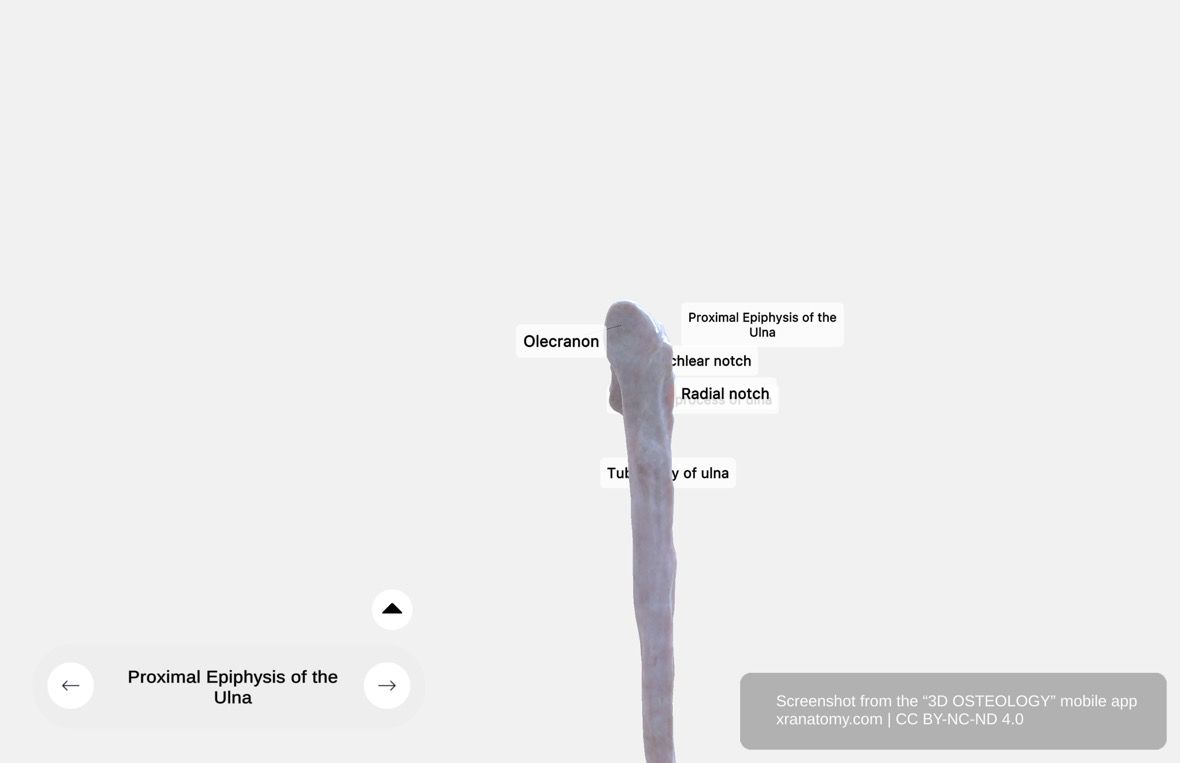
Proximal Epiphysis of the Ulna, Preview from the app. Download 3D OSTEOLOGY for full 3D control—multiple views, x-ray mode, and unlimited zoom.
The proximal end of the ulna is broader than the distal end and contains the key structures that form the hinge mechanism of your elbow joint. These include the olecranon, coronoid process, ulnar tuberosity, radial notch, and trochlear notch.
Olecranon
The olecranon is a robust, curved, beak-like formation located at the upper and dorsal region of the ulna. It fits into the olecranon fossa of the humerus and allows extension of your forearm during movement.
Coronoid Process
The coronoid process is a pyramidal projection at the upper end of the ulna. It fits into the coronoid fossa of the humerus during your forearm flexion. This structure is essential for elbow flexion and joint stability during motion.
Ulnar Tuberosity
The ulnar tuberosity is a rough prominence on the anterior surface near your elbow. It serves as the attachment point for the Brachialis muscle and plays a critical role in your elbow flexion.
Radial Notch
The radial notch is a narrow, elongated depression along the lateral aspect of the ulna. It articulates with the head of the radius and enables the rotational movements of pronation and supination in your forearm.
Trochlear Notch
The trochlear notch is a deep concavity formed by the olecranon and coronoid process. It articulates with the trochlea of the humerus and allows your elbow to function as a hinge joint for flexion and extension.
DISTAL EPIPHYSIS (LOWER END)
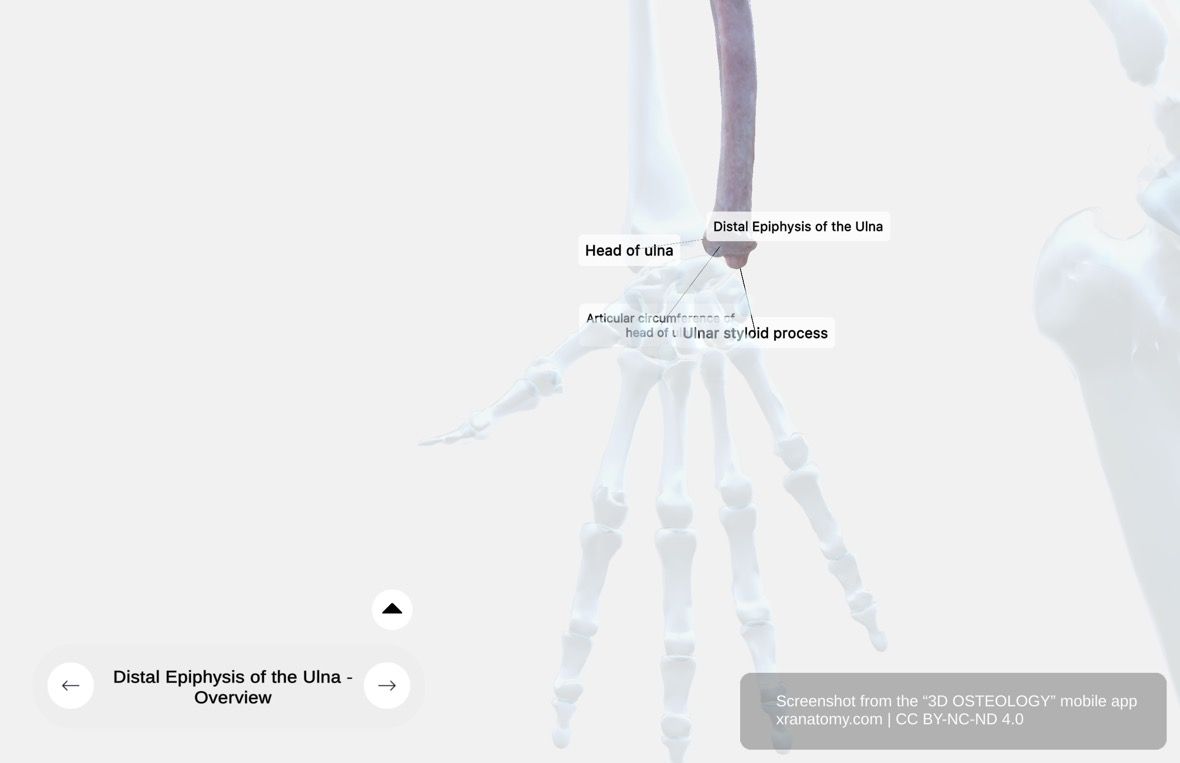
Distal Epiphysis of the Ulna, Preview from the app. Download 3D OSTEOLOGY for full 3D control—multiple views, x-ray mode, and unlimited zoom.
The distal end of the ulna is smaller than the proximal end and includes structures for your wrist stability and forearm rotation. Its key features are the head of the ulna, the articular circumference, and the ulnar styloid process.
Head of the Ulna
The head of the ulna is a prominent lateral protrusion at the lower extremity of the bone. It articulates with the radius at the distal radioulnar joint and provides stability for smooth forearm movement.
Articular Circumference of the Head
The articular circumference is a smooth surface that fits into the ulnar notch of the radius. It facilitates articulation between the ulna and radius and enables the rotational movements of pronation and supination.
Ulnar Styloid Process
The ulnar styloid process is a slender, protruding structure at the distal end of the ulna. It serves as an attachment site for ligaments and plays a key role in maintaining your wrist joint stability.
CHECK YOUR UNDERSTANDING
1. What are the three main sections of the ulna?
Reveal Answer
The body (shaft), the proximal epiphysis (upper end), and the distal epiphysis (lower end).
2. Name the five key structures of the proximal ulna that form the hinge mechanism of your elbow joint.
Reveal Answer
The olecranon, coronoid process, ulnar tuberosity, radial notch, and trochlear notch.
3. Which structure of the distal ulna articulates with the radius at the distal radioulnar joint?
Reveal Answer
The head of the ulna, a prominent lateral protrusion at the lower extremity of the bone.
WHAT'S NEXT
Now that you understand the ulna, the next page covers the Radius. You will explore the lateral forearm bone, including its disc-shaped head, radial tuberosity, and styloid process that forms the major part of your wrist joint.
Review this page again in 3 days to reinforce what you have learned.
BIBLIOGRAPHY
1. Henry G, Warren HL. Osteology. In: Anatomy of the Human Body. 20th ed. Philadelphia: Lea & Febiger; 1918. p. 129–97.
2. Standring S, editor. Gray's Anatomy: The Anatomical Basis of Clinical Practice. 41st ed. London: Elsevier; 2016.
3. Moore KL, Agur AMR, Dalley AF. Essential Clinical Anatomy. 5th ed. Philadelphia: Wolters Kluwer; 2015.