Anatomy
First Rib
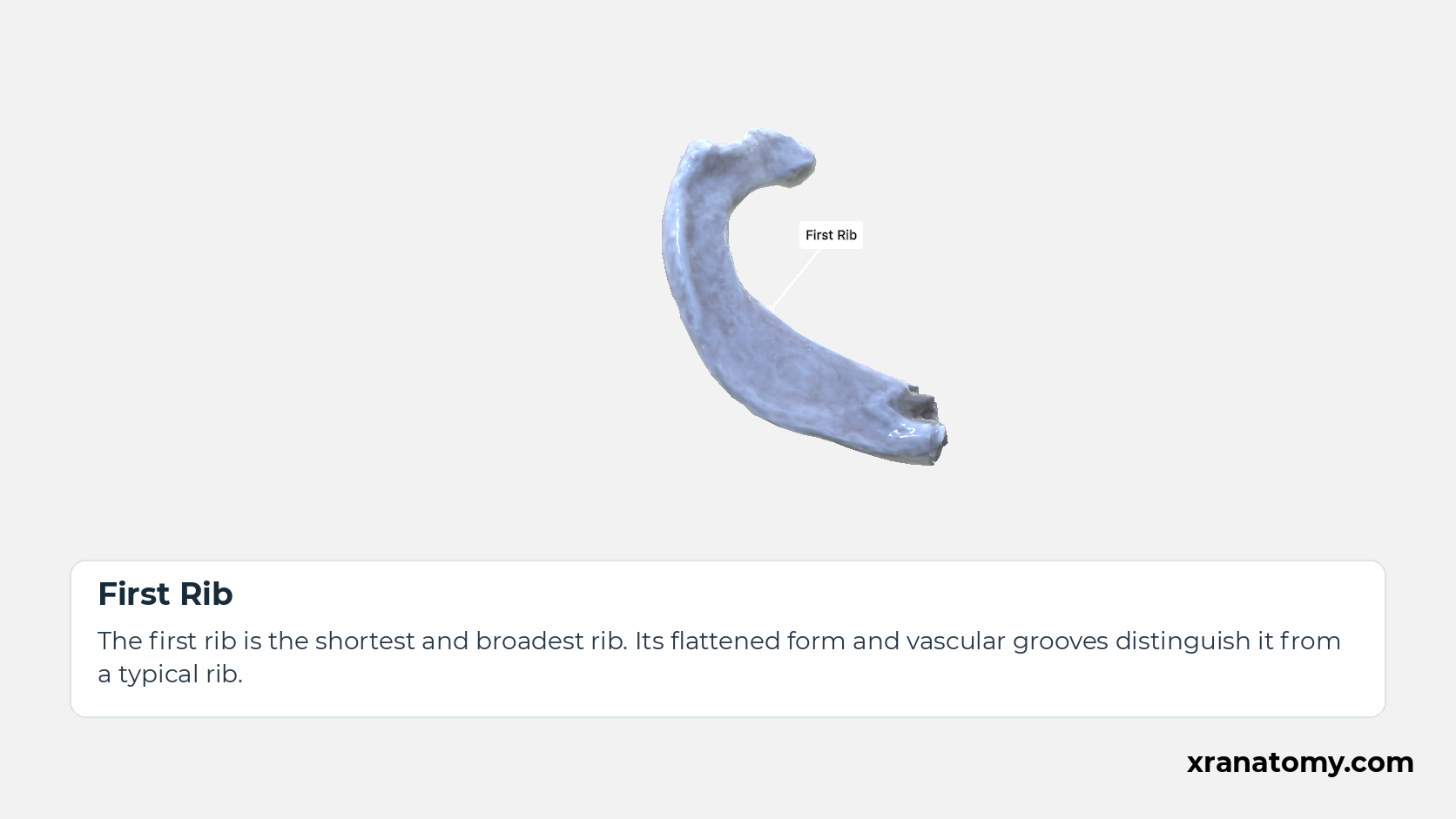
The first rib is the shortest and broadest rib. Its flattened form and vascular grooves distinguish it from a typical rib.
First Rib
First Rib
The first rib is the shortest and broadest rib. Its flattened form and vascular grooves distinguish it from a typical rib.
Study First Rib; Superior Surface in this fixed image. Use the thumbnails to move between the 2D views; each view highlights one structure. The image does not rotate.
Illustration by XR Anatomy.
Scalene Tubercle
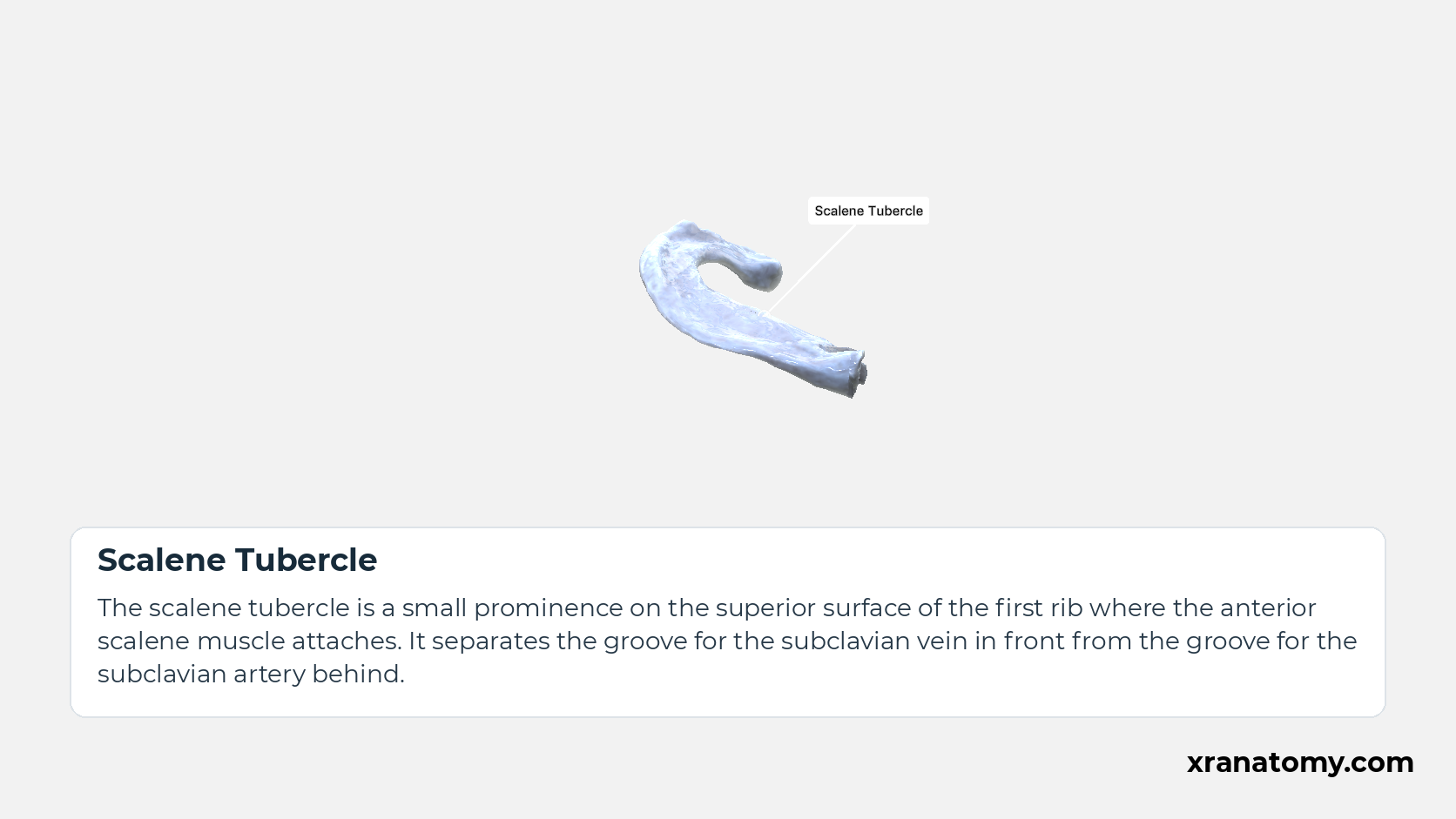
The scalene tubercle is a small prominence on the superior surface of the first rib where the anterior scalene muscle attaches. It separates the groove for the subclavian vein in front from the groove for the subclavian artery behind.
Illustration by XR Anatomy.
Groove for Subclavian Vein
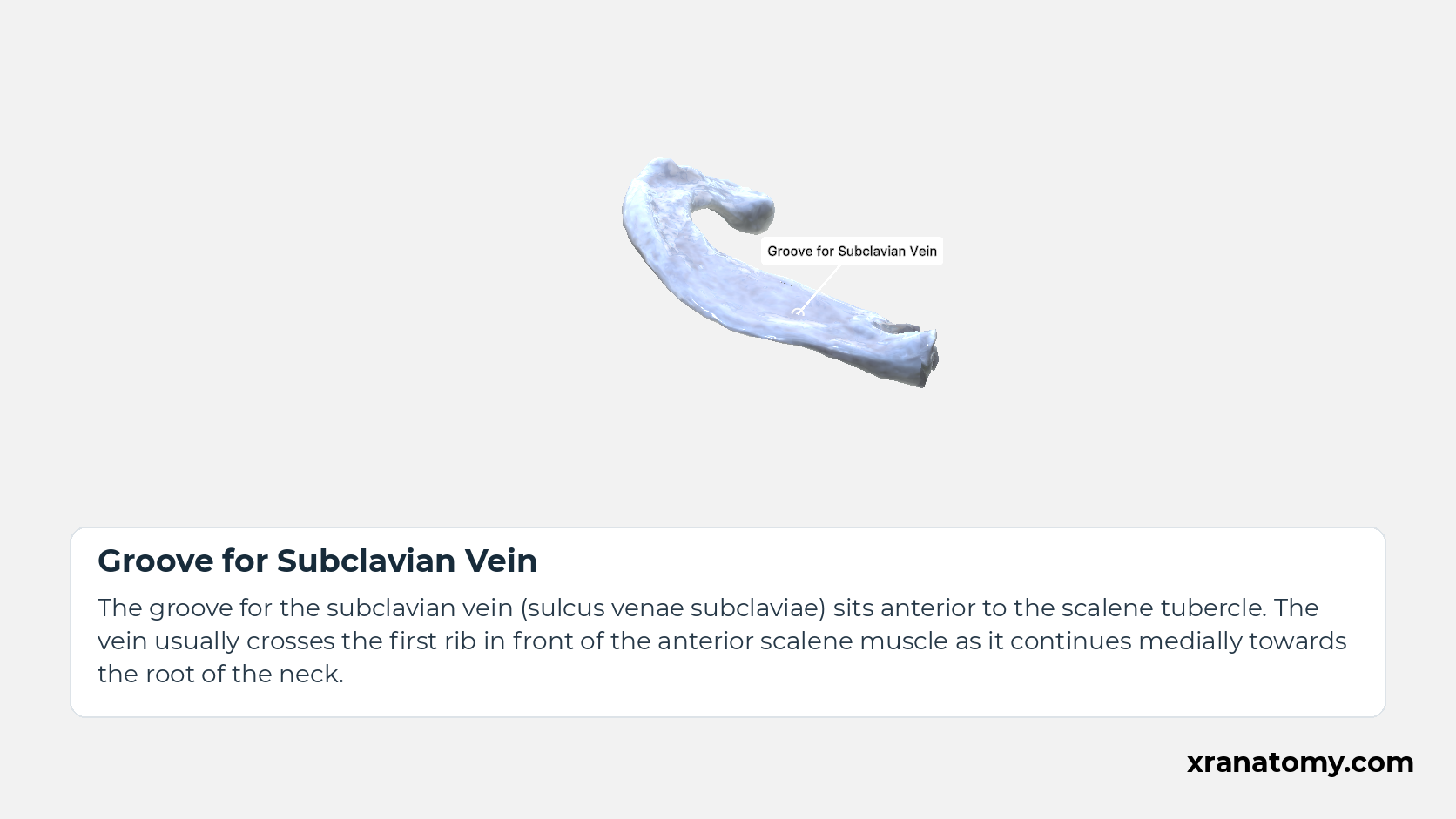
The groove for the subclavian vein (sulcus venae subclaviae) sits anterior to the scalene tubercle. The vein usually crosses the first rib in front of the anterior scalene muscle as it continues medially towards the root of the neck.
Illustration by XR Anatomy.
Groove for Subclavian Artery
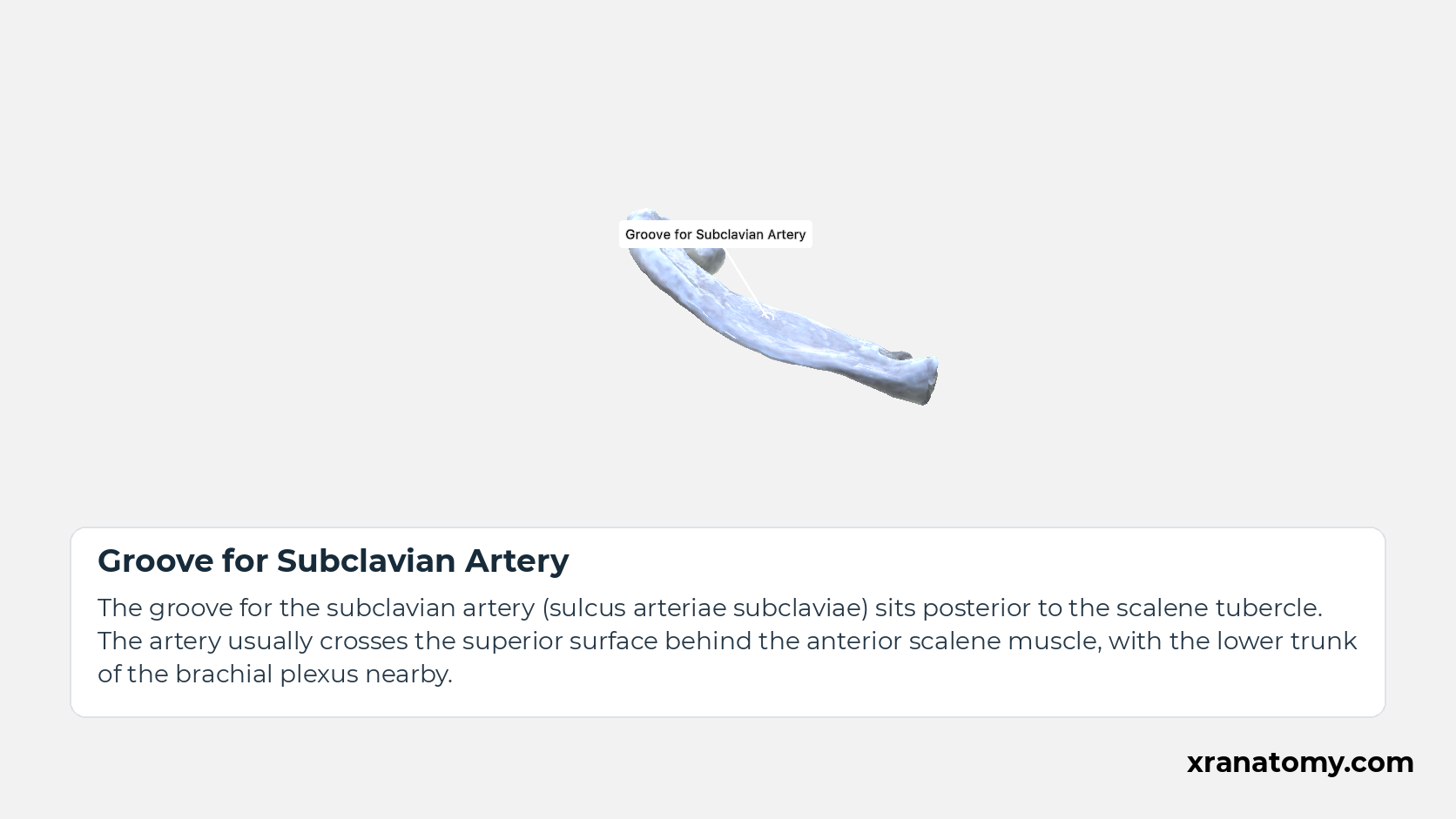
The groove for the subclavian artery (sulcus arteriae subclaviae) sits posterior to the scalene tubercle. The artery usually crosses the superior surface behind the anterior scalene muscle, with the lower trunk of the brachial plexus nearby.Show less
Illustration by XR Anatomy.
 ↺ drag to rotate · scroll to zoom
First Rib; Superior Surface
First Rib — Superior Surface
Drag to rotate First Rib — Superior Surface, then use the labels to compare the view from different angles.
Sourced from 3D Osteology.
The first rib (costa prima) is the shortest and broadest rib and is flattened from above downwards, so it has superior and inferior surfaces rather than the usual external and internal surfaces. Its head has a single facet for T1. Its inferior surface is smooth and lacks the typical inferior costal groove. On the superior surface, the scalene tubercle separates a groove for the subclavian vein anteriorly from a groove for the subclavian artery posteriorly; these vascular grooves are distinct from the costal groove of a typical rib.
In depth · 3 sections · 1 min read3 more sections on this part3 sections open — reading In depth- Scalene Tubercle
- Groove for Subclavian Vein
- Groove for Subclavian Artery
Scalene Tubercle
The scalene tubercle (tuberculum musculi scaleni anterioris) anchors the anterior scalene muscle. Sitting between the two vascular grooves, it is the key landmark for orienting the superior surface of the first rib.
Groove for Subclavian Vein
The groove for the subclavian vein (sulcus venae subclaviae) sits anterior to the scalene tubercle. The vein usually crosses the first rib in front of the anterior scalene muscle as it continues medially towards the root of the neck.
Groove for Subclavian Artery
The groove for the subclavian artery (sulcus arteriae subclaviae) sits posterior to the scalene tubercle. The artery usually crosses the superior surface behind the anterior scalene muscle, with the lower trunk of the brachial plexus nearby.
Practice · Active recall · 4 questions Recall: First Rib
Because it is flattened from above downwards, the first rib has surfaces.
superior and inferior
The first rib (costa prima) is the shortest and broadest rib and is flattened from above downwards, so it has superior and inferior surfaces rather than the usual external and internal surfaces. Its head has a single facet for T1. Its inferior surface is smooth and lacks the typical inferior costal groove. On the superior surface, the scalene tubercle separates a groove for the subclavian vein anteriorly from a groove for the subclavian artery posteriorly; these vascular grooves are distinct from the costal groove of a typical rib.
Review this sectionHow well did you know it? · press 1–4
Nice work — revisit in a few days.
In depth · 1 question Recall: Scalene Tubercle
The scalene tubercle anchors the muscle.
anterior scalene
The scalene tubercle (tuberculum musculi scaleni anterioris) anchors the anterior scalene muscle. Sitting between the two vascular grooves, it is the key landmark for orienting the superior surface of the first rib.
Review this sectionHow well did you know it? · press 1–4
Nice work — revisit in a few days.
In depth · 1 question Recall: Groove for Subclavian Vein
The groove for the subclavian vein lies to the scalene tubercle.
anterior
The groove for the subclavian vein (sulcus venae subclaviae) sits anterior to the scalene tubercle. The vein usually crosses the first rib in front of the anterior scalene muscle as it continues medially towards the root of the neck.
Review this sectionHow well did you know it? · press 1–4
Nice work — revisit in a few days.
In depth · 1 question Recall: Groove for Subclavian Artery
The groove for the subclavian artery lies to the scalene tubercle.
posterior
The groove for the subclavian artery (sulcus arteriae subclaviae) sits posterior to the scalene tubercle. The artery usually crosses the superior surface behind the anterior scalene muscle, with the lower trunk of the brachial plexus nearby.
Review this sectionHow well did you know it? · press 1–4
Nice work — revisit in a few days.
Bibliography
Every claim on this page is sourced against the standard anatomical references.
- FIPAT. Terminologia Anatomica, 2nd edition, Part 2: Bones. https://cdn.dal.ca/content/dam/dalhousie/pdf/library/FIPAT/TA2/FIPAT-TA2-Part-2.pdf
- Gray H. Anatomy of the Human Body. 21st ed. Philadelphia: Lea & Febiger; 1924.
- Drake RL, Vogl AW, Mitchell AWM. Gray's Anatomy for Students. Elsevier.
- Betts JG, et al. Anatomy and Physiology 2e. OpenStax; Rice University.
