METATARSAL BONES ANATOMY
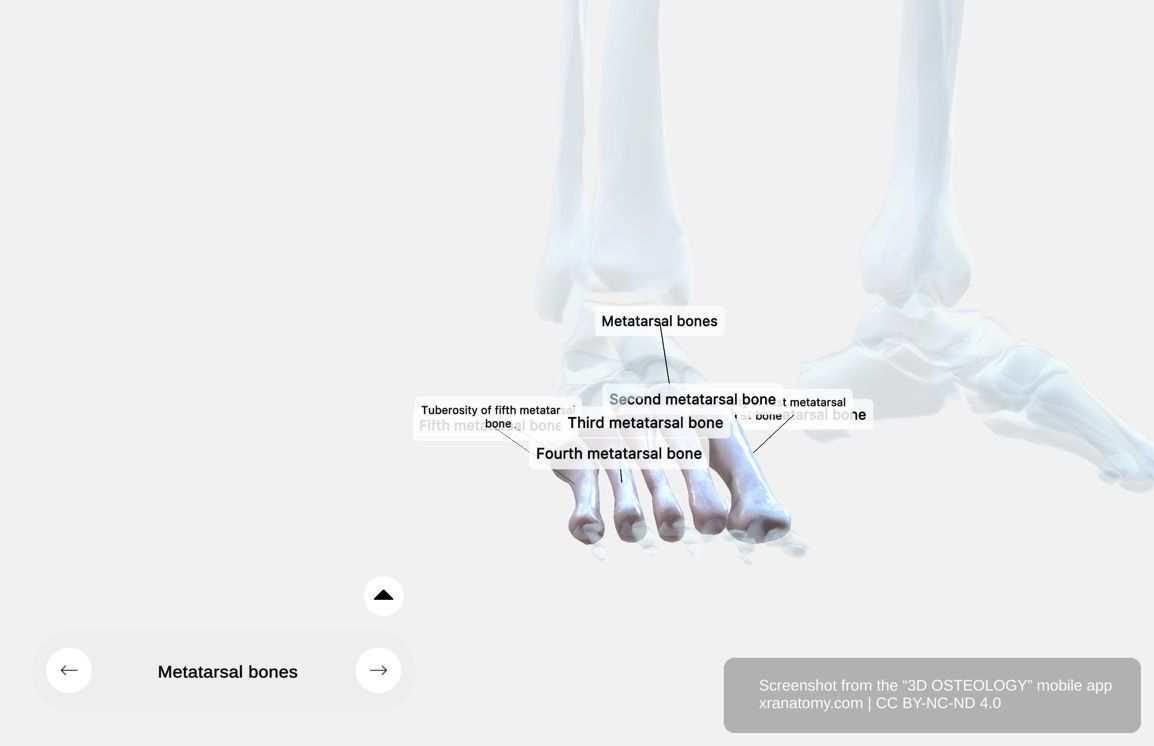
Metatarsal Bones - X-Ray View, Preview from the app. Download 3D OSTEOLOGY for full 3D control—multiple views, x-ray mode, and unlimited zoom.
WHY THIS MATTERS
Your five metatarsal bones form the framework of your forefoot and play a key role in weight distribution, balance, and locomotion. Understanding how each metatarsal differs in size, shape, and articulations helps you see why certain bones bear more load and why specific sites, like the fifth metatarsal tuberosity, are prone to fractures.
GENERAL STRUCTURE
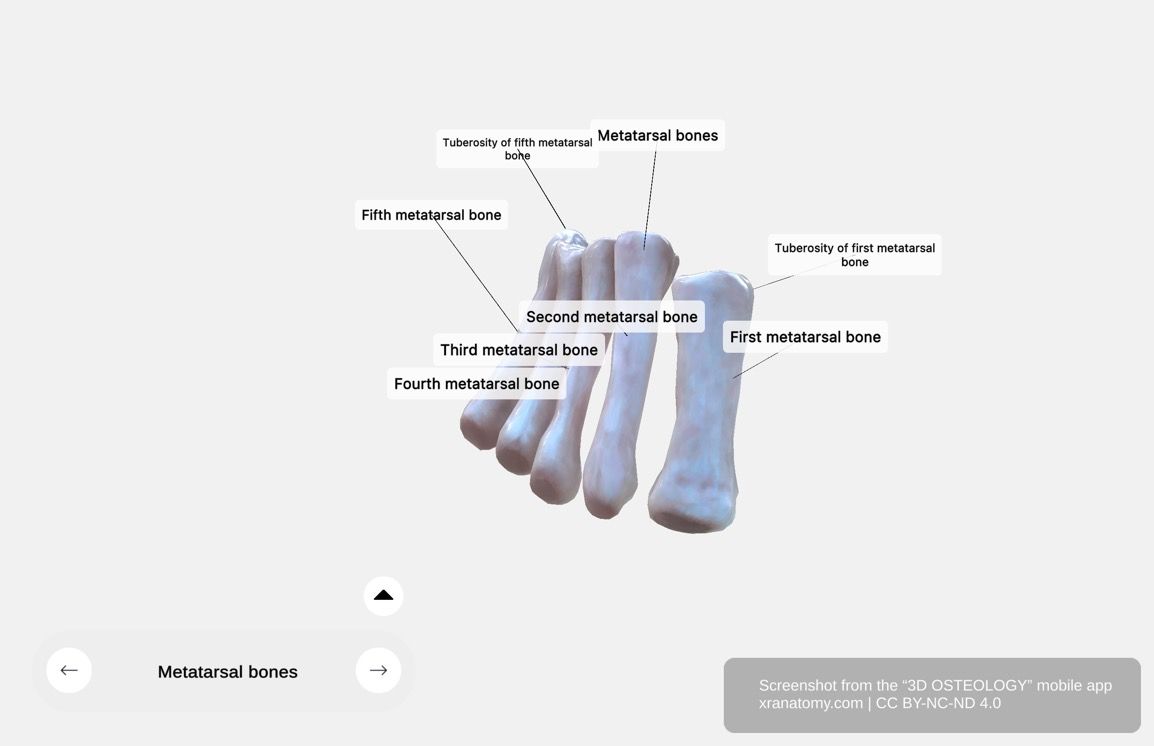
Metatarsal Bones - Overview, Preview from the app. Download 3D OSTEOLOGY for full 3D control—multiple views, x-ray mode, and unlimited zoom.
The metatarsal bones consist of five long bones numbered from the medial side of your foot. They form the framework of your forefoot and play a key role in weight distribution and foot mobility.
General Characteristics
The five metatarsal bones extend from the tarsal bones to the phalanges. Each bone consists of a body (shaft), a base (proximal end), and a head (distal end). They are numbered I-V from medial to lateral and are essential for your locomotion and balance.
FIRST METATARSAL BONE
The first metatarsal bone is the shortest and thickest of the metatarsal bones. It bears the greatest amount of your body weight during standing and walking. Its key features include a strong body, a base that articulates with the medial cuneiform, and a tuberosity on its plantar surface.
Body
The body of the first metatarsal is strong and prismoid in form. It is designed to bear significant weight and is more robust than the other metatarsal bodies.
Base
The base of the first metatarsal articulates mainly with the medial cuneiform bone. It features a large, kidney-shaped articular surface.
Tuberosity of First Metatarsal
The tuberosity is located at the plantar angle of the base. It is a rough, oval prominence that provides insertion for the tendon of the fibularis longus muscle (formerly peroneus longus).
SECOND METATARSAL BONE
The second metatarsal bone is the longest of the metatarsal bones. It is firmly anchored between the cuneiform bones, contributing to the stability of your foot.
Base
The base features four articular facets: one posteriorly for the intermediate cuneiform bone, one medially for the medial cuneiform bone, and lateral facets for the third metatarsal bone and the lateral cuneiform bone. It is wedged between the first and third cuneiforms, making it the most stable of all metatarsal bases.
THIRD METATARSAL BONE
The third metatarsal bone has a triangular base and articulates with the third cuneiform bone proximally.
Base
The base is triangular in shape and articulates proximally with the third cuneiform bone. It has two facets on the base for articulation with the second metatarsal bone and the fourth metatarsal bone.
FOURTH METATARSAL BONE
The fourth metatarsal bone is smaller than the third metatarsal bone and articulates with your cuboid bone.
Base
The base has an oblique, quadrilateral facet and articulates with the cuboid bone. It also has additional facets for the adjacent metatarsals.
FIFTH METATARSAL BONE
The fifth metatarsal bone is recognized by a rough eminence, the tuberosity, on the lateral side of its base.
Tuberosity of Fifth Metatarsal
The tuberosity is a prominent, rough eminence located on the lateral side of the base. It provides attachment for the tendon of the fibularis brevis muscle. You can easily palpate this landmark on the lateral side of your foot. It is a common site of avulsion fractures.
METATARSAL BONE ANATOMY
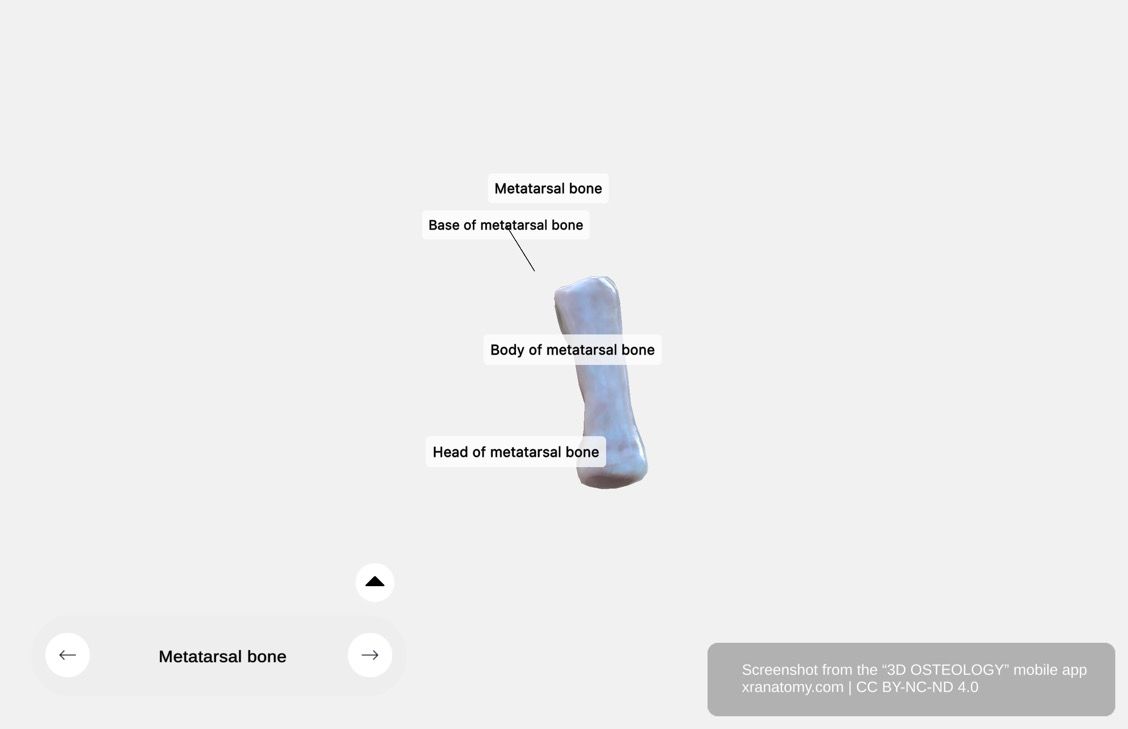
Metatarsal Bone - Individual Structure, Preview from the app. Download 3D OSTEOLOGY for full 3D control—multiple views, x-ray mode, and unlimited zoom.
Each metatarsal bone shares a common structural pattern consisting of three parts: the base (proximal end), the body (shaft), and the head (distal end). Specific features vary among the five bones.
Base of Metatarsal Bones
The base is the proximal end of each metatarsal. It articulates with the tarsal bones and with adjacent (contiguous) metatarsal bones. The base facilitates your foot stability and movement. It is wedge-shaped to interlock with neighbouring bones.
Body of Metatarsal Bones
The body is prismoid in shape and tapers from the wider base to the narrower head. It is slightly convex longitudinally on the dorsal aspect and provides attachment for the interosseous muscles.
Head of Metatarsal Bones
The head is the distal end of each metatarsal. It articulates with the proximal phalanx of the corresponding toe and features a convex articular surface on the plantar side. This allows smooth joint movement during your toe flexion and extension. The heads of the metatarsals form the ball of your foot.
CHECK YOUR UNDERSTANDING
1. Which metatarsal bone is the shortest and thickest, and which is the longest?
Reveal Answer
The first metatarsal is the shortest and thickest. The second metatarsal is the longest.
2. Name the three parts that every metatarsal bone shares.
Reveal Answer
The base (proximal end), the body (shaft), and the head (distal end).
3. What muscle tendon inserts on the tuberosity of the fifth metatarsal?
Reveal Answer
The tendon of the fibularis brevis muscle attaches to the tuberosity of the fifth metatarsal.
WHAT'S NEXT
Now that you know the five metatarsal bones of your forefoot, move on to the Phalanges of the Foot. You will explore the 14 bones that form your toes, including the proximal, middle, and distal phalanges and the unique two-phalanx arrangement of your great toe.
Review this page again in 3 days to reinforce what you have learned.
BIBLIOGRAPHY
1. Henry G, Warren HL. Osteology. In: Anatomy of the Human Body. 20th ed. Philadelphia: Lea & Febiger; 1918. p. 129–97.
2. Standring S, editor. Gray's Anatomy: The Anatomical Basis of Clinical Practice. 41st ed. London: Elsevier; 2016.
3. Moore KL, Agur AMR, Dalley AF. Essential Clinical Anatomy. 5th ed. Philadelphia: Wolters Kluwer; 2015.