PHALANGES OF THE FOOT ANATOMY
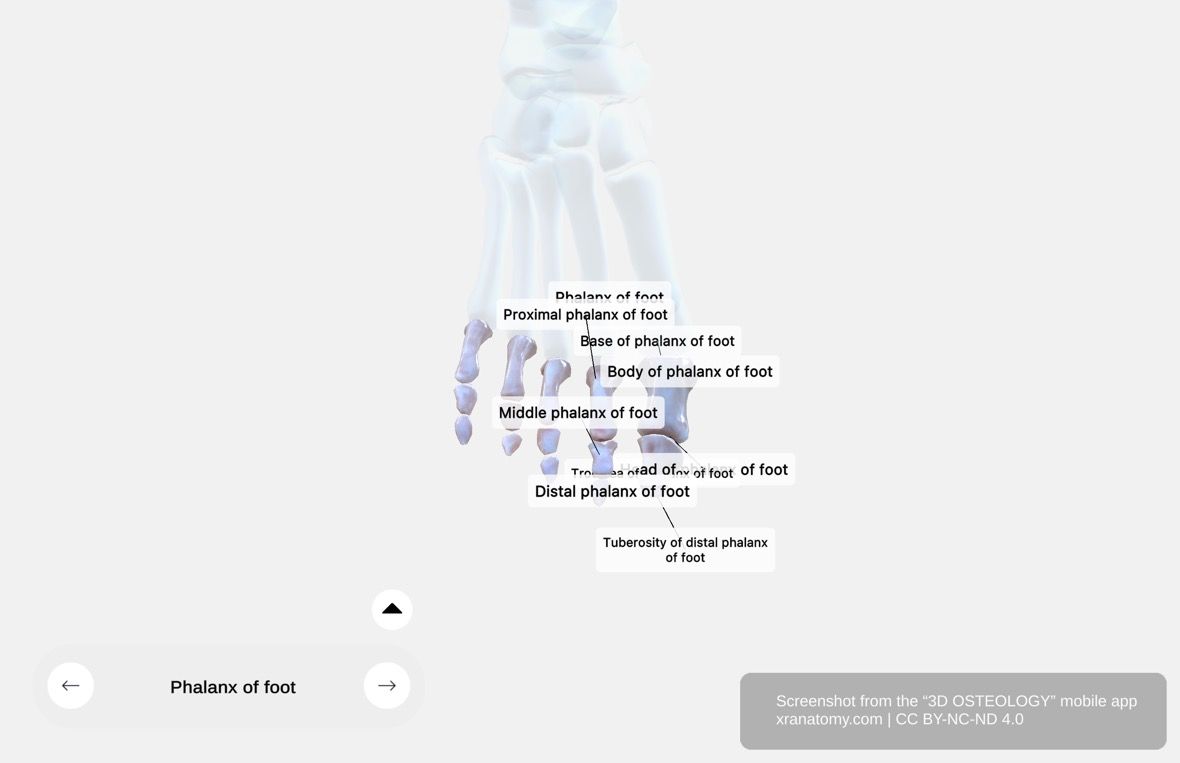
Phalanges of the Foot - Overview, Preview from the app. Download 3D OSTEOLOGY for full 3D control—multiple views, x-ray mode, and unlimited zoom.
WHY THIS MATTERS
Your 14 phalanges are the bones that form your toes. They enable push-off when you walk and help you maintain balance. Understanding how the proximal, middle, and distal phalanges differ in structure and function helps you see how your toes work together during movement.
GENERAL STRUCTURE
The phalanges of the foot correspond in number and arrangement to those of the hand. Your big toe consists of two phalanges, proximal and distal, while your other toes each have three phalanges: proximal, middle, and distal. These bones enable your toe movement and contribute to your balance and mobility.
General Characteristics
Each foot contains 14 phalanges. Your big toe (hallux) has 2 phalanges, while toes 2-5 each have 3 phalanges. They share a similar structure to the phalanges of your hand but are shorter and compressed from side to side. These bones are essential for push-off when you walk and for maintaining your balance.
STRUCTURE OF EACH PHALANX
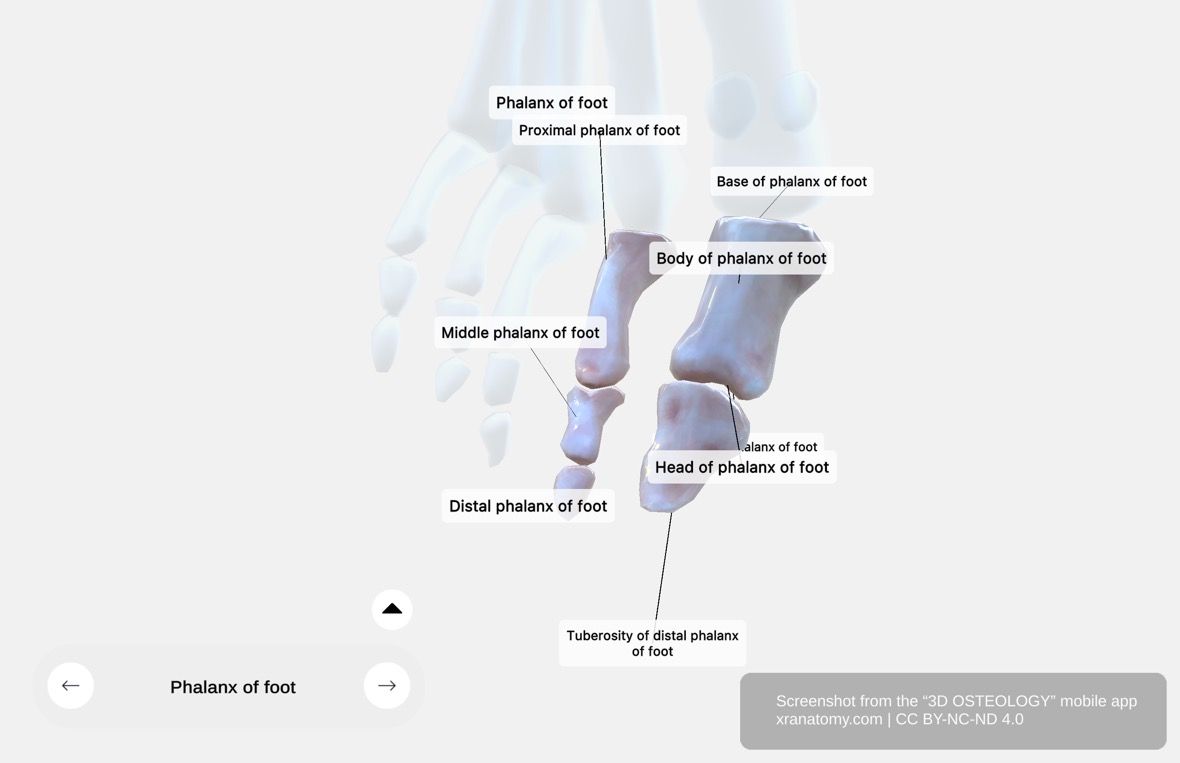
Phalanx - Individual Structure, Preview from the app. Download 3D OSTEOLOGY for full 3D control—multiple views, x-ray mode, and unlimited zoom.
Each phalanx shares a common structural pattern consisting of a base, body, and head, similar to the metatarsal bones but on a smaller scale.
Base
The base is a concave structure at the proximal end. It articulates with the head of the corresponding metatarsal bone. For the middle and distal phalanges, the base articulates with the head of the preceding phalanx.
Body
The body is compressed from side to side. Its dorsal surface is convex, while its plantar surface is concave. The body tapers from the base to the head.
Head
The head sits at the distal end of each proximal and middle phalanx. It presents a trochlear surface for articulation with the adjacent phalanx. Its pulley shape allows flexion and extension movements.
TROCHLEA
The trochlea is a critical articular feature found on the head of the proximal and middle phalanges that enables smooth joint movement. It provides a smooth articular surface for movement between adjacent phalanges. Its pulley-shaped (grooved) configuration allows hinge-type movements: flexion (curling your toes) and extension (straightening your toes).
PROXIMAL PHALANGES
The proximal phalanges form the first row of toe bones and are the longest of the three phalangeal types. You have five proximal phalanges in each foot. They articulate with the metatarsal bones at their bases. The proximal phalanx of your big toe is notably larger and thicker than the others.
MIDDLE PHALANGES
The middle phalanges form the second row of toe bones. They are present in all toes except the big toe, giving you four middle phalanges in each foot. They are shorter than the proximal phalanges and articulate proximally with the proximal phalanges and distally with the distal phalanges. The fifth toe middle phalanx is often rudimentary or may fuse with the distal phalanx.
DISTAL PHALANGES
The distal phalanges form the tips of your toes and have unique features for supporting your nail bed. You have five distal phalanges in each foot. Their key features include a crescent-shaped ungual tuberosity at the distal end and a tuberosity at the base for tendon attachment.
Characteristics
Each distal phalanx forms the tip of your toe. The distal end expands into a crescent-shaped ungual tuberosity that supports the nail bed of your toe. The base articulates with the head of the middle phalanx (or the proximal phalanx for your big toe).
Tuberosity
The base of each distal phalanx includes a tuberosity that serves as an attachment site for the tendons of your toe muscles. These include the flexor digitorum longus and, for your big toe, the flexor hallucis longus. The expanded distal end supports your nail bed.
CHECK YOUR UNDERSTANDING
1. How many phalanges does each foot contain, and how does the big toe differ from the other toes?
Reveal Answer
Each foot contains 14 phalanges. The big toe (hallux) has 2 phalanges (proximal and distal), while toes 2-5 each have 3 phalanges (proximal, middle, and distal).
2. Name the three parts that make up each phalanx.
Reveal Answer
Each phalanx consists of a base (proximal end), body (middle shaft), and head (distal end).
3. What is the trochlea and what type of movement does it allow?
Reveal Answer
The trochlea is a pulley-shaped (grooved) articular surface on the head of the proximal and middle phalanges. It allows hinge-type movements: flexion (curling your toes) and extension (straightening your toes).
WHAT'S NEXT
You have completed the entire osteology series. Review your journey from the beginning with the Vertebral Column Overview, where you first explored the five regions and four curvatures of your spine.
Review this page again in 3 days to reinforce what you have learned.
BIBLIOGRAPHY
1. Henry G, Warren HL. Osteology. In: Anatomy of the Human Body. 20th ed. Philadelphia: Lea & Febiger; 1918. p. 129–97.
2. Standring S, editor. Gray's Anatomy: The Anatomical Basis of Clinical Practice. 41st ed. London: Elsevier; 2016.
3. Moore KL, Agur AMR, Dalley AF. Essential Clinical Anatomy. 5th ed. Philadelphia: Wolters Kluwer; 2015.